Estimated reading time: 8 minutes
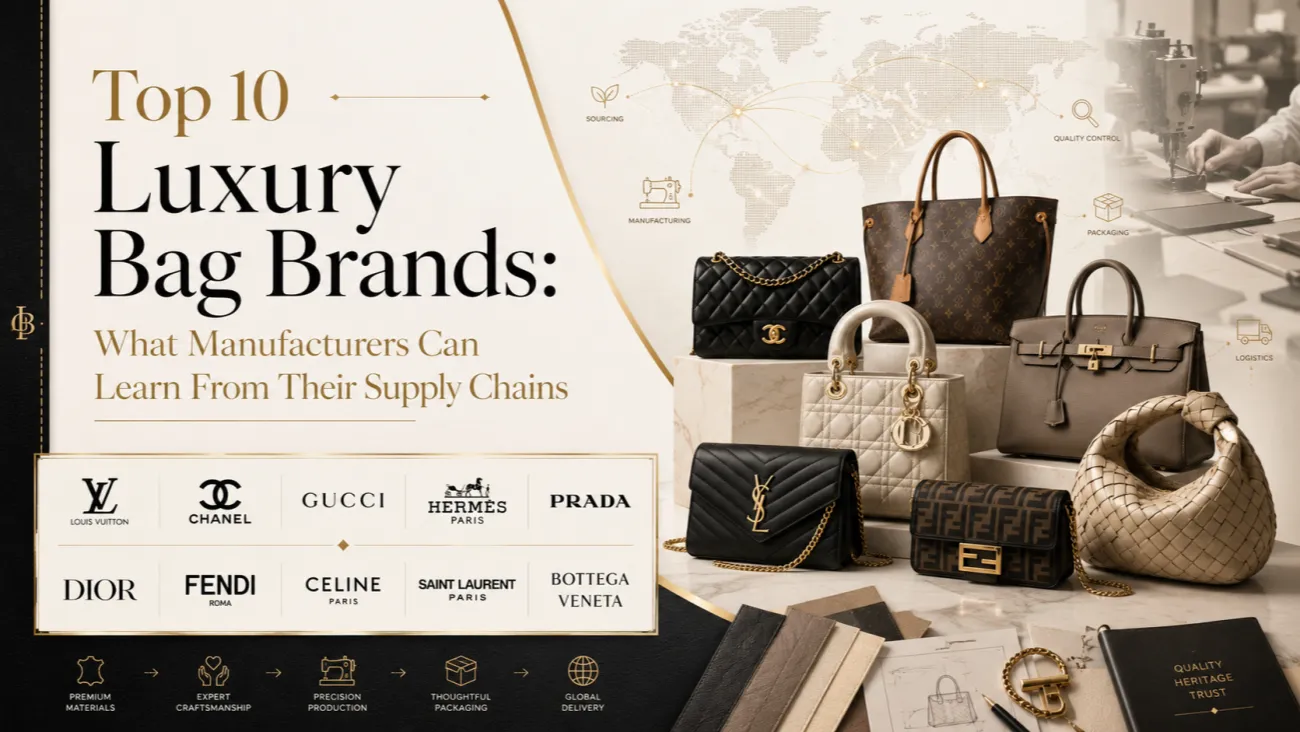
If you are searching for “top 10 luxury bag brands,” you are probably not looking for a shopping list. You are likely a brand founder, product developer, or procurement professional trying to understand what makes these companies successful — so you can apply the same principles to your own project.
The top luxury handbag brands did not get to where they are just because of their logos or celebrity endorsements. Behind every Birkin, every Classic Flap, and every Dionysus is a supply chain strategy that took years — sometimes decades — to build. The good news is that these strategies are not secret. They follow patterns that any brand, at any scale, can adapt.
This guide analyzes the supply chain models of the ten most influential luxury bag brands and extracts five practical lessons you can apply to your own brand, whether you are placing your first order or scaling your fifth collection.
If you are still in the early stages of setting up production, start with our complete guide to choosing a custom handbag manufacturer.
Table of Contents
- Why Understanding Luxury Supply Chains Matters for Your Brand
- Hermès — Full Vertical Integration & Artisan Model
- Louis Vuitton — Global Scale + Quality Consistency
- Chanel — Exclusivity Through Material Control
- Gucci — Flexible OEM/ODM Network
- Prada — Rapid Sampling & Seasonal Turnaround
- Dior — Hardware & Embellishment Mastery
- Fendi — Leather Craftsmanship & Iconic Silhouettes
- Saint Laurent — Minimalist Construction, Precision Finish
- Bottega Veneta — Material as Brand Identity
- Balenciaga — Streetwear Influence & Material Innovation
- 5 Supply Chain Lessons Any Bag Brand Can Apply
- Conclusion — From Studying Luxury to Building Your Own
- References
Why Understanding Luxury Supply Chains Matters for Your Brand
A luxury handbag does not start with a sketch. It starts with decisions about materials, production partners, quality standards, and timeline planning — exactly the same decisions any bag brand has to make.
What sets the top 10 apart is not that they have access to resources you do not. It is that they have been making these decisions consistently for years, and every choice reinforces their brand position. Hermès never compromises on leather sourcing because their entire brand promise depends on it. Bottega Veneta chose one material technique and made it their identity. Prada optimized for speed because their design cycle demands it.
The brands below are organized not by ranking (all ten are in the top tier for different reasons), but by the supply chain pattern they represent. Each example includes a specific lesson you can apply to your own production.
Hermès — Full Vertical Integration & Artisan Model
Hermès is the only luxury brand that controls virtually every step of its supply chain, from leather farming to final stitching.
A single Hermès Birkin bag takes 18 to 24 hours of work by one artisan, who is trained for years before being allowed to touch a Birkin. The brand owns its tanneries (some of the few LWG Gold-certified facilities in France), sources directly from cattle farms, and maintains a leather reserve that spans months, not weeks. This vertical control means Hermès can reject an entire hide if even one square foot does not meet its standard — and still have enough material on hand to meet production targets.
Lesson for your brand: You do not need to own a tannery to apply vertical thinking. Identify which one or two steps in your production process most directly affect your product quality — for most bag brands, that is material sourcing and final QC. Never outsource control of these steps to a third party without your own verification.
Louis Vuitton — Global Scale + Quality Consistency
Louis Vuitton operates production facilities in over 20 countries and still maintains quality consistency within ±2 mm tolerance on every bag.
Each LV bag goes through more than 100 manufacturing steps and over 50 quality checkpoints before it is approved for sale. What is remarkable is not the number of checks, but the standardization across different factories in different countries. A LV bag made in France and one made in Spain are held to the same measurable standards — stitch density, edge paint thickness, hardware torque specs — all documented in a shared QC manual.
Lesson for your brand: Standardize your QC criteria in writing, not in memory. When you start working with multiple factories or scaling from sample to bulk, the factory that knows exactly what you will check at each stage will produce better results than the one guessing. For a ready-to-use QC framework, see our custom handbag quality control checklist.
Chanel — Exclusivity Through Material Control
Chanel’s supply chain strategy is built on controlling access to rare and premium materials.
Chanel owns or has exclusive partnerships with suppliers of lambskin, tweed, and exotic leathers. The result is that certain materials simply are not available to competing brands at the same quality level. This exclusivity is not a marketing gimmick — it is a supply chain decision. By locking down material sources, Chanel ensures its products cannot be directly replicated, regardless of how closely a competitor studies their designs.
Lesson for your brand: You do not need exclusive access to crocodile leather to benefit from this principle. Even at small scale, working with a single, consistent material supplier who understands your quality requirements will produce better results than switching suppliers every order to save 5% on material cost. For a breakdown of leather grades and their sourcing implications, see our leather quality grades explained guide.
Gucci — Flexible OEM/ODM Network
Unlike Hermès’ fully vertical model, Gucci operates a hybrid system that blends in-house Italian production with a network of OEM and ODM partners.
Classic, high-volume styles are made in Gucci’s own Italian facilities. Seasonal collections, smaller runs, and accessories are produced through carefully selected third-party manufacturers — often in China and Vietnam — under strict supervision. This hybrid model lets Gucci scale production quickly for trending styles while keeping core classics under direct control.
Lesson for your brand: Not every product needs to be made the same way. Consider splitting your product line into “core” items (where you invest in higher quality and longer production timelines) and “seasonal” items (where speed and flexibility matter more). This gives you cost flexibility without compromising your hero products. For a detailed comparison of manufacturing models, see our OEM vs ODM guide for custom handbags.
Prada — Rapid Sampling & Seasonal Turnaround
Prada’s supply chain is optimized for speed — from design concept to sample-ready in as little as four to six weeks for seasonal collections.
Prada operates on a fast-turn model: materials are pre-sourced before the design is finalized, sample makers work in parallel with product developers, and production slots are reserved in advance so the pipeline does not stall between approval and bulk cutting. This speed allows Prada to respond to market trends within a single season rather than planning a full year ahead.
Lesson for your brand: A fast sampling process is not just about speed — it is about pattern. The brands that get to market faster are the ones that overlap steps rather than sequencing them. If you are ordering for the first time, aligning your material sourcing with your design phase can cut your timeline by weeks. For the full sampling workflow, see our custom handbag sample process guide.
Dior — Hardware & Embellishment Mastery
Dior differentiates its bags through exceptional hardware and embellishment — metal components that feel substantial, engraving that is crisp at 2× magnification, and closures that click with precision.
Dior works with specialized hardware manufacturers who cast, polish, and plate each component to tight tolerances. The CD turnlock on a Lady Dior, for example, goes through seven finishing steps before assembly. This attention to metal and embellishment detail is a supply chain decision — Dior invests more per bag in hardware than most brands spend on their entire closure mechanism.
Lesson for your brand: Hardware quality is the fastest way to change perceived value. A bag with a stamped, lightweight buckle feels entry-level. The same bag with a solid cast buckle with engraved detailing feels premium. This upgrade typically adds \$1–\$3 to the unit cost — a small investment that can justify a significantly higher retail price. For logo and branding methods that work with different materials, see our logo and branding options guide.
Fendi — Leather Craftsmanship & Iconic Silhouettes
Fendi’s supply chain strength lies in its leather craftsmanship — specifically the Selleria hand-stitching technique that has been part of the brand’s identity since 1925.
The Selleria method uses a single needle and waxed thread, with each stitch pulled to an even tension by hand. This technique creates seams that are stronger than machine stitching and develop a unique character over time. Fendi trains artisans specifically for this skill, keeping it from becoming a lost craft.
Lesson for your brand: Consider identifying one construction detail that can become your signature — a specific stitch pattern, an edge finish treatment, or a strap attachment method. When that detail is consistent across all your products, it becomes your visual shorthand for quality.
Saint Laurent — Minimalist Construction, Precision Finish
Saint Laurent bags are defined by clean lines and minimal hardware — which paradoxically makes them harder to produce correctly.
When a bag has no visible logo on the exterior (as many YSL styles do), every seam alignment, edge paint line, and panel symmetry becomes the “logo.” Any imperfection is immediately visible because there is no embellishment to distract the eye. This means Saint Laurent’s supply chain must prioritize precision over speed — slower cutting speeds, tighter panel matching, and more rigorous final inspection than brands with busier designs.
Lesson for your brand: If your design is simple, your execution must be flawless. Investing in an extra round of assembly inspection is not a cost — it is a necessity. Minimalist designs win on finish quality, not on features.
Bottega Veneta — Material as Brand Identity
Bottega Veneta turned one material treatment — the Intrecciato woven leather technique — into a globally recognized brand identity without using a logo.
The Intrecciato weave requires strips of specially tanned leather cut to exact widths, then hand-woven into a continuous surface. This material treatment is difficult to replicate at scale, which is precisely its value. The supply chain is built around this single process: leather is selected for its ability to hold the weave without stretching, and artisans are trained specifically for Intrecciato weaving.
Lesson for your brand: Your material choice can be your differentiator, not just a practical decision. A unique material or finish gives customers a reason to remember your bags beyond the shape or price. For a full comparison of material options, see our best materials for custom shoulder bags guide.
Balenciaga — Streetwear Influence & Material Innovation
Balenciaga pushes material boundaries — recycled leather, technical fabrics, and unconventional treatments — as a core part of its brand strategy.
Unlike traditional luxury brands that rely on heritage materials, Balenciaga actively experiments with new materials and production methods. This approach requires a supply chain that is willing to prototype, fail, and iterate. It means working with factories that can handle non-standard materials and that understand the difference between “this is how it is usually done” and “this is how we want to do it.”
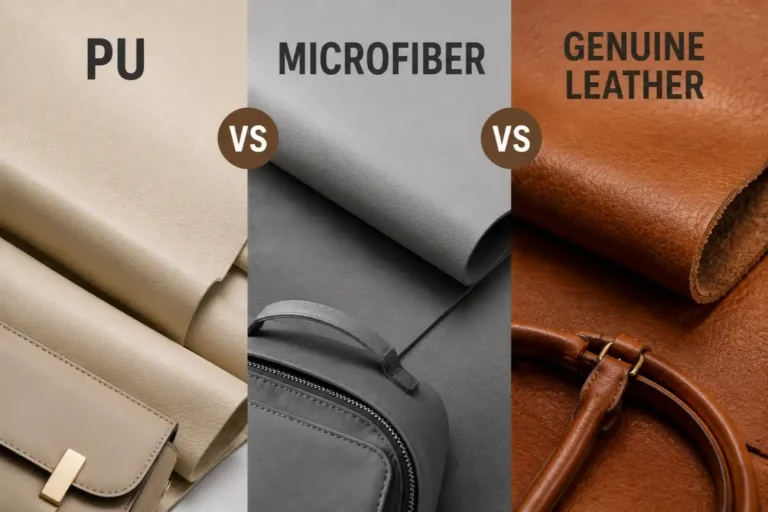
Lesson for your brand: Material innovation is accessible at any scale. Testing a new material — even for a small first run — can differentiate your brand in a crowded market. The willingness to try is more important than the size of your order. For an overview of material comparisons, see our PU vs microfiber vs genuine leather guide.
5 Supply Chain Lessons Any Bag Brand Can Apply
Across these ten brands, five consistent patterns emerge — and every one of them is applicable at any order size.
| Lesson | From | What It Means for Your Brand |
|---|---|---|
| 1. Never outsource control of your critical quality step | Hermès | Identify the one step that most affects your final product quality — usually material sourcing or final QC — and always verify it yourself, even if a factory offers to handle it. |
| 2. Standardize QC in writing, not in memory | Louis Vuitton | Write down your QC standards (stitch density, hardware torque, dimension tolerance) and share them with your factory before production starts. A written standard prevents 90% of disputes. |
| 3. Material consistency builds brand trust faster than price | Chanel, Bottega Veneta | Stick with one or two consistent material suppliers rather than switching for every order. Customers notice material quality more than they notice small price differences. |
| 4. Speed comes from overlapping steps, not working faster | Prada | Start material sourcing and sample development in parallel rather than sequentially. Most timeline delays are caused by waiting for one step to finish before starting the next. |
| 5. Upgrade your hardware to upgrade your brand’s perceived value | Dior | Invest in better-quality zippers, buckles, and straps before investing in complex design features. Hardware is the highest-leverage component for perceived quality. |
Conclusion — From Studying Luxury to Building Your Own
The brands in this list did not build their supply chains in a year. They built them one decision at a time — choosing a better material, writing down a QC standard, investing in a signature technique, finding a manufacturing partner that understood their vision. These are the same decisions every brand founder makes, regardless of budget or scale.
Here is a starting sequence:
Step 1: Review our manufacturer selection guide to align your brand requirements with the right production partner.
Step 2: Choose your bag type and material using our materials guide and OEM vs ODM comparison.
Step 3: Once you are ready, contact us with your initial requirements. We regularly work with emerging brands building their first collections and provide the same QC rigor we apply to larger runs.
References
- Forbes — Hermès, LVMH and Chanel: Global Luxury Forecast — Financial data and market positioning analysis of top luxury fashion groups and their manufacturing strategies.
- McKinsey — The State of Fashion Report 2026 — Industry research on luxury supply chain trends, sustainability mandates, and manufacturing model shifts in the global fashion industry.
- Vogue Business — How LVMH’s Supply Chain Keeps Quality Consistent at Scale — Analysis of LVMH’s multi-country manufacturing network and quality control standardization practices.
- Leather Working Group (LWG) — Certified Tanneries Database — Global certification standard for leather sourcing sustainability and quality used by all major luxury handbag brands.
- Statista — Luxury Goods Market Overview — Market data on luxury handbag segment growth, regional production volumes, and consumer purchasing trends.