If you are sourcing travel bags for wholesale, the material you choose is the single biggest factor that determines your product cost, your brand positioning, and your customer’s satisfaction. Material accounts for roughly 40-50% of your total FOB cost, and it directly affects how your bag looks, how long it lasts, and how well your logo shows up.
In our experience working with wholesale buyers across different segments — from promotional product distributors to premium luggage brands — there is no single “best” material. The right choice depends on your target price point, your market positioning, and your order volume. This guide compares the four most common travel bag materials so you can make an informed sourcing decision.
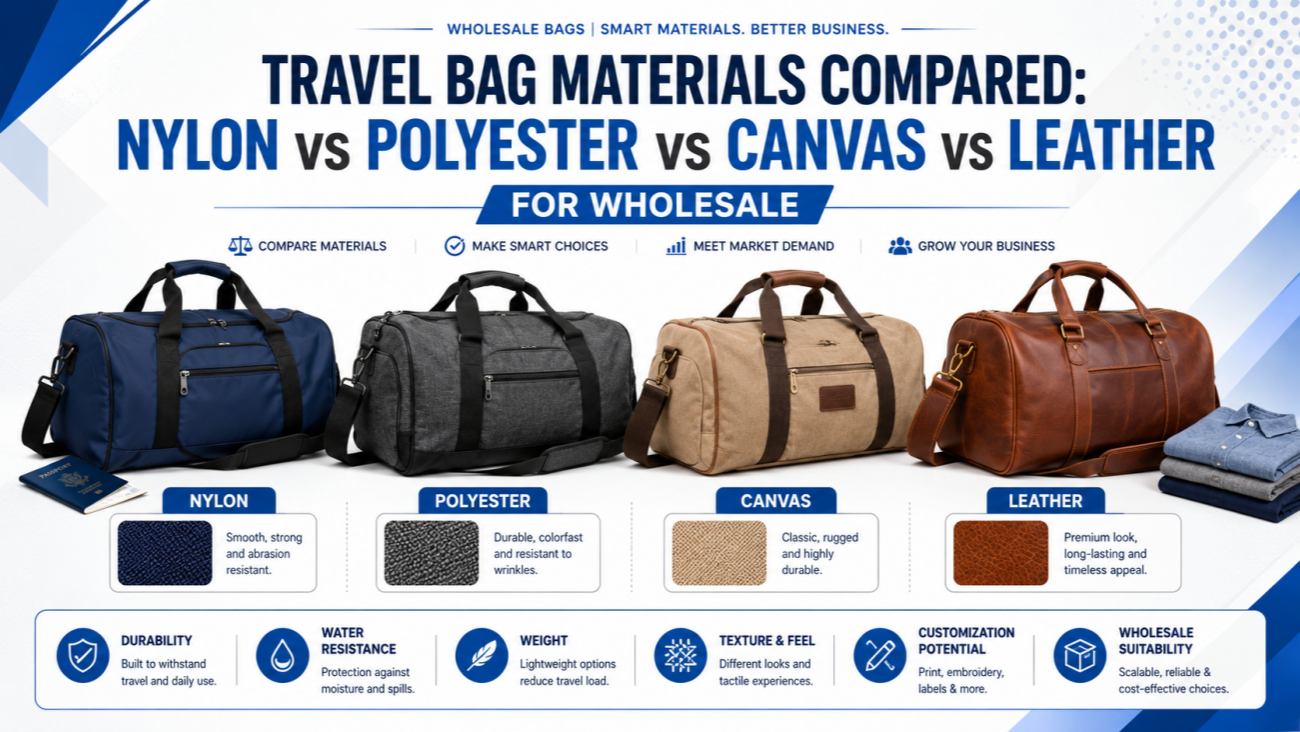
At a Glance: How These Four Materials Compare
Here is a quick overview of the four materials across the dimensions that matter most for wholesale buying. We will go into detail on each one in the sections below.
| Dimension | Polyester | Nylon | Canvas | Leather (PU) |
|---|---|---|---|---|
| Fabric cost / yd | $3 – $6 | $4 – $8 | $5 – $9 | $6 – $12 |
| FOB price range | $8 – $15 | $12 – $22 | $14 – $25 | $18 – $30+ |
| Weight | Medium | Light | Medium-heavy | Medium |
| Water resistance | Good (with coating) | Excellent (natural) | Low (needs treatment) | Moderate |
| Best logo technique | Embroidery, screen print | Heat transfer, woven label | Embroidery, deboss | Deboss, metal plate |
| Typical MOQ (ODM) | 300 – 500 pcs | 300 – 500 pcs | 500 – 800 pcs | 500 – 800 pcs |
Polyester: The Wholesale Standard
Polyester is the most common material for wholesale travel bags for one simple reason: it delivers the best balance of cost, durability, and production speed. In our experience, roughly 60% of bulk travel bag orders use polyester — it is the default choice for a reason.
What you get: 600D polyester is the entry-level standard — affordable, lightweight enough for travel, and capable of handling regular use. 900D polyester is heavier and more abrasion-resistant, suitable for bags that get checked in or handled roughly. Both can be coated with PU for water resistance, which adds about $0.50-1.00 per yard.
Logo compatibility: Polyester takes embroidery beautifully — the fibers hold thread well without distorting. Screen printing and heat transfer also work reliably. This makes it the easiest material to brand, especially for large corporate or promotional orders.
Best fit for: Promotional product distributors, corporate gift programs, budget to mid-range retail brands, and first-time importers. If you are ordering for the first time, we usually recommend starting with polyester. It gives you the most room for error — the cost is low enough that you can learn the sourcing process without risking too much capital.
Nylon: Lightweight and Travel-Ready
Nylon is the go-to material when weight and packability matter most. A nylon travel bag weighs roughly 30-40% less than a polyester bag of the same size — a difference that travelers notice immediately.
The trade-off is cost: Nylon fabric runs $4-8 per yard, about 30-50% more than entry-level polyester. The FOB price for a nylon travel bag typically falls in the $12-22 range, compared to $8-15 for polyester. For wholesale orders, we usually suggest using nylon if your target customer is willing to pay a premium for lighter carry.
Natural water resistance: Nylon has better natural water resistance than polyester, meaning you can use a lighter coating (or none at all for urban travel bags) and still protect the contents. The ripstop weave variant adds cross-hatched reinforcement threads that prevent tears from spreading — a popular feature for adventure travel bags.
Logo consideration: Nylon’s slick surface means embroidery can leave visible needle holes. Heat transfer and woven labels are better choices for nylon. Many buyers focus on price first and pick polyester, but if your brand targets frequent travelers or outdoor enthusiasts, nylon is worth the upgrade.
Canvas: The Mid-Range Favorite
Canvas sits in the middle of the material range — higher cost than polyester but more affordable than leather, with a look and feel that customers perceive as premium. It is the go-to material for fashion-oriented travel bags and brands targeting the casual-luxury segment.
Price and production: Canvas runs $5-9 per yard. FOB prices for canvas travel bags typically range from $14-25. One thing to keep in mind: canvas is heavier than both polyester and nylon, which adds to shipping costs. A 50L canvas duffle can weigh 40-50% more than a nylon version of the same size.
The biggest advantage of canvas is its branding potential. Embroidery on canvas looks exceptional — the threads sit cleanly on the surface with a rich, textured appearance. Debossing (pressing your logo into the material) also works beautifully on canvas, creating a subtle, high-end look without adding color.
One common mistake we see with canvas bags: buyers skip the water-resistant treatment to save money. Canvas is naturally absorbent — without a treatment, a wet towel placed inside can soak through the bag in minutes. Before confirming the sample, make sure to specify a waterproof coating or lining if your bags will be used outdoors or in humid climates.
Leather: Premium Positioning, Higher Commitment
Leather travel bags sit at the top of the price pyramid — and for good reason. In wholesale, “leather” usually means PU leather (polyurethane-coated fabric) rather than genuine leather, unless otherwise specified. PU leather offers a leather-like appearance at a fraction of the cost.
Cost and MOQ: PU leather runs $6-12 per yard, with FOB prices ranging from $18-30+ per bag. Genuine leather is $15-30+ per yard and typically requires a MOQ of 1,000+ pieces, plus careful attention to color consistency between dye lots. If you are a first-time buyer, we suggest starting with PU leather — the visual difference at retail is minimal, but the production risk is significantly lower.
Best logo techniques: Debossing on PU leather creates a clean, sophisticated logo that feels high-end. Metal plate logos (riveted or glued onto the bag) also work exceptionally well. Avoid embroidery on PU leather — the needle holes do not close up cleanly, and over time the stitching can cause the coating to peel.
Best fit for: Fashion brands, boutique retailers, hotel amenity programs, and premium corporate gifts — anywhere the bag is as much a style statement as a functional item.
Logo & Branding: Which Material Works Best for Each Technique
Choosing the right logo technique for your material is just as important as choosing the material itself. A mismatch can lead to poor logo visibility, production delays, or quality issues that require rework.
| Technique | Polyester | Nylon | Canvas | Leather (PU) |
|---|---|---|---|---|
| Embroidery | ✅ Excellent | ⚠️ OK (may leave holes) | ✅ Excellent | ❌ Not recommended |
| Heat Transfer | ✅ Good | ✅ Excellent | ✅ Good | ✅ Excellent |
| Screen Print | ✅ Excellent | ⚠️ OK (fabric too slick) | ✅ Good | ❌ Not recommended |
| Debossing | ⚠️ Subtle (fabric blends) | ⚠️ Subtle | ✅ Excellent | ✅ Excellent |
| Metal Plate | ✅ Good | ✅ Good | ✅ Good | ✅ Excellent |
| Woven Label | ✅ Good | ✅ Excellent | ✅ Good | ✅ Good |
✅ = recommended | ⚠️ = usable with caution | ❌ = avoid
This may sound like a small detail, but getting the logo technique wrong on your first order can mean re-cutting and re-sewing hundreds of bags. Before confirming the sample, make sure the factory runs a logo test on your chosen material and signs off on the result.
Conclusion: What Material Should You Choose?
Here is the short version of everything above:
- Polyester — The safe, cost-effective choice. Start here if you are new to sourcing or targeting the mass market.
- Nylon — Upgrade to nylon when weight and packability are your customers’ priority. Higher cost but lower return rates.
- Canvas — Choose canvas when brand image and logo presentation matter more than weight. The best “premium but affordable” positioning.
- Leather (PU) — Go with PU leather for the highest perceived value and retail price point. Higher MOQ, but the margins are worth it for the right market.
In our experience, the most successful wholesale buyers do not pick one material — they build a range. Use polyester or canvas for your core volume line, then add a PU leather option as a premium SKU. This gives your retail customers a price ladder to choose from, without forcing you to commit all your inventory to a single material bet.
For a closer look at the travel bags we produce across different materials, browse our duffle bag collection or contact our team to discuss your material requirements.
References
- Future Market Insights. (2025). Travel Bags Market Outlook 2025-2035. futuremarketinsights.com
- Mordor Intelligence. (2026). Travel Bag Market Analysis 2026-2031. mordorintelligence.com
- Grand View Research. (2024). Duffel Bags Market Growth & Trends. Accio market analysis