Estimated reading time: 9 minutes
When sourcing custom handbags, the material you choose is not a cosmetic decision — it is a business decision that affects your unit cost, minimum order quantity, logo options, and long-term return rate. PU leather, microfiber leather, and genuine leather each serve different brand positions and price points. Choosing the wrong one can mean unnecessary cost overruns on a budget line, or disappointing durability on a premium product.
This guide compares the three materials across the dimensions that matter most in B2B sourcing: cost, durability, production consistency, logo compatibility, and what to check when the material samples arrive at your desk.
Table of Contents
- Why This Choice Matters for B2B Buyers
- What Each Material Actually Is (B2B Definition)
- Head-to-Head Comparison: Cost, Durability, MOQ & Logo Compatibility
- How to Choose by Brand Type and Channel
- What to Check When You Receive Material Samples
- Conclusion — Start Your Custom Bag Project with the Right Material
- References
Why This Choice Matters for B2B Buyers
Selecting the wrong leather material does not just affect the hand feel — it drives up your defect rate, delays your production schedule, and increases post-sale returns.
Many buyers focus on how a material looks and feels in a sample, then discover during bulk production that the material behaves differently at scale — the color varies between rolls, the surface scuffs after a week of wear testing, or the factory cannot source enough of the same grade for a reorder.
In our experience, the material choice should be based on three things: your brand’s price positioning, your target market’s climate and usage patterns, and your tolerance for variance between production batches. When these factors are aligned with the right material, the rest of the sourcing process becomes significantly smoother.
What Each Material Actually Is (B2B Definition)
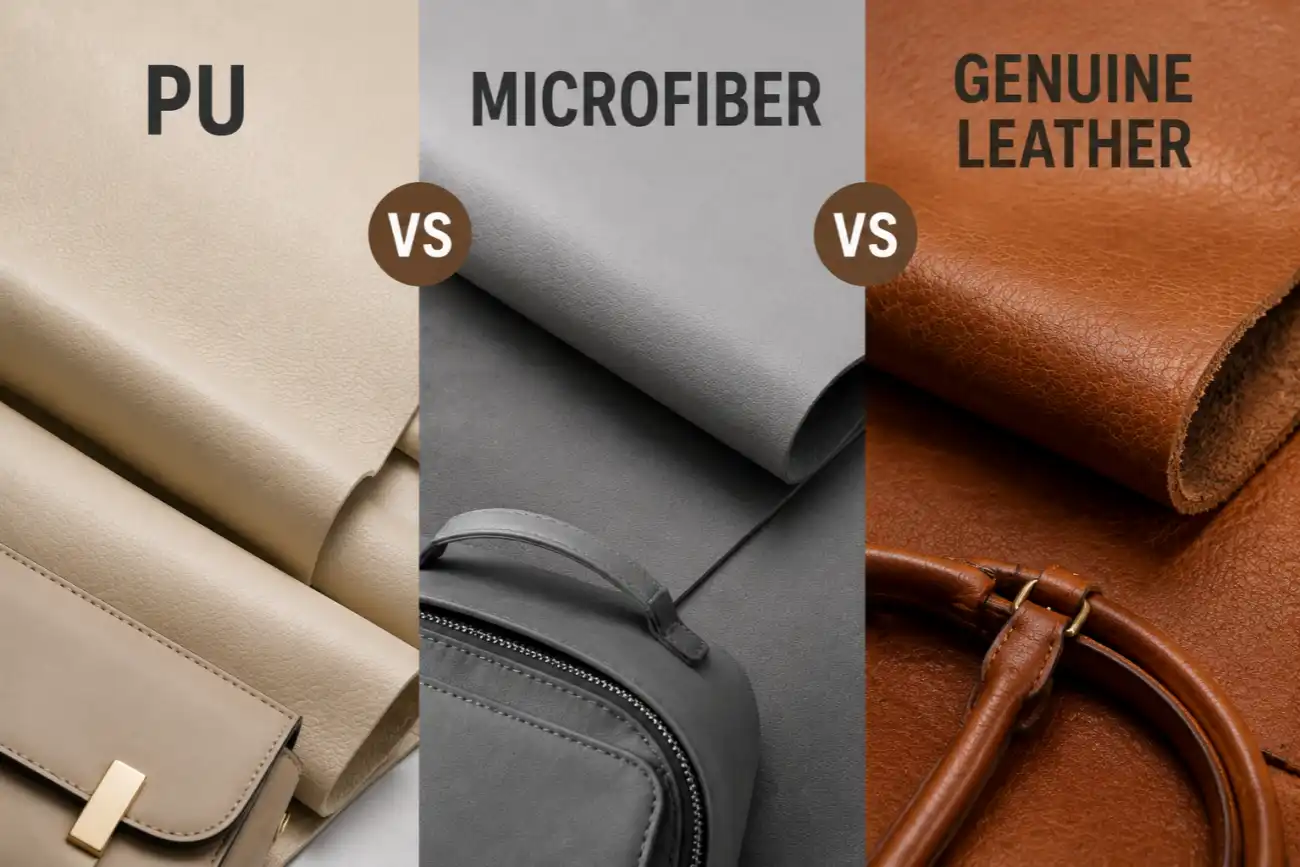
These three materials serve different price points and performance tiers. Understanding how they are built tells you more about their long-term behavior than any marketing label.
Genuine Leather — Grade Matters More Than the Label
“Genuine leather” is a broad term that includes everything from full-grain hides to split leather with heavy surface finish. The grade, thickness, tanning method, and finish type affect durability and consistency far more than the label on the price tag. Full-grain leather develops a natural patina and can last decades with care, but every hide is unique — shade variation and surface markings are inherent. Corrected-grain and split leather are more uniform but also less durable, and their surface coating can peel over time.
For a detailed breakdown of leather quality grades, see our guide on leather quality grades explained.
Key B2B considerations: Genuine leather requires careful hide selection and yield management. Expect up to 5–10% material waste from natural imperfections. Reorder consistency depends on the same tannery and dye lot being available.
PU Leather — The Workhorse of Volume Production
PU (polyurethane) leather is a synthetic material made by coating a fabric backing — typically polyester — with a polyurethane layer. It is consistent across rolls, available in virtually any color, and costs significantly less than genuine leather. These qualities make it the default choice for high-volume production runs where color matching and batch consistency are critical. The main limitation is durability: standard PU can develop surface cracking at flex points over time, especially in hot or humid environments. If your bags will be used in tropical climates or stored in non-air-conditioned spaces, ask your factory for hydrolysis-resistant PU — it is formulated to resist the chemical breakdown that standard PU undergoes in heat and moisture.
Microfiber Leather — The Higher-Performance Synthetic
Microfiber leather uses a more advanced construction: a 3D non-woven matrix of ultra-fine polyamide fibers impregnated with polyurethane. This structure mimics the fibrous network of genuine leather more closely than standard PU, giving it superior tear strength, abrasion resistance, and a supple hand feel close to real leather. Microfiber costs about 30% of genuine leather and roughly 30–50% more than standard PU, but delivers 5× the abrasion resistance of PU in standardized wear tests. It is the preferred choice for brands that want animal-free materials with genuine-leather-like performance, or for Amazon/DTC brands where consistency across production runs and low return rates are top priorities.
Head-to-Head Comparison: Cost, Durability, MOQ & Logo Compatibility
The table below compares the three materials across the four dimensions that matter most in a B2B sourcing decision.
| Dimension | Genuine Leather | PU Leather | Microfiber Leather |
|---|---|---|---|
| Relative Cost | High (baseline) | Low (20–30% of genuine) | Moderate (~30% of genuine) |
| Abrasion Resistance | High (varies by grade) | Moderate (may crack at flex points) | High (5× PU in tests) |
| Batch Consistency | Low (natural variation) | High (uniform across rolls) | High (uniform across rolls) |
| Typical MOQ (sq meters) | 500+ (hide sourcing) | 200–300 | 300–500 |
| Logo Embossing | Excellent (deep, crisp) | Fair (shallow, may fade) | Good (deep, close to leather) |
| Foil Stamping | Good (depends on finish) | Good | Good |
| Metal Plate / Rivet | Excellent | Good | Good |
If you are ordering for the first time and plan to emboss your logo, microfiber leather delivers the closest result to genuine leather at a fraction of the cost — the 3D fiber structure holds embossing pressure better than standard PU, which tends to bounce back after pressing.
How to Choose by Brand Type and Channel
There is no single “best” material — the right choice depends on your brand positioning, sales channel, and customer expectations.
| Brand Type / Channel | Recommended Material | Why |
|---|---|---|
| Premium / Heritage brand | Full-grain or top-grain leather | Patina, exclusivity, repairability — your customers expect natural variation |
| Contemporary fashion (fast drops) | PU or microfiber | Speed, color flexibility, consistent look across production runs |
| Amazon / DTC (return-sensitive) | Microfiber | Consistency reduces returns; durable enough to withstand customer use and reviews |
| Corporate gifting / promo | PU | Cost control, brand color matching, predictable lead time |
| Eco-conscious / Vegan brand | Microfiber (certified free of animal content) | Animal-free, durable, available with eco-certifications |
One common mistake we see is mid-market brands choosing genuine leather to “look premium” but setting a retail price that cannot absorb the material cost variance and higher defect rate. In our experience, microfiber leather often delivers the same customer satisfaction score at a significantly lower total landed cost.
This may sound like a small detail, but also consider your return policy. Materials that look premium in product photos but show visible wear after two weeks of use will drive up your return rate. If your customers expect durable everyday bags, prioritize abrasion resistance over surface appearance. The material that reduces your return rate is the one that protects your margin.
What to Check When You Receive Material Samples
A material sample tells you more in five minutes of hands-on testing than a 20-page spec sheet. Here is a quick checklist you can use when the factory sends you material swatches:
- Flex test. Fold the sample sharply 20 times at the same spot. Check for surface cracking or whitening. Standard PU will show stress lines faster than microfiber or genuine leather.
- Scratch test. Drag your fingernail across the surface with moderate pressure. Genuine leather may show a temporary mark that buffs out. PU leaves permanent scratches. Microfiber resists scratching better than both in most cases.
- Color check. View the sample under natural daylight, warm indoor light, and cool fluorescent light. Color can appear different under each — this is how your customers will see it in different environments.
- Weight and thickness. Use a caliper to verify thickness matches the spec (e.g., 1.0mm ±0.1mm). Weight should be consistent across multiple samples from the same roll.
- Backing inspection. Turn the sample over. A well-constructed material has a clean, even backing. Loose threads, uneven coating, or exposed fabric are signs of poor manufacturing.
For more detail on the overall sample process and what to check at each stage of sampling, see our custom handbag sample process guide. And for a broader view of how material inspection fits into your QC workflow, our custom handbag quality control guide covers the full picture.
Conclusion — Start Your Custom Bag Project with the Right Material
Choosing between PU, microfiber, and genuine leather is not about finding the “best” material in isolation — it is about finding the material that best fits your brand’s price point, quality expectations, and production scale. PU delivers cost and consistency for high-volume production. Microfiber offers genuine-leather-like performance at a moderate price for brands that need reliability without the natural variation of real leather. Genuine leather remains the gold standard for brands that can absorb its higher cost and variability in exchange for the unmatched hand feel and heritage it conveys.
Ready to start your custom bag project? Contact us with your product idea, target price point, and performance requirements — we can help you match the right material to your needs.
References
- ASTM D4157 — Standard Test Method for Abrasion Resistance of Textile Fabrics (Wyzenbeek) — Industry standard for measuring abrasion resistance of coated fabrics and synthetic leather materials used in bag production.
- ISO 9001:2015 — Quality Management Systems — Quality management framework used by professional leather and synthetic leather manufacturers to maintain consistent material quality.
- International Trade Administration — Importing Textiles and Apparel — U.S. government resource for compliance, labeling, and customs documentation for leather and synthetic leather products.
- EU REACH Regulation — European regulation on chemicals, applicable to synthetic leather materials containing polyurethane and other chemical substances.