Estimated reading time: 9 minutes
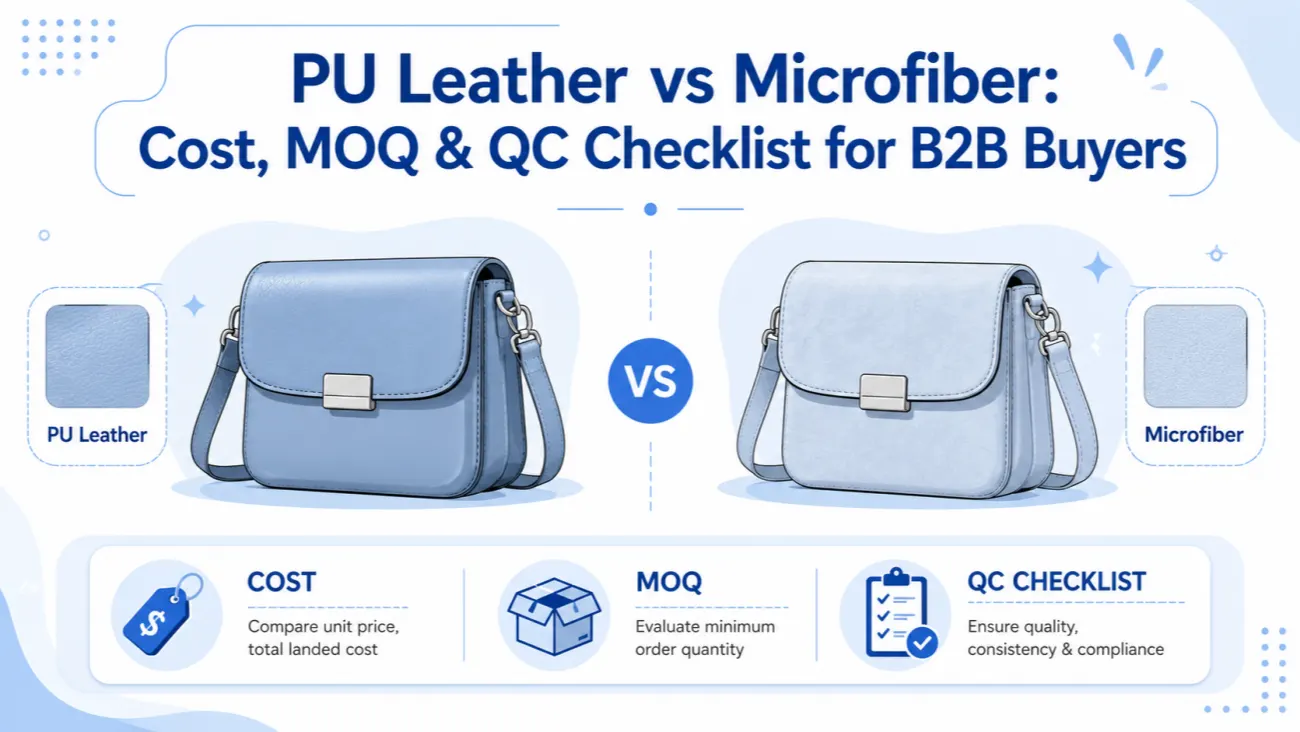
If you are sourcing custom bags and comparing PU leather against microfiber leather, you have probably already read the general comparisons — which one looks better, which one feels more premium, which one is more eco-friendly. This guide is different. It focuses on three practical factors that directly affect your bottom line: what each material actually costs per unit, how MOQ differs and why, and exactly what to check when the shipment arrives.
We published a simpler overview of these two materials in our best vegan leather for handbags guide. This article goes deeper for buyers placing wholesale orders.
Table of Contents
- Cost Breakdown — PU vs Microfiber Per Unit
- MOQ Differences — Why the Gap Exists and How to Work Around It
- Hidden Cost Factors Buyers Often Miss
- QC Checklist for PU Leather Bags
- QC Checklist for Microfiber Leather Bags
- Common Sourcing Mistakes
- Conclusion
- References
Cost Breakdown — PU vs Microfiber Per Unit
Let us start with the number that matters most: what you pay per finished bag.
The material cost gap between PU and microfiber is real, but it is narrower than many buyers assume. Here is the breakdown at raw material level and at finished product level.
Raw material cost (per square meter):
- Standard PU leather: $3 – $8 per m²
- Premium PU (thicker, better backing): $8 – $12 per m²
- Microfiber leather (standard grade): $12 – $18 per m²
- Microfiber leather (premium grade): $18 – $25 per m²
Estimated cost per finished medium shoulder bag (approx. 0.4 m² material usage):
- PU leather bag: $5 – $12 per piece (material + labor + hardware)
- Microfiber leather bag: $12 – $20 per piece
The 2x to 3x gap at material level shrinks to about 1.5x to 2x at finished product level, because labor, hardware, lining, and packaging cost about the same regardless of material. In our experience, the real cost difference for a 500-piece order is often $3–$6 per unit — not as large as the raw material numbers suggest.
For a complete comparison of all shoulder bag materials including cost, check our best materials for custom shoulder bags guide.
MOQ Differences — Why the Gap Exists and How to Work Around It
MOQ is where PU and microfiber differ most — and where many buyers get stuck.
PU leather has a clear MOQ advantage. Standard PU colors are widely stocked by fabric suppliers, so factories can often start production at 200–300 pieces per color. If you choose from the factory’s in-stock PU colors, some will accept as low as 100 pieces for a first trial order. This makes PU the natural choice for brands testing a new market or launching a limited collection.
Microfiber leather typically requires 500–800 pieces per color as a starting point. The reason is not that factories want to push you — it is that microfiber base material is manufactured in longer production runs and has fewer standard colors in stock. When a factory orders microfiber specifically for your project, they commit to a minimum roll quantity that covers roughly 500 bags.
Three ways to lower microfiber MOQ:
- Choose a standard color. Black, dark brown, and navy are the most commonly stocked microfiber colors. With these, MOQ can drop to 300–400 pieces.
- Combine multiple bag styles under the same color. If you need 200 totes and 200 crossbodies in the same microfiber color, a factory may count them as one 400-piece order toward the material MOQ.
- Accept a slightly higher per-unit price on a smaller first order, then negotiate lower MOQ on reorders once the material is already in the factory’s inventory.
For a full walkthrough of how MOQ works across different bag types and materials, our complete custom handbag manufacturer guide covers this in more detail.
Hidden Cost Factors Buyers Often Miss
Beyond the material price itself, three less obvious costs affect your total budget.
1. Cutting yield. PU leather has a higher utilization rate — about 92–95% — because its coating surface is uniform and defects are rare. Microfiber leather has slightly lower yield at 88–90% due to minor surface inconsistencies in the non-woven base. For a 1,000-piece order, this difference means you need about 5% more microfiber material, adding roughly $0.30–$0.50 per bag.
2. Logo application cost. As we covered in our logo on microfiber vs PU leather guide, some logo methods cost more on microfiber (deeper embossing requires more pressure and longer press time), while others cost more on PU (surface pre-treatment for screen printing adds a step). Budget an extra $0.20–$0.80 per unit depending on your chosen logo method.
3. Freight weight. Microfiber leather is denser than PU — typically 1.2–1.6 mm vs 0.8–1.2 mm. For a container shipment of 2,000 bags, the weight difference adds approximately 8–12% to sea freight costs. This alone can add $0.15–$0.30 per bag on international shipping.
QC Checklist for PU Leather Bags
When your PU leather bags arrive from the factory, run these five checks before approving the batch.
| Check | What to Look For | How to Test |
|---|---|---|
| 1. Surface coating | No bubbles, particles, or uneven gloss | Visual inspection under natural light |
| 2. Fold test | No whitening or cracking at the crease | Fold the bag flap or gusset 180° and release |
| 3. Thickness | Matches spec (±0.1 mm tolerance) | Measure with a thickness gauge at 3 points |
| 4. Color consistency | No visible difference between pieces | Place 3 bags side by side under the same light |
| 5. Logo adhesion | No peeling, no blurred edges | Press adhesive tape onto logo, peel firmly |
One thing many buyers overlook: PU leather from different production batches can feel different even if the color code is the same. Before confirming the sample, ask your factory to keep a reference swatch from the approved batch so future reorders can be matched against it.
QC Checklist for Microfiber Leather Bags
Microfiber leather needs a slightly different set of checks because its failure modes are different from PU.
| Check | What to Look For | How to Test |
|---|---|---|
| 1. Weight & thickness | Should feel denser than PU, 1.2–1.6 mm | Weigh and measure; compare to spec sheet |
| 2. Surface grain | Texture is consistent across all panels | Run your hand across multiple bags — texture should feel the same |
| 3. Tear resistance | Should not tear easily at stitch holes | Gently stretch the material near a stitch line |
| 4. Color fastness | No color transfer to white cloth | Rub a white cloth firmly on the surface 10 times |
| 5. Hydrolysis report | Supplier can provide test data (min. 3-year resistance) | Request the hydrolysis test report from your supplier |
For a complete QC framework that covers all materials and production stages, see our custom handbag quality control checklist.
Common Sourcing Mistakes
Here are three mistakes we see regularly — and the simple fix for each.
1. Comparing only raw material prices.
A buyer sees PU at $5/m² and microfiber at $15/m² and assumes microfiber is three times more expensive. But when you factor in labor, hardware, packaging, and the fact that microfiber bags can be priced higher at retail, the real gap is much smaller. Always compare finished product cost, not material cost alone.
2. Using PU MOQ expectations for microfiber.
We have seen buyers spend weeks negotiating a 300-piece MOQ on microfiber, only to have every factory decline. It is not that factories are being difficult — the material supply chain simply does not support it. Either plan for 500+ pieces on microfiber, or use the workaround strategies we listed in section 2.
3. Applying the same QC checklist to both materials.
PU fails by peeling and cracking. Microfiber fails by surface scuffing and color transfer. If you use a PU-focused QC checklist on a microfiber shipment, you will miss the issues that actually matter — and vice versa. Use the two checklists in this article separately for each material.
Conclusion — Choose Based on Your Order Profile, Not Features
The choice between PU leather and microfiber leather for your custom bag order comes down to three questions:
- What is your order size? Under 300 pieces → PU is your practical option. 500+ pieces → Microfiber becomes viable.
- What is your target retail price? Under $70 retail → PU gives you better margin. $100+ retail → Microfiber supports the price point.
- What is your quality promise? 1–2 year product lifecycle → PU is sufficient. 3+ year product → Microfiber is the safer choice.
Ready to start your project? Contact us with your target bag type, quantity, and preferred material, and we will send you a cost comparison based on actual production numbers.
References
- Leather Naturally — Material Performance Data — Industry reference for synthetic leather testing standards including hydrolysis resistance and abrasion testing for PU and microfiber materials.
- ISO 11644 — Adhesion Test for Leather Finishes — Standard method for testing coating adhesion on finished leather and synthetic leather, directly relevant to PU quality control.
- ASTM D5034 — Breaking Strength and Elongation of Textile Fabrics — Standard test method for measuring fabric strength, applicable to microfiber leather tear resistance testing.
- Textile Exchange — Preferred Fiber & Materials Market Report 2025 — Market data on synthetic leather pricing trends and adoption rates in the bag and accessories sector.