Estimated Reading Time: 5 minutes
Table of Contents
- What “Vegan Leather” Means (In Plain Words)
- PU Leather: The Popular, Budget-Friendly Option
- Microfiber Leather: The Premium, Longer-Lasting Option
- PU vs Microfiber: Side-by-Side Comparison
- How to Pick the Best Vegan Leather for Your Handbags
- Simple Sampling Checklist (Ask Your Supplier)
- MOQ: Why It Changes by Material and Color
- Quick Recommendation Summary
What “Vegan Leather” Means (In Plain Words)
When a supplier says “vegan leather,” they usually mean a material that looks like leather but is made without animal hide. Most of the time, it’s a fabric base with a protective top layer that gives it the leather look and makes it easier to clean.
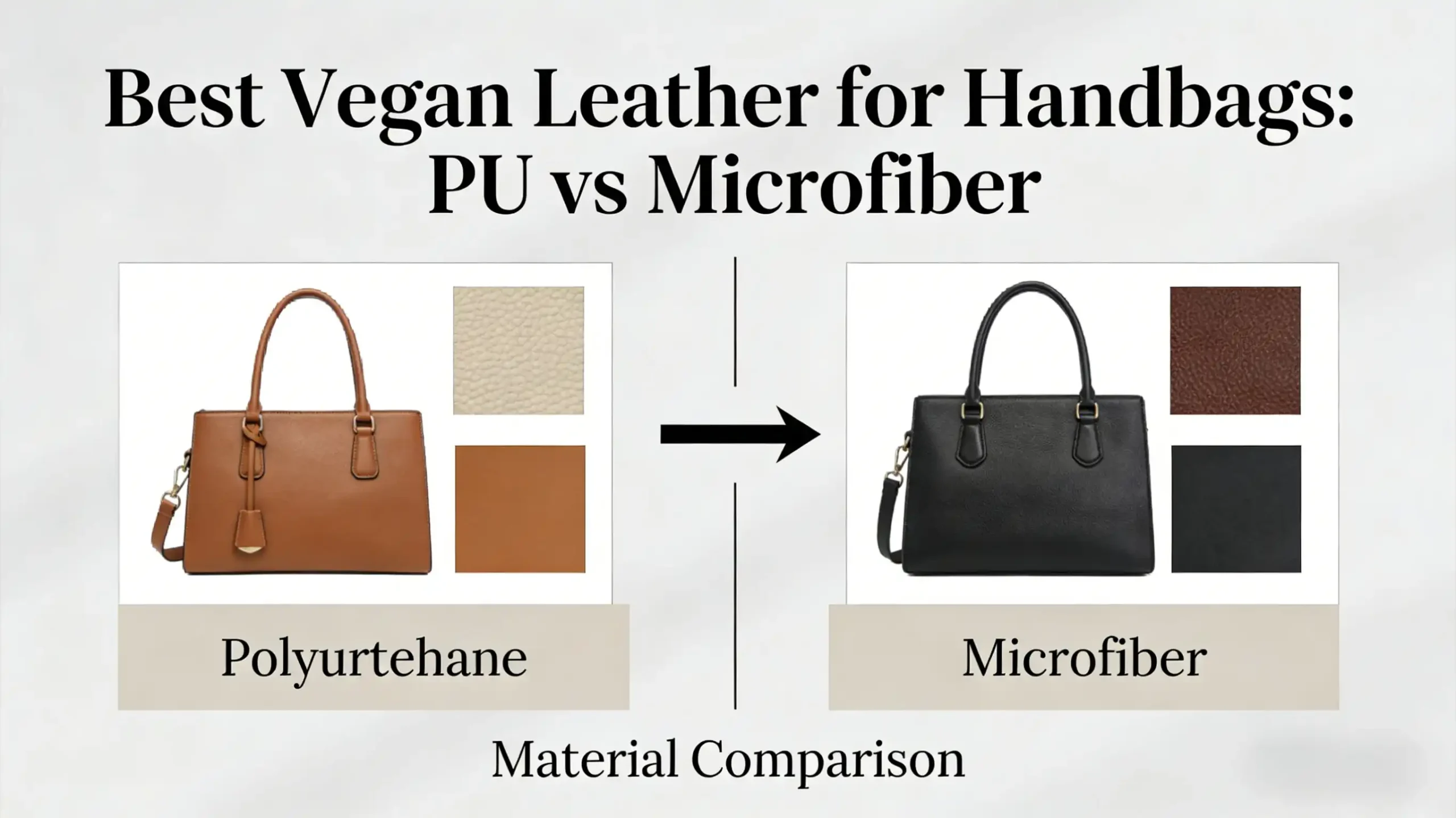
For handbags, you’ll most often be choosing between:
- PU leather: very common, flexible, and cost-effective.
- Microfiber leather: designed to feel closer to real leather and last longer.
[Image suggestion: A clean close-up photo of two swatches labeled “PU” and “Microfiber,” with a hand touching both to show texture.]
PU Leather: The Popular, Budget-Friendly Option
Think of PU leather like this: a textile base (often polyester) with a smooth protective coating. That top layer can be matte, glossy, pebbled, or embossed (croc, saffiano, etc.).
Why brands choose PU
- Cost: PU helps you keep unit costs lower, which is useful for entry-level price points and trend-driven collections.
- Color freedom: it’s easier to make bright colors and consistent batches.
- Easy care: most PU is wipe-clean and handles light rain well.
- Fast sampling: factories usually have more PU options in-stock.
What to watch out for
- Peeling risk: lower-grade PU can crack or peel with heat, friction, or time.
- Feel: some PU feels stiff or “plastic,” especially in cold weather.
- Creasing: soft PU can show crease lines faster on structured designs.
Buyer tip: If your brand sells under $60–$90 retail, PU can be a smart choice, but you must sample carefully. A “good PU” and a “cheap PU” can look identical in photos and behave completely differently after 30 days of use.
Microfiber Leather: The Premium, Longer-Lasting Option
Microfiber leather is built to mimic real leather more closely. Instead of only relying on a coating, it uses a dense, fine fiber structure that gives it a more leather-like hand feel and improves durability.
Why brands choose microfiber
- Better durability: generally resists cracking and surface damage better than standard PU.
- More “luxury” feel: softer touch, better drape, and less plastic-like sensation.
- More stable aging: better performance for customers who carry the same bag daily.
- Premium positioning: easier to justify higher price points.
Trade-offs to consider
- Higher cost: you pay more per bag, and that affects your retail strategy.
- Color MOQs can be higher: custom colors often require larger production runs.
- Not all microfiber is equal: “microfiber” can be used loosely. You still need samples and testing.
[Image suggestion: Macro photo of microfiber backing texture compared with PU backing to show the difference.]
PU vs Microfiber: Side-by-Side Comparison
- Feel in hand: PU can feel smooth and “coated”; microfiber often feels more like real leather.
- Long-term wear: PU varies widely; microfiber is usually more stable for daily use.
- Scratch resistance: depends on finish; microfiber often performs better on matte/pebbled surfaces.
- Structure: both can work; microfiber tends to hold a premium look with less cheap shine.
- Color options: PU is easiest; microfiber may require planning for custom colors.
- Cost: PU is lower; microfiber is higher.
How to Pick the Best Vegan Leather for Your Handbags
“Best” depends on your customers and your price point. Use these simple rules:
Choose PU if you are optimizing for price and speed
- Your handbags are trend-based, seasonal, or you release many colors/styles.
- You need competitive pricing and lower upfront investment.
- You plan to use textured/embossed finishes (croc, lizard, saffiano) where the coating look is expected.
Choose microfiber if you are building “keep-it-for-years” quality
- You want fewer returns and stronger reviews about “quality.”
- Your customer expects a premium feel and is willing to pay for it.
- You focus on classic designs meant for daily use (totes, work bags, structured shoulder bags).
Simple positioning guide: If you want your brand to be known for “affordable and cute,” good PU can work. If you want “premium and long-lasting,” microfiber is usually the safer bet.
Simple Sampling Checklist (Ask Your Supplier)
Before a bulk order, ask for swatches and a sample bag. Then check:
- Smell test: strong chemical odor is a red flag.
- Bend test: fold the swatch 20–30 times; look for cracking lines.
- Scratch test: lightly rub with a fingernail; see if the surface marks easily.
- Color rub: wipe with a clean white cloth; check for color transfer.
- Heat reality: if your market is hot/humid, ask for a more heat-stable option.
If you need help selecting materials for your next collection, start with clear targets (retail price, customer use case, and desired feel) and request swatches from your supplier. Many brands also keep one “approved swatch set” to match future reorders.
MOQ: Why It Changes by Material and Color
MOQ (minimum order quantity) is not just a factory rule. It often depends on the material supplier’s production run. In simple terms: if a color or finish is not in stock, the mill may require a larger batch to produce it.
In general:
- In-stock PU colors often allow lower MOQs and faster lead times.
- Custom PU colors may require a higher MOQ, especially for special finishes.
- Microfiber custom colors often need more planning and sometimes a higher MOQ than PU.
Buyer tip: If your MOQ is tight, choose an in-stock color for the first run, validate demand, then upgrade to custom color in your second run. This reduces risk while still allowing brand differentiation.
For production support and material options, you can explore our manufacturing service and request swatches here: http://www.lilalilabags.com/.
Quick Recommendation Summary
- Best for budget collections: High-quality PU with careful sampling.
- Best for premium collections: Microfiber leather for better feel and durability.
- Best for first-time brands: Start with reliable in-stock PU, then upgrade after validating sales.
- Best for long-term brand value: Microfiber with consistent hardware and stitching standards.
References
- Textile Exchange. Preferred Fiber & Materials Market Report.
- Material Innovation Initiative. Next-Gen Materials reports and resources.
- Vogue Business. Coverage on vegan leather and material impacts.