Estimated reading time: 6 minutes
Table of Contents
- What Does It Cost to Produce a Tote Bag? (2026 FOB Price Benchmarks)
- The 5 Cost Components Behind Every Tote Bag Quote
- Examples: Canvas, RPET, and Leather Tote Cost Calculations
- Is Investing in High-Quality Tote Bags Worth the Additional Cost?
- FAQ
What Does It Cost to Produce a Tote Bag? (2026 FOB Price Benchmarks)
The cost to produce a tote bag in 2026 ranges from $2.50 for a basic cotton canvas tote at volume to over $90.00 for a full-grain leather tote at low MOQ — and the material you choose accounts for roughly 80% of that price difference. Tote bags are structurally the simplest bag category: minimal hardware, few panels, and short sewing cycles. This makes them the lowest-cost entry point for brands and Amazon sellers launching a private label bag line.
Here are 2026 FOB benchmarks by material type (China origin):
| Material | 100 pcs | 300 pcs | 500+ pcs |
|---|---|---|---|
| Cotton Canvas (10–16 oz) | $4.00–$7.50 | $3.20–$5.80 | $2.50–$5.00 |
| RPET / Recycled Polyester | $5.50–$10.00 | $4.50–$8.00 | $3.50–$7.00 |
| PU Leather | $12.00–$25.00 | $10.00–$20.00 | $8.00–$18.00 |
| Genuine Leather | $45.00–$90.00 | $35.00–$70.00 | $25.00–$55.00 |
Tote bag cost structure differs from other bag types in one critical way: fabric area dominates. A standard 15″×16″ canvas tote uses approximately 1.2 yards of shell fabric — more than a similarly priced backpack because the tote body is a single large panel. Conversely, hardware is negligible (0–2 components vs. 8–15 on a backpack), and labor minutes are the lowest of any bag category at 15–25 minutes for canvas and 40–65 minutes for leather.
Understanding these benchmarks is the starting point. The sections below break down exactly what drives these numbers — and how to calculate your own.
The 5 Cost Components Behind Every Tote Bag Quote
Every tote bag FOB quote is built from five cost blocks: fabric/leather, accessories, labor, overhead, and packaging/testing. Fabric alone accounts for 40–55% of total cost — the single largest lever in your pricing.
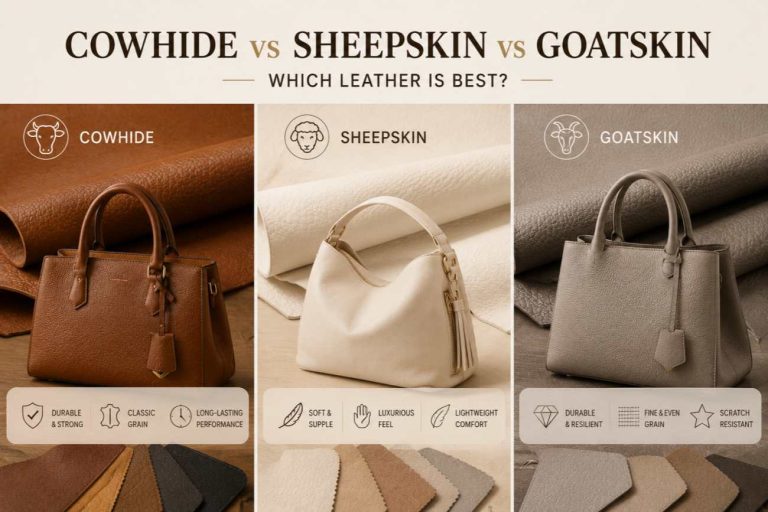
1. Fabric / Leather (40–55% of total cost). This is the biggest variable. Cotton canvas ranges from $1.50–$4.00/yard depending on weight (6–16 oz) and finish. RPET commands a 20–35% premium over standard polyester but is increasingly expected by US and EU buyers. PU leather runs $3.00–$8.00/yard. Genuine leather is priced per square foot: $3.00–$5.00 for split grain, $5.00–$8.00 for top grain, and $8.00–$15.00+ for full grain. For leather totes, factor in a 15–30% waste rate due to natural hide imperfections — only 70–85% of a hide is usable [1].
2. Accessories & Branding (8–15%). Lining, webbing straps, thread, edge paint, labels, and — critically for totes — logo application. Screen printing adds $0.15–$0.50 per color, heat transfer $0.30–$1.00 for multicolor, and embroidery $0.50–$2.00. The branding technique you select directly affects both cost and perceived retail value.
3. Labor (15–22%). Tote bags require the fewest labor minutes of any bag type. A canvas tote takes 15–25 minutes; a structured leather tote takes 40–65 minutes including hand-edge painting. Labor cost follows a simple formula: Labor $/unit = (Minutes ÷ 60) × Hourly Rate. At China/Vietnam rates of $3.50–$5.00/hr, canvas tote labor is $0.88–$2.08/unit. At US rates ($12–$25/hr), the same work costs $3.00–$10.42 [2].
4. Overhead (8–12%). Pattern making ($30–$80 for totes, which are simpler than structured bags), sample development, cutting setup, utilities, and administration. These are usually applied as a percentage of prime cost (materials + labor).
5. Packaging & Compliance Testing (3–6%). Polybag, hangtag, barcode sticker, and export carton run $0.30–$1.00/unit. Compliance testing — REACH, Prop 65, colorfastness — costs $120–$250 per style and is amortized across the order. Many sourcing guides omit this line entirely, but it is mandatory for US retail and Amazon [3]. Confirm your factory holds current manufacturing certifications before ordering.
Examples: Canvas, RPET, and Leather Tote Cost Calculations
Below are three worked FOB calculations for the most common tote bag types. These examples show that material selection drives 80% of the price spread — labor and overhead shift only modestly.
16 oz Cotton Canvas Tote (500 pcs, 2 colors, 1-color screen print)
- Canvas shell: 1.2 yd × $2.80 = $3.36
- Lining + webbing straps + thread = $0.80
- Screen print (1 color) = $0.25
- Materials subtotal: $4.41
- Labor: 18 min × $4.00/hr = $1.20
- Overhead (10%): $0.56
- Testing (amortized): $0.40
- FOB cost: $6.57 → Supplier margin 12% → FOB quote: $7.36/unit
RPET Eco Tote (300 pcs, 1 color, 2-color heat transfer)
- RPET shell: 1.2 yd × $3.80 = $4.56
- Lining + webbing + thread = $0.75
- Heat transfer (2 colors) = $0.60
- Materials subtotal: $5.91
- Labor: 20 min × $4.00/hr = $1.33
- Overhead (10%): $0.72
- Testing (incl. GRS verification): $0.80
- FOB cost: $8.76 → Supplier margin 12% → FOB quote: $9.81/unit
Full-Grain Leather Tote (200 pcs, 1 color, embossed logo + brass feet)
- Full-grain cowhide: 12 sq ft × $3.80/sq ft = $45.60 (includes 25% waste)
- Lining + edge paint + thread + plate = $2.00
- Hardware: YKK zip + 4 brass feet = $2.30
- Embossed logo = $0.30
- Materials subtotal: $50.20
- Labor: 55 min × $4.50/hr = $4.13
- Overhead (15%, reflecting leather complexity): $8.15
- Testing: $1.50
- FOB cost: $63.98 → Supplier margin 15% → FOB quote: $73.58/unit
The key insight: moving from canvas to leather, material cost jumps from $4.41 to $50.20 (11×), while labor increases from $1.20 to $4.13 (3.4×). If your target market supports a $60+ retail price, leather totes deliver substantially higher absolute margins. For volume-driven Amazon sellers, canvas and RPET totes offer the best FOB-to-retail ratio.
Is Investing in High-Quality Tote Bags Worth the Additional Cost?
Yes — a higher FOB cost per unit consistently delivers better total economics when you account for return rates, brand perception, re-order rates, and long-term margin. A $3.50 canvas tote that arrives with fraying seams and faded prints costs you far more than a $7.00 canvas tote that sells through at full price and generates repeat customers.
Here is the financial logic behind quality investment:
Lower return rates save more than quality costs. Amazon’s apparel-and-accessories category averages a 15–25% return rate. Low-quality totes — thin canvas that distorts, printing that cracks after one wash, straps that detach — push returns to the high end of that range. Each returned unit is a total loss: FOB cost + FBA fees + return processing + unsellable inventory. For a $7.36 FOB canvas tote selling at $19.99 on Amazon, one return costs you approximately $15 in total losses. If quality improvements of $2.00/unit reduce returns from 20% to 8%, you save $1.80/unit net across 100 units — nearly offsetting the upgrade cost entirely [4].
Higher perceived value enables premium pricing. A 16 oz canvas tote with reinforced stress points, clean double-needle stitching, and a well-executed logo technique can retail at $24.99–$34.99 instead of $14.99–$19.99. The FOB difference is $1.50–$3.00, but the retail uplift is $10–$15. On a 500-unit order, that is $5,000–$7,500 in additional revenue for a $750–$1,500 quality investment.
Repeat orders reduce per-unit costs over time. Brands that invest in quality see higher re-order rates from both wholesale accounts and direct consumers. A private label tote that becomes a customer favorite generates predictable re-orders, which unlock volume pricing (22% savings moving from 100 to 1,000+ pcs) and eliminate re-sampling costs on subsequent runs.
Compliance and certification protect against catastrophic costs. A tote that fails Prop 65 or REACH testing after production means the entire batch cannot enter the US or EU market. The cost is not just the inventory — it is the lost selling season, the wasted marketing spend, and the potential legal liability. Factories with current BSCI, ISO, or GRS certifications charge 3–8% more per unit, but this premium is insurance against a zero-revenue scenario.
The bottom line: for brands and Amazon sellers, the question is never “how cheap can I produce a tote?” — it is “what FOB price gives me the best profit after returns, compliance risk, and brand value are factored in?” In nearly every scenario, that number is 15–25% above the lowest available quote.
When you are ready to get a transparent, line-item FOB quotation for your custom tote project, Lilalila Bags supports canvas, RPET, PU, and genuine leather totes with OEM/ODM services, custom logo application, private label packaging, and sample development. MOQ starts at 50 pieces.
Need an Accurate FOB Quote for Your Custom Tote Bag?
At Lilalila Bags, we provide transparent, line-item quotations for canvas, RPET, PU, and leather totes — no hidden fees. OEM/ODM, custom logo, private label packaging, and sample development. MOQ starts at 50pcs.
📩 Get Your Free Tote Bag Quote | 📦 Request a Sample
References
- Hongbang Leather. “How Much Do Custom Leather Bags Cost?” https://www.hongbangleathers.com/custom-leather-bags-really-cost/
- Meyzy. “Custom Bag Cost Breakdown: Materials × Operations × Testing.” https://www.meyzy.com/custom-bag-cost-breakdown/
- U.S. Consumer Product Safety Commission. “CPSIA.” https://www.cpsc.gov/Regulations-Laws–Standards/
- OMASKA. “How Much Does It Cost to Manufacture Bags? 2026 Strategic Sourcing Whitepaper.” https://www.omaska.com/bag-manufacturing-cost-breakdown-2026/