Estimated reading time: 8 minutes
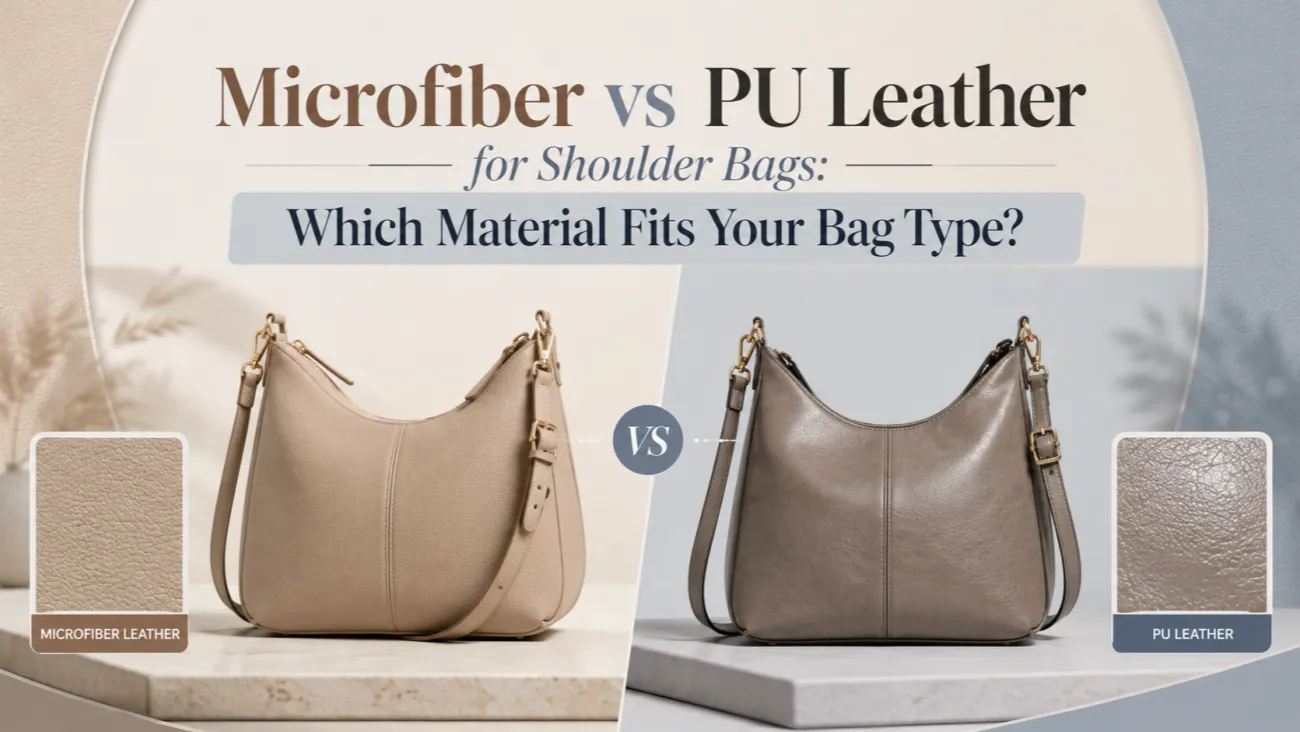
If you are sourcing custom shoulder bags and comparing synthetic leather options, you have likely come down to two choices: PU leather and microfiber leather. Both are vegan-friendly, both can look convincingly like genuine leather, and both are widely used in bag manufacturing. But they differ significantly in durability, feel, cost, and — most importantly — which shoulder bag types they work best with.
This guide compares microfiber and PU leather from a B2B manufacturing perspective: material properties, cost and MOQ differences, logo method compatibility, and a decision matrix that maps each material to the right shoulder bag type. If you have not yet chosen a bag silhouette, start with our complete types of shoulder bags guide before deciding on a material.
Table of Contents
- Why This Decision Matters for Your Shoulder Bag Production
- PU Leather for Shoulder Bags — Strengths and Limits
- Microfiber Leather for Shoulder Bags — Strengths and Limits
- Microfiber vs PU Leather — Head-to-Head Comparison
- Which Shoulder Bag Type Should Use Which Material?
- How Material Choice Affects Logo Methods & QC
- Conclusion — Choose the Right Material for Your Project
- References
Why This Decision Matters for Your Shoulder Bag Production
Choosing between microfiber and PU leather is not simply a matter of budget — it directly affects how your finished shoulder bag performs, how it feels, and how long it lasts. More importantly, each material works best with specific bag types.
The key differences are structural:
- PU leather is a coated material — a fabric base (typically polyester) with a polyurethane surface layer. It is flexible, cost-effective, and comes in many colors and textures. Its durability depends heavily on the thickness of the coating and the quality of the base fabric.
- Microfiber leather uses ultra-fine synthetic fibers (0.001–0.003 denier) bonded together in a 3D structure, then coated with a thin PU layer. This construction makes it significantly stronger, more breathable, and closer to genuine leather in hand feel.
For a complete overview of all shoulder bag materials — including canvas, nylon, genuine leather, and more — see our best materials for custom shoulder bags guide.
PU Leather for Shoulder Bags — Strengths and Limits
PU leather is the most widely used synthetic leather in shoulder bag production, and for good reason: it delivers a leather-like appearance at the lowest cost.
Strengths:
- Color range. PU can be produced in virtually any color with consistent batch-to-batch matching. This makes it ideal for seasonal collections and brands that need precise Pantone matching.
- Surface texture variety. Saffiano, pebbled, smooth, matte, gloss, croco-embossed — PU can replicate most finishes.
- Low MOQ. Most PU colors can be ordered at 200–300 pieces per color, making it accessible for small-batch launches.
- Light weight. PU is typically lighter than microfiber, an advantage for larger bags like totes.
Limits:
- Cracking risk. At thicknesses below 0.8 mm, PU can crack at stress points — strap attachments, fold lines, and corners. This is the most common return reason for PU shoulder bags.
- Cold stiffening. PU noticeably hardens below 5°C. For bags destined for cold-climate markets, this is a real concern.
- Shorter lifespan. A well-made PU bag typically lasts 2–4 years of regular use before surface wear becomes visible.
PU is a solid choice for totes and promotional slings where cost is the primary driver and the bag is not expected to last for years. For a broader comparison that includes genuine leather, see our PU vs microfiber for handbags guide.
Best shoulder bag types for PU: Tote (entry-level), Sling (budget-friendly), fashion-forward seasonal styles.
Typical MOQ: 200–500 pieces.
Cost index: Low (baseline).
Microfiber Leather for Shoulder Bags — Strengths and Limits
Microfiber leather is the premium synthetic alternative, designed to address the durability gaps of standard PU while maintaining a leather-like aesthetic.
Strengths:
- Tear strength. Microfiber’s 3D fiber structure delivers 2–3× the tear resistance of standard PU. In Martindale abrasion tests, quality microfiber often exceeds 50,000 cycles without surface damage.
- Cold performance. Microfiber remains flexible at −20°C, making it suitable for winter accessories and cold-climate markets.
- Hand feel. It closely mimics genuine leather’s softness and warmth, with a “napped” backing that feels like real hide on the reverse.
- Longer lifespan. A microfiber shoulder bag typically lasts 5–8 years with normal use.
Limits:
- Higher cost. Microfiber is typically 1.5–2× the cost of standard PU leather.
- Higher color MOQ. Custom colors usually require 500+ pieces per color because of the more complex production process.
- Fewer surface textures. While microfiber can be embossed, its texture range is narrower than PU’s.
For bag types that demand structure and durability — particularly satchels and hobos — microfiber is the better long-term choice. Our leather quality grades guide explains how microfiber compares against full-grain and top-grain leather for bag applications.
Best shoulder bag types for microfiber: Satchel, Hobo, premium Tote.
Typical MOQ: 300–500 pieces (premium), 500+ (custom colors).
Cost index: Medium (1.5–2× PU).
Microfiber vs PU Leather — Head-to-Head Comparison
The table below compares both materials across the sourcing dimensions that directly affect your production plan and unit economics.
| Dimension | PU Leather | Microfiber Leather |
|---|---|---|
| Construction | Fabric base + PU coating | Ultra-fine fiber matrix + thin PU coat |
| Thickness range | 0.4 – 1.2 mm | 0.6 – 1.6 mm |
| Abrasion resistance | 10,000 – 30,000 Martindale cycles | 50,000+ Martindale cycles |
| Tear strength | Medium | 2–3× PU |
| Cold flexibility | Hardens below 5°C | Flexible to −20°C |
| Hand feel | Smooth / plastic-like (varies by quality) | Close to genuine leather |
| Color range | Virtually unlimited | Wide, but fewer specialty finishes |
| Logo — Embossing | ⚠️ Only on 1.0 mm+ thickness | ✅ Excellent |
| Logo — Screen Print | ✅ Excellent on smooth finish | ⚠️ Requires surface prep |
| Logo — Metal Plate | ✅ Good (on thick material) | ✅ Good |
| Cost index | Low (1× baseline) | Medium (1.5–2×) |
| Typical MOQ | 200–500 pcs | 300–500 pcs (500+ for custom colors) |
| Estimated lifespan | 2–4 years | 5–8 years |
| Best shoulder bag types | Tote, Sling, fashion styles | Satchel, Hobo, premium Tote |
Which Shoulder Bag Type Should Use Which Material?
The right material depends on your bag type’s structural demands. Here is a clear decision matrix based on real production experience.
| If Your Bag Type Is… | Choose Microfiber When… | Choose PU When… |
|---|---|---|
| Tote | You want a premium-feel tote that lasts; target retail above $80 | You need a low-cost tote for seasonal or promotional use; target retail under $60 |
| Satchel | Always choose microfiber. Satchels need structured, durable material that supports hardware — PU under 1.0 mm will collapse | Only if 1.2 mm+ thick PU with backing board |
| Hobo | Preferred choice. Hobo’s crescent shape needs flexible but durable material — microfiber drapes well and resists wear at the curve | Soft PU can work for budget lines, but expect shorter lifespan at the curve seam |
| Sling | For premium slings where logo embossing is required and durability matters | Standard choice. Lightweight, cost-effective, and sufficient for most sling bag applications |
For a detailed comparison of how these four shoulder bag types differ in construction and production requirements, see our tote vs satchel vs hobo vs sling guide. If you are still comparing material options more broadly, our complete guide to choosing a custom handbag manufacturer covers the full sourcing process.
How Material Choice Affects Logo Methods & QC
Your choice between PU and microfiber also determines which logo methods are available and what quality checks matter most.
Logo compatibility:
- Embossing/debossing works very well on microfiber — the fiber matrix holds crisp edges. On PU, deep embossing requires at least 1.0 mm thickness to avoid cracking.
- Screen printing works best on smooth PU surfaces. On microfiber, the fiber structure can cause ink to bleed, requiring a pre-coating step.
- Metal nameplates attach well to both materials, but require a firm backing in PU bags to prevent the plate from flexing and loosening over time.
QC considerations:
- For PU: Coating adhesion is the top QC risk. A simple finger scratch test on a hidden corner — if the coating flakes, reject the material batch.
- For microfiber: Thickness uniformity is the main check. Microfiber rolls should be measured at 3+ points across the width; variation beyond ±0.1 mm indicates production inconsistency.
For a full breakdown of logo method options, see our logo and branding options for custom shoulder bags guide. For comprehensive QC checkpoints specific to each shoulder bag type, refer to our custom shoulder bag quality control guide.
Conclusion — Choose the Right Material for Your Project
Neither microfiber nor PU leather is universally “better.” The right choice depends on your shoulder bag type, target price point, and quality expectations. Use this three-step process to decide:
Step 1: Confirm your shoulder bag type — review the types of shoulder bags guide.
Step 2: Use the decision matrix above to select your material — microfiber for satchels and hobos, PU for entry-level totes and slings.
Step 3: Specify your material thickness and logo method requirements when requesting a quote — this avoids costly sample revisions.
Ready to start your project? Contact us with your bag type, preferred material, and target quantity. We will provide material swatches and a sampling timeline matched to your specifications.
References
- ASTM D4966 — Abrasion Resistance of Textile Fabrics (Martindale Method) — Standard test method used to evaluate the abrasion resistance of PU leather and microfiber leather for bag applications.
- Intertek — Hardline Testing Services — Third-party testing standards for synthetic leather tear strength, cold crack resistance, and surface adhesion in bag manufacturing.
- OEKO-TEX Standard 100 — Certification standard for synthetic leather materials used in bag production, ensuring compliance with EU and US chemical safety regulations.
- Textile Exchange — Preferred Fiber & Materials Market Report — Industry data on synthetic leather market trends, microfiber adoption rates, and sustainable material innovation in accessories manufacturing.
- SGIA — Specialty Graphic Imaging Association — Industry standards for logo application methods including screen printing and heat transfer on synthetic leather surfaces.