Estimated reading time: 8 minutes
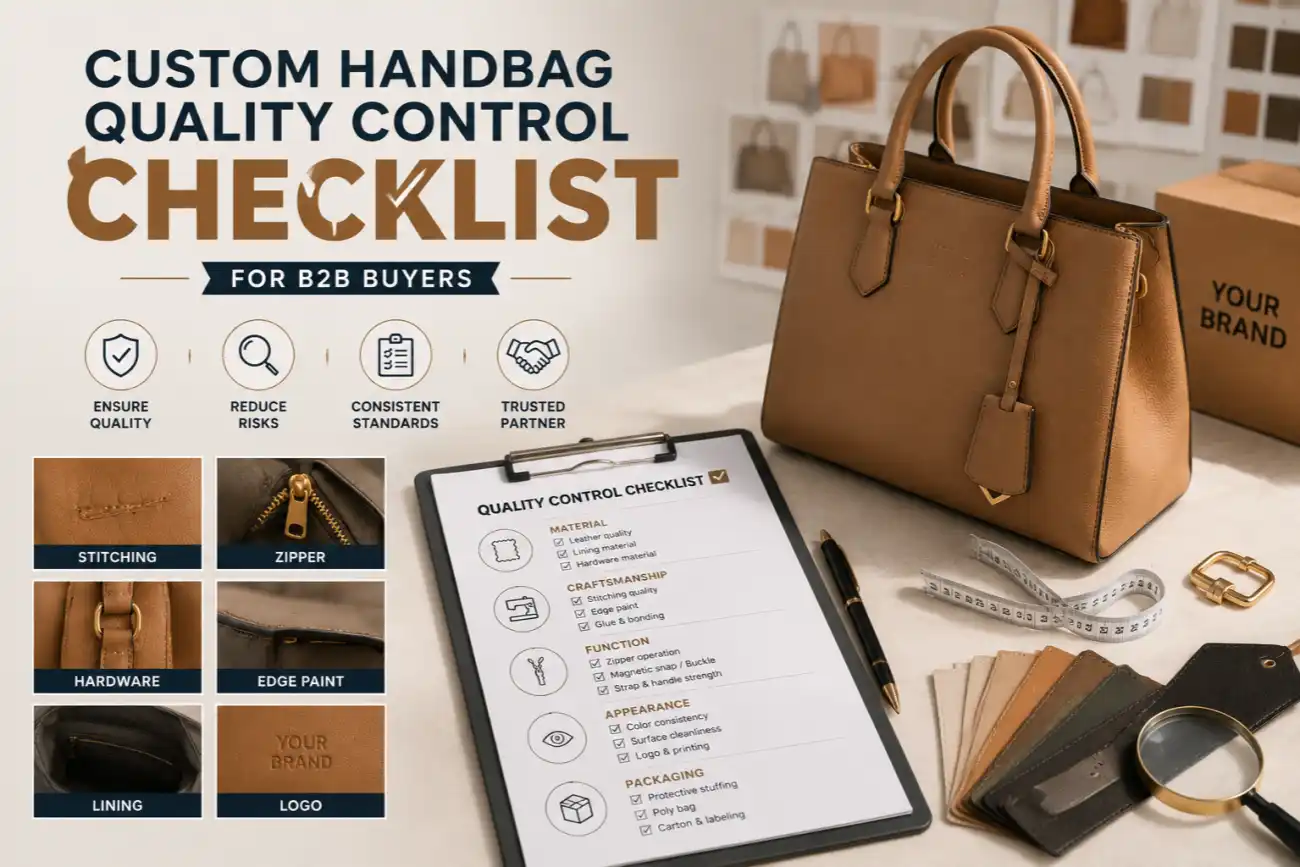
If you are sourcing custom handbags for your brand, quality control is not a single event at the end of production. It is a four-stage process that starts when the first sample is made and continues until your container leaves the factory. Each stage catches a different type of problem — and the earlier you catch it, the cheaper it is to fix.
This guide walks through each of the four QC stages with a practical checklist you can use, whether you are ordering backpacks, gym bags, totes, or travel duffles.
Table of Contents
- Why QC Matters in Custom Handbag Manufacturing
- Stage 1: QC During the Sample Stage
- Stage 2: Raw Material Inspection (Pre-Production)
- Stage 3: During Production Inspection (DUPRO)
- Stage 4: Pre-Shipment Inspection (PSI)
- Common Handbag Defects to Watch For
- DIY vs Third-Party Inspection: What B2B Buyers Should Know
- Conclusion — Build Quality into Your Sourcing Process
- References
Why QC Matters in Custom Handbag Manufacturing
A quality problem in a single sample is a quick fix. The same problem across 1,000 units is a financial loss and a damaged brand reputation.
Many buyers focus their energy on negotiating the unit price and finalizing the design, then hope the factory will deliver everything perfectly. In our experience, hope is not a QC strategy. A structured inspection process at each stage of production catches issues while they are still small — a wrong zipper pull, a stitch tension problem, a material shade variation — before they become part of thousands of bags.
From what we see in bulk production, approximately 80% of serious quality issues can be identified at the pre-production or early production stage. The cost of fixing a defect at the sample stage is measured in dollars. The same defect caught at the pre-shipment stage may cost you weeks of delay and thousands in rework or air freight.
Stage 1: QC During the Sample Stage
Quality control begins with your approved sample — not after production starts.
The sample stage is where you set the quality baseline for your entire order. The PP (pre-production) sample is the most critical checkpoint: it must be made using the exact materials, hardware, and trims that will be used in bulk production. Do not approve a PP sample made with substitute fabrics or temporary hardware.
When reviewing your PP sample, confirm these items and record the specifications — they become your QC reference for later stages:
- Dimensions: Measure length, width, height, and strap drop. Record acceptable tolerance (±3mm is standard).
- Stitch density (SPI): Count stitches per inch on the main seams. 6–8 SPI is standard for most handbags.
- Hardware finish: Confirm zipper type, buckle finish, and D-ring thickness match your spec.
- Material and color: Hold the sample against your original material swatch under natural light.
- Logo and label placement: Measure position from the nearest seam or edge.
If you need a refresher on the full sample journey, our custom handbag sample process guide covers each sample type in detail. Once you have a signed-off PP sample with documented specs, you have a clear benchmark for the rest of the QC process.
Stage 2: Raw Material Inspection (Pre-Production)
Before the factory cuts a single piece of fabric, the raw materials should be verified against your approved specifications.
This inspection typically takes a few hours and happens at the factory or the material supplier’s warehouse. Its purpose is straightforward: confirm that the materials arriving for production match what you approved in the PP sample.
What to check at this stage:
- Fabric or leather: Color consistency across rolls or hides, hand feel, weight (GSM or oz), and finish. Check for dye lots — two rolls from different lots can have visible color variation.
- Lining material: Same checks as outer fabric. Lining defects are easy to miss because they are on the inside, but a poor lining undermines perceived quality.
- Hardware: Zipper pull action (smooth open/close), buckle weight and finish, magnetic snap strength. Check for scratches, tarnish, or sharp edges.
- Webbing and straps: Width consistency, edge fraying, color match.
- Labels and hang tags: Correct artwork, color, material composition, and care instructions.
One common mistake we see is buyers skipping this stage entirely, assuming the factory ordered the correct materials. If you are ordering for the first time, ask your factory for material swatch approvals or photos before they begin cutting. A 10-minute check at this stage can prevent a US$5,000 rework later.
Stage 3: During Production Inspection (DUPRO)
This is the most overlooked inspection stage — and the one that delivers the highest return on investment.
A DUPRO inspection happens when approximately 20–30% of the order is complete. At this point, enough units have been produced to show patterns and trends, but few enough that corrections are still inexpensive.
Many buyers skip DUPRO to save the inspection fee (typically US$200–400). In our experience, this is false economy. Catching a stitching issue at 30% completion means adjusting a few workstations. Catching it at 100% means reworking or scrapping the entire batch.
What to check during DUPRO:
- Randomly pull units from different production lines and different operators — check 5–10 units minimum
- Compare against the approved PP sample — side by side, under good lighting
- Check construction consistency: seam allowance, strap attachment, zipper alignment
- Verify dimensions on at least 3 units
- Test functionality: open and close all zippers, snap all buckles, check pocket access
“This may sound like a small detail, but pay close attention to how different sewing operators work. Even with the same pattern, different skill levels can produce visible variation in stitch quality. If you see one operator’s work consistently below standard during DUPRO, you can request retraining or reassignment before the rest of the order is sewn.”
Stage 4: Pre-Shipment Inspection (PSI)
The pre-shipment inspection is the final quality gate before your goods leave the factory. It happens when 80–100% of the order is finished and packed. An inspector visits the factory, randomly selects units following AQL sampling standards, and checks them against your approved specifications.
AQL Sampling Standards for Handbags
AQL (Acceptable Quality Level) is the international standard for product inspection, based on ISO 2859-1. For most custom handbag orders, the following levels apply:
| Defect Type | Standard AQL | Example |
|---|---|---|
| Critical | 0% (zero tolerance) | Sharp edges that cut skin, broken zipper, off-spec material |
| Major | 2.5% | Visible stitching defects, color mismatch, wrong hardware |
| Minor | 4.0% | Loose thread ends, slight ink smudge on lining, minor creasing |
What the PSI covers:
- Appearance check — color, texture, overall look vs. PP sample
- Function check — zippers, snaps, straps, pockets
- Measurement check — dimensions within ±3mm tolerance
- Packaging check — polybag condition, carton quality, label placement
- Quantity verification — count matches packing list
For a more detailed inspection list focused specifically on leather handbags, refer to our wholesale leather handbag QC checklist. The current guide covers materials of all types — nylon, polyester, canvas, and leather alike.
Common Handbag Defects to Watch For
After working with hundreds of production runs, these five defects surface most often in handbag orders:
- Stitch skipping or loose tension. Usually caused by incorrect needle size for the material or an untensioned machine. Check under the flap and inside pockets where operators tend to rush.
- Hardware tarnish or scratching. Nickel-plated and brass hardware can arrive with surface damage from being stored loose in bins. Ask the factory to individually wrap hardware before attachment — a small request that makes a big difference in final presentation.
- Size deviation beyond tolerance. A bag that is 5mm wider than spec may not seem like much, but if you are selling it as a “fits-a-laptop” bag and the dimensions are off, returns increase. Measure every 10th unit during DUPRO.
- Zipper malfunction. The most common functional defect. Check that zippers glide smoothly along the full track, especially around curves and corners.
- Color variation between production units. Even fabrics from the same dye lot can show variation if different cutting layers or production days are involved. Hold units from different production batches side by side during PSI.
Understanding these common defects before your order starts gives you a clear advantage. When you know what to look for, you can spot problems early and communicate them precisely to the factory.
DIY vs Third-Party Inspection: What B2B Buyers Should Know
You do not always need a professional inspection company — but there are clear situations where you should use one.
| Factor | DIY Inspection | Third-Party |
|---|---|---|
| Cost | Free (your time) | US$200–400 per inspection |
| Best for | Repeat orders, trusted factories, small orders (<500 pcs) | First orders, high-value orders (>$5,000), complex products |
| Expertise | You need a trained eye and detailed checklist | Professional inspector with product knowledge |
| Objectivity | You may overlook issues | Independent, no bias |
| Report quality | Basic photos and notes | Detailed report with photos, measurements, and pass/fail |
If you choose to do your own inspection, create a standardized checklist and use it every time. The wholesale leather handbag QC checklist can serve as a starting point — adapt it for your specific product.
A reliable manufacturer will welcome both DIY and third-party inspections. If a factory resists or limits your ability to inspect at any stage, that is a clear warning sign.
Conclusion — Build Quality into Your Sourcing Process
Quality control is not a last-minute check before shipping. It is a four-stage process that starts when you approve your first sample and continues through material inspection, in-line production checks, and final pre-shipment verification. Each stage serves a different purpose, and each one protects your brand from a different kind of risk.
Whether you are sourcing gym bags, backpacks, or luxury handbags — the same principle applies: inspect early, inspect often, and document everything. If you would like a partner who takes quality as seriously as you do, contact us to discuss your custom handbag project.
References
- ISO 2859-1 — Sampling Procedures for Inspection by Attributes — The international standard for AQL-based random sampling used in pre-shipment inspection for bags and soft goods.
- International Trade Administration — Importing Textiles and Apparel — U.S. government resource covering import compliance and inspection requirements for textile and bag products.
- ISO 9001:2015 — Quality Management Systems — Quality management framework used by professional bag manufacturers to maintain consistent production quality.