Estimated reading time: 9 minutes
Choosing the right material is the single most impactful decision in any custom shoulder bag project. It determines how the bag looks, how long it lasts, how much it costs to produce, and even which logo methods are available to you. But here is what many first-time buyers miss: the best material for your shoulder bag depends entirely on which type of shoulder bag you are making.
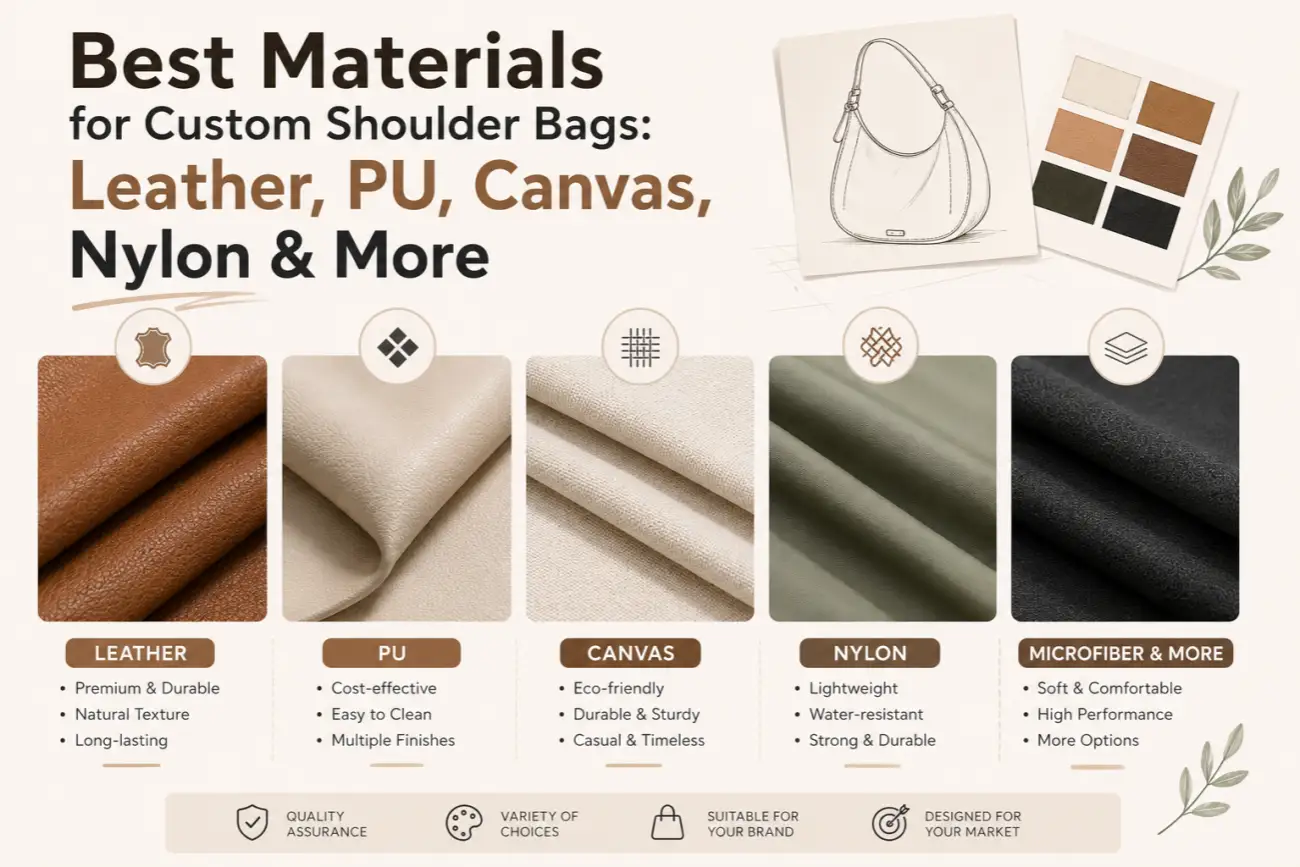
This guide compares seven of the most common materials used in custom shoulder bag manufacturing — genuine leather, PU leather, microfiber leather, canvas, nylon, polyester, and RPET (recycled materials). For each one, we cover cost range, MOQ, durability, logo compatibility, and which shoulder bag types it works best with.
If you have not yet decided on a bag silhouette, start with our complete types of shoulder bags guide to choose your base style first.
Table of Contents
- Why Material Choice Depends on the Shoulder Bag Type
- Leather — Full-Grain, Top-Grain, PU & Microfiber
- Fabric Materials — Canvas, Nylon, Polyester & RPET
- Material Comparison Table — Cost, MOQ, Durability & Logo Compatibility
- Which Material for Which Shoulder Bag? (Decision Matrix)
- Common Material Sourcing Mistakes to Avoid
- Conclusion — Start Your Custom Shoulder Bag Project
- References
Why Material Choice Depends on the Shoulder Bag Type
You cannot choose a material until you know which type of shoulder bag you are producing, because the material must match the bag’s structural requirements.
A satchel needs a firm, structured material that holds its shape — soft nylon or thin PU will collapse and look cheap. A hobo needs a flexible, drapable material that follows the crescent curve — stiff full-grain leather will not drape naturally. A sling needs lightweight, water-resistant material — heavy canvas adds unnecessary weight for an everyday carry bag.
In our experience, the fastest way to waste a sample round is to choose a material based on price or looks alone without considering how it behaves in the specific bag construction. We walk through each shoulder bag type’s material requirements in detail here, but the short rule is: the bag type dictates the material shortlist.
Leather — Full-Grain, Top-Grain, PU & Microfiber
Leather and leather-like materials form the premium tier of shoulder bag production. They offer the widest range of textures, finishes, and perceived value. The key is understanding that “leather” is not one material — it covers four distinct categories with very different performance and cost profiles.
Genuine Leather (Full-Grain & Top-Grain)
Genuine animal leather remains the gold standard for premium shoulder bags, but only at the right grade. Full-grain leather uses the complete hide with natural grain intact. It develops a rich patina over years of use and is the choice for luxury satchels and structured shoulder bags. Top-grain leather is lightly sanded for a more uniform surface and works well for mid-to-high-end business shoulder bags.
From a manufacturing perspective, genuine leather requires more careful cutting (hide has natural variations, so piece yield is lower) and higher MOQ to control unit cost — typically 500 to 1,000 pieces. Sampling takes 4 to 6 weeks because leather needs to be sourced, graded, and matched for color consistency. For a deeper breakdown of grades, see our leather quality grades explained guide.
Best for: Satchels, structured shoulder bags, premium collections.
MOQ: 500–1,000 pcs.
Logo methods: Embossing/debossing, metal nameplate, foil stamping.
Cost: Highest tier — expect 2–4× the cost of synthetic alternatives.
PU Leather
PU (polyurethane) leather is the most widely used synthetic leather in shoulder bag manufacturing, and for good reason. It offers a leather-like appearance at a fraction of the cost, comes in hundreds of colors and textures (smooth, pebbled, saffiano, matte, gloss), and supports MOQ as low as 200 to 300 pieces.
What PU cannot do is match genuine leather’s longevity in high-stress areas. The shoulder strap attachment points, flap fold lines, and corner edges are where lower-grade PU will show wear first — typically cracking or peeling after 12 to 24 months of regular use. This is not necessarily a problem if your price point matches that lifespan. Many fast-fashion and entry-level brands use PU precisely because it allows a leather look at an accessible price.
For structured designs like satchels, PU must be paired with a backing board or lining stiffener to hold shape. Our PU vs microfiber vs genuine leather comparison covers the performance differences in more detail.
Best for: Totes, fashion shoulder bags, entry-level satchels.
MOQ: 200–500 pcs.
Logo methods: Screen printing, embossing, metal plate, woven label.
Cost: Low to medium — the most cost-effective leather alternative.
Microfiber Leather
Microfiber leather sits between PU and genuine leather in both performance and cost, making it a strong middle-ground option. It is made from a dense microfiber base (typically polyester and polyamide) coated with a thin PU layer. The result is a material that approaches genuine leather’s tear strength and abrasion resistance while weighing about 30% less.
From what we see in bulk production, microfiber leather is increasingly chosen by brands that want a premium feel without the MOQ commitment of genuine leather. It performs well on durability tests (50,000+ Martindale abrasion cycles) and maintains consistent color across production batches — a genuine advantage over natural leather’s batch-to-batch variation.
Best for: Totes, everyday shoulder bags, slings, laptop shoulder bags.
MOQ: 300–500 pcs.
Logo methods: Embossing, foil stamping, metal plate, silicone patch.
Cost: Medium — approximately 1.5–2× PU leather, 40–60% of genuine leather.
Fabric Materials — Canvas, Nylon, Polyester & RPET
Fabric-based materials dominate the casual, outdoor, and eco-conscious shoulder bag segments. They are lighter than leather, generally more water-resistant, and offer different aesthetic options that leather cannot match.
Canvas
Canvas is a heavy-duty woven fabric — traditionally cotton — known for its durability and natural texture. It is the standard material for casual totes, canvas shoulder bags, and market bags. Canvas weight is measured in ounces per square yard; 12 oz to 16 oz is the typical range for shoulder bags. Waxed canvas adds water resistance while maintaining the classic look.
One common mistake we see is buyers choosing a canvas weight that is too light for the bag size — a 16″×14″ tote in 10 oz canvas will sag under moderate load. For custom shoulder bags, 14 oz or heavier is recommended. Canvas also absorbs moisture (about 7–8% by weight), so consider a PU back coating if the bag will be used outdoors frequently.
Best for: Totes, casual shoulder bags, eco-friendly collections.
MOQ: 200–500 pcs.
Logo methods: Screen printing (best), woven label, patch.
Cost: Low to medium.
Nylon
Nylon is the go-to material for functional shoulder bags — slings, travel crossbodies, and outdoor designs. It offers the best strength-to-weight ratio among common bag fabrics. Key specifications include denier rating (D): higher numbers mean thicker, stronger fibers. 420D nylon is standard for everyday slings; 1000D Cordura nylon is used for heavy-duty tactical-style shoulder bags.
For wholesale orders, we usually suggest nylon when the bag’s primary selling point is lightweight carry and water resistance. Nylon dries quickly, resists mildew, and takes DWR (durable water repellent) coatings very well. The trade-off is that nylon has a distinctly synthetic look and feel — not suitable if your brand positioning is natural or premium leather.
Best for: Sling bags, travel shoulder bags, outdoor/athletic styles.
MOQ: 300–600 pcs.
Logo methods: Silicone patch, foil stamping, woven label, reflective print.
Cost: Low to medium (higher for Cordura-grade nylon).
Polyester
Polyester is the most cost-effective fabric option for shoulder bags, with stable color performance and mature global supply chains. It is widely used in promotional shoulder bags, school bags, and budget fashion lines. Common specifications include 300D, 600D, and 1200D, with 600D Oxford polyester + PU coating being the industry standard for price-sensitive bag production.
Polyester’s main advantage over nylon is price — typically 20–40% lower. Its disadvantage is lower abrasion resistance (about half of nylon’s Martindale rating) and reduced flexibility in cold temperatures. For temperate climate markets and indoor-use shoulder bags, polyester is a perfectly adequate choice that keeps unit costs low.
Best for: Budget shoulder bags, promotional totes, school bags.
MOQ: 300–500 pcs.
Logo methods: Screen printing, heat transfer, woven label.
Cost: Lowest tier.
RPET (Recycled Materials)
RPET (recycled polyethylene terephthalate) is the standard eco-friendly material for shoulder bags in 2026. Made from recycled plastic bottles, RPET can be woven into fabric or processed into non-woven material. It performs similarly to virgin polyester but carries a strong sustainability story that matters for EU and North American buyers.
For wholesale orders, we usually suggest RPET when your target market requires verifiable sustainability credentials (GRS certification, OEKO-TEX). The material cost is 15–20% higher than virgin polyester, and MOQ typically starts at 500 pieces. The trade-off is worth it for brands that need to meet corporate ESG requirements or appeal to eco-conscious end consumers.
Best for: Eco-branded shoulder bags, corporate promotional lines, EU-market collections.
MOQ: 500+ pcs.
Logo methods: Screen printing, woven label, heat transfer.
Cost: Medium (higher than virgin polyester).
Material Comparison Table — Cost, MOQ, Durability & Logo Compatibility
The table below compares all seven materials across the sourcing dimensions that directly affect your production plan and unit economics.
| Material | Cost Index | Typical MOQ | Durability | Water Resistance | Best Logo Methods | Best Shoulder Bag Types |
|---|---|---|---|---|---|---|
| Full-Grain Leather | High (100) | 500–1,000 | Excellent | Low (needs treatment) | Emboss, Metal Plate | Satchel, Structured |
| Top-Grain Leather | Med-High (75) | 500–1,000 | Very Good | Low–Medium | Emboss, Metal Plate | Satchel, Business |
| PU Leather | Low (20–30) | 200–500 | Medium | Good (by coating) | Print, Emboss, Label | Tote, Fashion, Entry Satchel |
| Microfiber Leather | Medium (45–55) | 300–500 | Very Good | Good | Emboss, Foil, Plate | Tote, Sling, Everyday |
| Canvas | Low–Med (25–35) | 200–500 | Very Good | Low (waxed = Medium) | Screen Print, Label | Tote, Casual |
| Nylon | Low–Med (30–40) | 300–600 | Excellent | High (inherent) | Silicone Patch, Foil | Sling, Travel, Outdoor |
| Polyester | Low (15–20) | 300–500 | Medium–Good | Medium (coating needed) | Print, Heat Transfer | Budget, Promo, School |
| RPET | Low–Med (25–35) | 500+ | Good | Medium (coating needed) | Print, Label | Eco Collections, Corp Gifts |
Which Material for Which Shoulder Bag? (Decision Matrix)
The following matrix maps each shoulder bag type to its recommended material options based on real production experience.
| If Your Bag Type Is… | Start With These Materials | Why | Avoid |
|---|---|---|---|
| Tote | Canvas, PU Leather, Microfiber | Open-top structure needs flexible but strong materials; canvas gives casual durability, PU gives fashion appeal | Stiff full-grain leather (overbuilt for a tote) |
| Satchel | Full-Grain Leather, Microfiber, Stiff PU | Structured flap design needs materials that hold shape and support hardware | Nylon, thin PU (will not hold structure) |
| Hobo | Soft PU, Microfiber, Soft Genuine Leather | Crescent shape requires flexible, drapable materials; stiffness ruins the silhouette | Canvas, thick nylon (cannot drape naturally) |
| Sling | Nylon, PU Leather, Polyester | Compact, water-resistant, lightweight — nylon is the top performer here | Heavy canvas, thick genuine leather (adds unnecessary weight) |
Each of these shoulder bag types has its own full sourcing guide. For a detailed comparison that includes sizing, production complexity, and logo strategies, see our tote vs satchel vs hobo vs sling comparison.
Common Material Sourcing Mistakes to Avoid
Over years of production, we see the same material-related mistakes repeat across different buyers. Here are the three most common ones.
1. Choosing material by price alone without specifying weight or thickness.
A buyer picks “PU leather” because it is affordable, but does not specify thickness (e.g., 0.8 mm vs 1.2 mm). The factory uses 0.8 mm to keep costs down, and the finished satchel collapses at the flap. The fix: always specify minimum thickness when requesting a quote. For structured shoulder bags, require 1.0 mm or thicker PU or microfiber.
2. Selecting a material that does not support the intended logo method.
Deep embossing on thin PU will crack the surface. Screen printing on coarse canvas will produce a blurry logo. Heavy metal hardware on lightweight nylon will distort the fabric. Before confirming the sample, make sure your logo method and material are compatible — a mismatch here can delay production by weeks.
3. Ignoring color batch variation in natural materials.
Genuine leather has inherent color variation between hides and even within a single hide. If your brand requires perfect color consistency across 1,000 units, choose a synthetic material (PU, microfiber, or nylon) or budget extra leather and accept 5–10% hide waste. Many buyers focus on getting the lowest leather price first, then discover they cannot match color across production runs. For the full QC framework that covers material inspection, refer to our custom handbag quality control checklist.
Conclusion — Start Your Custom Shoulder Bag Project
There is no single “best” material for custom shoulder bags — only the material that best matches your bag type, brand positioning, and production budget. Follow these two steps:
Step 1: Confirm your shoulder bag type. Review our complete types of shoulder bags guide to choose the silhouette that fits your market.
Step 2: Use the decision matrix in this article to shortlist 2–3 materials for that bag type. Request material swatches from your manufacturer before committing to sampling.
Ready to start? Contact us with your bag type and target quantity, and we will send you matched material recommendations and a sampling timeline.
References
- Alibaba.com B2B Blog — Leather vs Nylon vs Canvas Bags: Complete Material Comparison Guide — Industry data on material cost indices, denier specifications, and market segment analysis for B2B bag buyers.
- Fortune Business Insights — Handbag Market Size Report — Global handbag market data including material trends and shoulder bag segment growth projections through 2028.
- ASTM D3884 — Abrasion Resistance of Textile Fabrics (Rotary Platform) — Standard abrasion test method used to evaluate fabric durability for bag materials including canvas, nylon, and polyester.
- ISO 9001 — Quality Management Systems — Quality management framework used by professional bag manufacturers to standardize material inspection and production processes.
- Textile Exchange — Preferred Fiber & Materials Market Report — Market data on sustainable material adoption including RPET growth and recycled fiber usage trends in the bag industry.