Estimated Reading Time: 7 minutes
Table of Contents
1. Introduction: Why Custom Shoulder Bags?
2. OEM vs. ODM: Which Model Fits Your Brand?
3. The Design & Development Process
4. Material Selection: PU, Leather, Nylon & More
5. Prototyping & Sampling
6. Mass Production & Quality Control
7. Packaging & Logistics
8. Cost Structure & Timeline
9. How to Choose the Right Manufacturer
10. FAQ
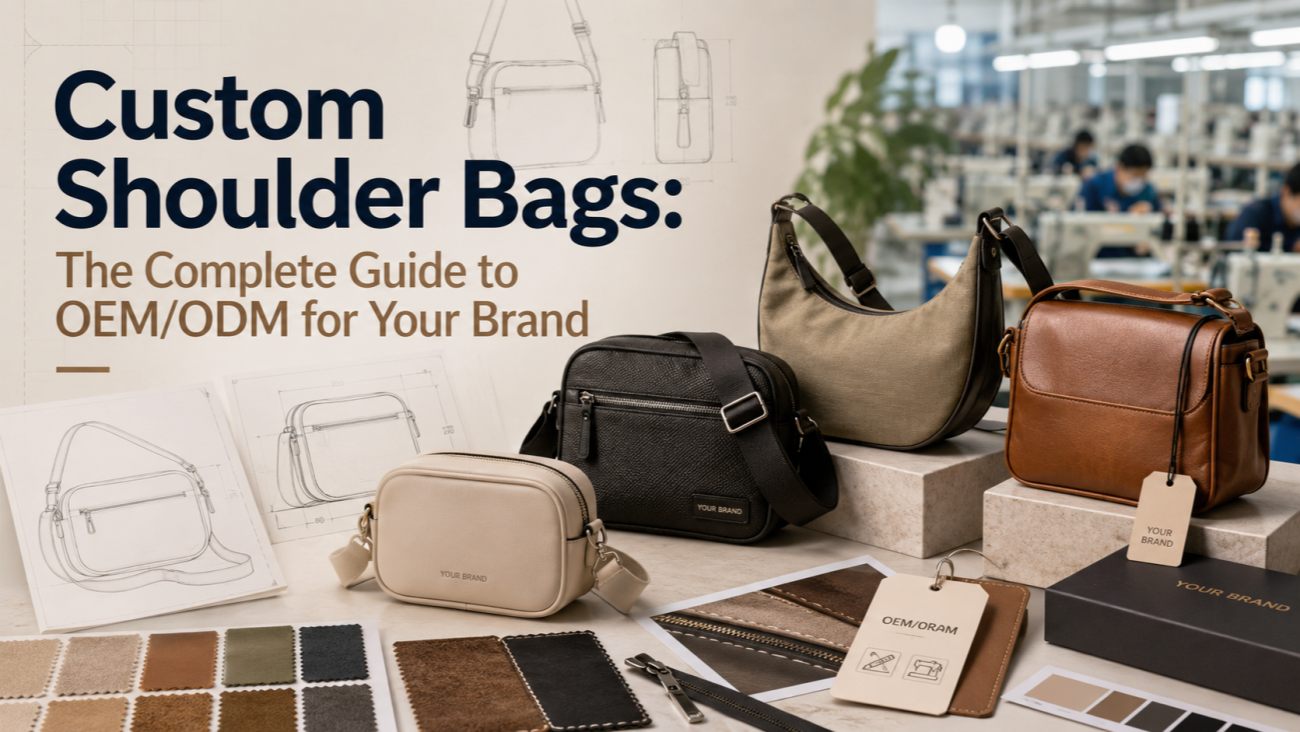
Custom Shoulder Bags: The Complete Guide to OEM/ODM for Your Brand
The global shoulder bag market continues to grow as fashion brands, lifestyle labels, and e-commerce businesses seek differentiated products that stand out in a crowded marketplace. Whether you are a startup brand launching your first collection or an established retailer expanding your product line, custom shoulder bags manufactured through OEM or ODM partnerships offer a proven path to market differentiation without the overhead of building your own production facility.
This guide walks you through every stage of the custom shoulder bag manufacturing process—from understanding OEM versus ODM models, through material selection, prototyping, production, quality control, and logistics. By the end, you will have a clear roadmap for bringing your custom shoulder bag designs to market with confidence.
OEM vs. ODM: Which Model Fits Your Brand?
Before diving into production, you need to decide between two fundamental manufacturing models. Your choice here will affect every subsequent decision, from design flexibility to cost structure and timeline.
OEM (Original Equipment Manufacturing)
In an OEM arrangement, you provide the complete design specifications—including sketches, tech packs, material specifications, and hardware details—and the manufacturer produces exactly what you specify. This model offers maximum creative control and is ideal for established brands with dedicated design teams. However, it typically requires higher minimum order quantities (MOQs) and longer development lead times due to the need for custom tooling and molds.
ODM (Original Design Manufacturing)
With ODM, you select from the manufacturer’s existing designs and customize them with your branding, colors, and minor modifications. This model is faster and more cost-effective, making it ideal for startups, e-commerce brands, and businesses testing new markets. Most ODM partners offer stock designs that can be personalized with custom logos, hardware, and packaging within 3-5 weeks.
| Factor | OEM | ODM |
|---|---|---|
| Design Control | Full (your design, your specs) | Limited (modify existing designs) |
| MOQ | 500-1000+ pcs per design | 50-200 pcs per design |
| Lead Time | 40-60 days (incl. tooling) | 25-35 days |
| Unit Cost | Lower at scale (amortized tooling) | Slightly higher per unit |
| Best For | Brands with unique designs | Testing markets, quick launches |
Many brands start with ODM to validate their market and transition to OEM as they grow. A purse manufacturing MOQ guide can help you understand which MOQ thresholds apply to your specific customization needs.
The Design & Development Process
Once you have chosen your manufacturing model, the next step is translating your vision into a producible design. This stage typically involves five phases:
- Concept & Brief: Define your target customer, price point, intended use, and aesthetic direction. Reference images, competitor products, and material swatches are invaluable here.
- Technical Drawing: Your manufacturer will create a CAD (Computer-Aided Design) or hand-drawn technical flat sketch showing all dimensions, seam lines, pocket placements, and hardware positions.
- Tech Pack Creation: A comprehensive tech pack includes construction details, material specifications, stitching requirements, hardware placements, labeling instructions, and packaging requirements. This document serves as the blueprint for production.
- Material Identification: Your manufacturer sources material options based on your requirements and budget, providing swatches for your approval.
- Costing & Quotation: Based on the finalized design and materials, the manufacturer provides a detailed cost breakdown including material costs, labor, tooling fees, and MOQ.
The entire design and development phase typically takes 1-3 weeks, depending on the complexity of your design and how clearly you communicate your requirements.
Material Selection: PU, Leather, Nylon & More
Material selection is arguably the most impactful decision in custom shoulder bag production. It determines the bag’s appearance, durability, cost, and perceived value. Here are the most common options:
PU Leather (Polyurethane)
The most popular choice for mid-market shoulder bags. PU leather offers excellent value, consistent texture, and easy maintenance. It is available in various finishes including smooth, pebble grain, croco embossed, and metallic. For brands seeking vegan leather options, our comparison of PU vs. microfiber leather provides detailed guidance on selecting the right material for your price point and performance requirements.
Genuine Leather
Full-grain and top-grain leather offer unmatched durability and premium appeal. Leather bags command higher retail prices and develop a unique patina over time. However, genuine leather requires higher MOQs (typically 100-300 pcs), longer production times, and more rigorous quality control due to natural material variations.
Nylon & Polyester
Lightweight, water-resistant, and durable—nylon and polyester are ideal for casual, sporty, and travel-oriented shoulder bags. These materials are cost-effective, offer excellent color consistency, and are compatible with custom printing and embroidery.
Canvas & Cotton
Popular for casual and eco-conscious brands. Canvas shoulder bags offer a natural, textured aesthetic and can be customized with screen printing, embroidery, or patchwork. Organic cotton options appeal to sustainability-focused buyers.
| Material | Cost Level | Durability | MOQ | Best For |
|---|---|---|---|---|
| PU Leather | $$ | Good | 50-200 pcs | Mid-market fashion bags |
| Genuine Leather | $$$$ | Excellent | 100-300 pcs | Premium/luxury brands |
| Nylon/Polyester | $ | Very Good | 50-100 pcs | Sporty/travel bags |
| Canvas/Cotton | $$ | Good | 100-500 pcs | Casual/eco-friendly bags |
Prototyping & Sampling
Before committing to full production, every custom shoulder bag project requires a sampling phase. This critical step ensures that your design translates correctly into a physical product and allows you to make adjustments before mass production begins.
There are typically three sample stages:
- Sample Type 1 – Development Sample (Dvlp Sample): The first physical prototype based on your tech pack. Focuses on confirming silhouette, proportions, and construction feasibility.
- Sample Type 2 – Photo Sample: Refined sample with correct materials and hardware. Used for product photography, marketing materials, and internal buy-in.
- Sample Type 3 – Approval Sample (Gold Seal Sample): The final pre-production sample that must be approved before mass production begins. This sample should match the production quality exactly.
Sampling typically takes 7-15 days per round, and most projects require 1-2 rounds of sampling before approval. Some manufacturers charge a sample fee that is refundable upon placing the bulk order.
Mass Production & Quality Control
Once your final sample is approved, mass production begins. A reliable manufacturer will have a structured quality control (QC) process in place throughout production:
- Incoming QC (IQC): Inspection of all raw materials and components upon arrival at the factory. This ensures that fabrics, hardware, linings, and trims meet your approved specifications.
- In-Process QC (IPQC): Ongoing inspection during cutting, sewing, and assembly. Key checkpoints include stitch density, seam alignment, hardware installation, and pocket dimensions.
- Final Random Inspection (FRI): Statistical sampling of finished products (typically AQL 2.5 or 4.0 standard) to verify overall quality, functionality, and appearance before shipment.
- Pre-Shipment Inspection (PSI): Final check of packed goods, including packaging integrity, labeling accuracy, and carton markings.
For established manufacturers like Lilalila Bags, our custom shoulder bag product page demonstrates the quality standards achievable through a structured QC process with multi-stage inspection protocols.
Packaging & Logistics
Custom packaging enhances your brand experience and protects products during transit. Common packaging options for shoulder bags include:
- Individual Dust Bags: Non-woven or cotton dust bags with your brand logo printed or debossed.
- Poly Bags: Cost-effective clear or opaque poly bags for basic protection.
- Branded Boxes: Premium rigid gift boxes for retail-ready presentation.
- Bulk Carton Packaging: Export-standard corrugated cartons with inner dividers for wholesale shipments.
Shipping methods vary by order size and urgency:
- Express (DHL/FedEx/UPS): 5-8 days. Best for samples and small orders under 50kg.
- Air Freight: 7-12 days. Cost-effective for orders between 50-500kg.
- Sea Freight (LCL/FCL): 25-35 days. The most economical choice for bulk orders over 1 cubic meter.
Cost Structure & Timeline
Understanding the full cost breakdown helps you budget accurately and avoid surprises. Here is a typical cost structure for custom shoulder bag production:
| Cost Component | Typical Range | Notes |
|---|---|---|
| Sample Fee | $50 – $200 | Often refundable with bulk order |
| Tooling/Mold Fee | $100 – $500 | Required for OEM custom shapes |
| Unit Cost (PU) | $5 – $15 | Depends on complexity & quantity |
| Unit Cost (Leather) | $15 – $40 | Higher material & labor cost |
| Custom Packaging | $0.50 – $5/unit | Dust bags, boxes, tags |
| Shipping | Varies | Express/air/sea depending on volume |
Typical timeline from start to delivery:
- Design & Development: 1-3 weeks
- Sampling: 2-4 weeks (1-2 rounds)
- Mass Production: 3-5 weeks
- Shipping: 1-5 weeks (depending on method)
- Total: 8-14 weeks
How to Choose the Right Manufacturer
Selecting the right manufacturing partner is the single most important decision in your custom shoulder bag project. Here are the key evaluation criteria:
- Specialization: Does the manufacturer specialize in the type of bag you need? A factory focused on shoulder bags will have the right machinery, skilled workers, and material sourcing networks.
- MOQ Flexibility: Can they accommodate your order volume? If you are a smaller brand, look for manufacturers offering flexible MOQs of 50-200 pieces per design.
- Communication & Responsiveness: How quickly do they reply to inquiries? Do they ask clarifying questions about your project? Clear communication prevents costly mistakes.
- Quality Certifications: Look for factories with ISO 9001, BSCI, or other relevant certifications that demonstrate commitment to quality and ethical manufacturing.
- Client Portfolio: A manufacturer with experience serving international brands and wholesalers is more likely to understand export requirements, compliance standards, and global market trends.
- Sample Quality: The quality of their initial samples is the best indicator of production quality. Never skip the sampling phase.
Frequently Asked Questions
What is the minimum order quantity (MOQ) for custom shoulder bags?
MOQs vary widely depending on the manufacturer and the level of customization. For ODM orders (modifying existing designs), MOQs typically range from 50-200 pieces per design. For full OEM orders with custom tooling, MOQs may start at 500 pieces. Review our detailed purse manufacturing MOQ guide for specific thresholds by material and style.
How long does it take to manufacture custom shoulder bags?
A typical project timeline is 8-14 weeks from design approval to delivery. This includes 1-3 weeks for design, 2-4 weeks for sampling, 3-5 weeks for production, and 1-5 weeks for shipping depending on the method selected.
Can I use my own materials for production?
Yes, many manufacturers accept customer-supplied materials (called “free issue materials” or “consignment materials”). However, they will need to test your materials for compatibility with their production processes. Note that using customer-supplied materials may void certain quality guarantees, and you will be responsible for any material defects.
Can I get custom hardware with my logo?
Absolutely. Custom hardware—including engraved logo plates, embossed zipper pulls, custom rivets, and branded magnetic snaps—is one of the most effective ways to elevate your product’s perceived value. Custom hardware typically requires a tooling mold fee of $100-$300 per design.
Conclusion
Bringing a custom shoulder bag to market through OEM or ODM manufacturing is a structured but rewarding process. By understanding each stage—from design and material selection through prototyping, production, and logistics—you can make informed decisions that protect your investment and deliver products your customers will love.
The key takeaways are simple: start with a clear design brief, choose materials that align with your brand positioning, never skip the sampling phase, and partner with a manufacturer whose capabilities match your needs.
Whether you are launching your first collection or expanding an existing product line, custom shoulder bags offer a scalable path to market differentiation in a growing global category.
Ready to start your custom shoulder bag project?
Contact our team for a free consultation. We offer OEM/ODM services with MOQ as low as 50 pcs, in-house design support, and factory-direct pricing.
Email: lilalilan8@aliyun.com |
Phone: +86 19180670556
Jinniu District, Chengdu, China
Related resources: