Estimated reading time: 9 minutes
Travel bags are one of the most demanding bag categories to manufacture. They need to be lightweight enough to carry, durable enough to survive airport handling, water-resistant enough to protect their contents, and organized enough to make packing and unpacking easy. Getting all four right requires careful decisions at every stage — from the material you choose to the QC tests you run before shipment.
If you are a brand owner or product developer planning a custom travel bag line, this guide walks through the full manufacturing process in seven steps. We cover material selection, design features that matter, how to evaluate a travel bag factory, the sampling timeline, QC standards specific to travel bags, and the cost breakdown you can expect.
If you are newer to bag manufacturing, start with our step-by-step guide to starting a handbag brand — the same principles apply to travel bags.
Table of Contents
- What Is a Custom Travel Bag?
- Step 1: Choose Your Bag Type & Target Market
- Step 2: Select the Right Materials for Travel Bags
- Step 3: Design for Travel — Features That Matter
- Step 4: Work with a Travel Bag Manufacturer
- Step 5: Sampling & Production Timeline
- Step 6: Quality Control for Travel Bags
- Step 7: Cost Breakdown, Packaging & Shipping
- Conclusion — Start Your Project
- References
What Is a Custom Travel Bag?
A custom travel bag is any bag designed specifically for travel — ranging from a weekend duffel to a wheeled carry-on to a travel backpack — manufactured to a brand’s specifications for materials, dimensions, features, logo, and packaging.
Travel bags sit in a different category from everyday handbags or backpacks. They are judged by different criteria: weight, water resistance, packing efficiency, durability under load, and how well they hold up after being checked, tossed, stacked, and stuffed into overhead bins. These requirements affect every manufacturing decision, from the denier of the fabric to the type of zipper used.
The travel bag market has grown significantly as air travel rebounds and the “bleisure” (business + leisure) trend reshapes how people pack. More brands are entering the category, and wholesale buyers are looking for reliable manufacturing partners who understand the specific demands of travel bag production.
For a deeper look at where the market is heading, see our wholesale travel bag trends 2026 guide.
Step 1: Choose Your Travel Bag Type & Target Market
Before you choose a fabric or a factory, decide which type of travel bag you are making and who will buy it.
The main travel bag categories are:
| Category | Common Materials | Target Customer | Key Manufacturing Considerations |
|---|---|---|---|
| Duffel / Weekend Bag | Nylon, canvas, PU leather | Gym-goers, weekend travelers | Lightweight, foldable, water-resistant base |
| Rolling Luggage | Polyester, ABS/PC hard shell, aluminum frame | Business travelers, vacationers | Wheel + handle assembly, frame reinforcement |
| Travel Backpack | Nylon (420D–1000D), RPET | Backpackers, digital nomads | Ergonomic straps, laptop sleeve, weight distribution |
| Garment / Suit Bag | Polyester, nylon, felt | Business travelers | Wrinkle-resistant lining, hanger hook, fold design |
| Travel Tote / Carry-All | Canvas, nylon, PU leather | Female travelers, commuters | Sturdy handles, interior organization, laptop pocket |
Your target market determines the quality level. A travel bag for a budget airline passenger has different material and hardware requirements than one for a premium business traveler. Be clear on your price point before you start sourcing — it saves time and avoids mismatched expectations with your factory.
For a direct comparison between duffels and other travel bag types, see our travel bag vs duffel bag guide.
Step 2: Select the Right Materials for Travel Bags
Material choice is the single most important decision in travel bag manufacturing. The right fabric determines weight, durability, water resistance, and cost — and it must match your target customer’s expectations.
| Material | Weight | Water Resistance | Durability | Cost Index | Best For |
|---|---|---|---|---|---|
| Nylon 420D | Light | Good (with coating) | Medium-High | Low-Med | Day packs, lightweight duffels |
| Nylon 1000D (Cordura) | Medium | Good (with coating) | Very High | Medium-High | Tactical / heavy-use travel bags |
| Polyester 600D Oxford | Light-Med | Medium (coating needed) | Medium | Low | Budget travel bags, promotional |
| Canvas (14–18 oz) | Heavy | Low (waxed = Medium) | Very High | Medium | Classic duffels, heritage styles |
| PU Leather | Medium | Good | Medium | Low-Med | Fashion travel bags, carry-alls |
| RPET (Recycled) | Light-Med | Medium (coating needed) | Medium | Medium | Eco-branded travel lines |
Our experience: For a first travel bag order, nylon 420D with a PU coating is the safest starting point. It is light enough to meet airline weight limits, durable enough for regular travel use, and cost-effective at MOQ of 300–600 pieces. Upgrading to 1000D Cordura makes sense if your travel bag is positioned as heavy-duty / outdoor. For a detailed comparison of travel bag materials, see our travel bag materials compared guide.
Step 3: Design for Travel — Features That Matter
Travel bag design is about solving real problems: how to pack more in less space, how to keep things organized, and how to make the bag easy to carry in different situations.
Here are the design features that add the most value to a travel bag:
- TSA-friendly laptop compartment. A padded sleeve that opens flat for airport security — this feature alone can justify a higher price point for business travelers.
- Hidden passport / phone pocket. A flat zippered pocket on the back panel that is accessible while wearing the bag. Small detail, big perceived value.
- Shoe or wet pocket separation. A waterproof-lined compartment at the bottom or side for dirty shoes or wet clothes. This is expected in any travel duffel over $80 retail.
- Compression straps. Internal or external straps that reduce bag volume when it is not full. Keeps the bag looking neat and makes packing more efficient.
- Detachable shoulder strap with padded pad. The strap quality is one of the first things a customer notices. A cheap, thin strap makes a well-made bag feel cheap.
A good practice is to design for your packer, not for the shelf. The features that look good in a product photo (extra buckles, complex zipper lines) often add cost without improving the travel experience. Focus on the ones listed above — they are proven to matter to travelers.
Step 4: Work with a Travel Bag Manufacturer
Not every bag factory is equipped to make travel bags well. The key difference is experience with the specific materials, hardware, and QC standards that travel bags require.
When evaluating a travel bag manufacturer, ask these questions:
- Have you made travel bags, duffels, or luggage before? Ask for photos of similar products.
- Do you work with nylon, polyester, and waterproof coatings? Some factories focus on leather and struggle with synthetic materials.
- Can you source YKK or branded zippers? Travel bags go through more zipper cycles than any other bag type — a quality zipper is non-negotiable.
- Do you offer PU coating or DWR treatment on fabric? Water resistance is a core requirement for travel bags.
- What is your MOQ per style? Travel bags with custom prints or coatings may require higher MOQ than standard designs.
One thing we see often: Buyers choose a factory based on a single sample, then discover during bulk production that the factory cannot handle the volume or maintain stitch consistency across 500 units. Before committing, ask for references from other travel bag brands the factory has worked with, and if possible, visit the factory or arrange a video walkthrough.
For a complete evaluation checklist, see our 9 things to check before choosing a travel bag manufacturer.
OEM vs ODM for Travel Bags
OEM — You provide the complete design and tech pack. Best if you have a unique travel bag concept or established brand identity.
ODM — You select from the factory’s existing travel bag designs and customize materials, color, and logo. Best for first-time buyers who want to test the market at lower cost and faster speed. Many successful travel bag brands started with ODM and added OEM designs in their second or third production run.
For a full comparison of both models, see our OEM vs ODM guide for custom handbags (the same principles apply to travel bags).
Step 5: Sampling & Production Timeline
Sampling for a travel bag follows the same process as other bag types, but the timeline can be longer due to the complexity of features like padding, zipper routing, and waterproofing.
Here is what a typical timeline looks like:
| Stage | Duration | What Happens |
|---|---|---|
| Design & tech pack review | 3–5 days | Factory reviews your design and suggests adjustments for manufacturability |
| First sample (A sample) | 10–15 days | Factory produces a physical prototype based on your specs |
| Sample revision (B sample) | 5–7 days | Adjustments to size, pocket placement, strap length, zipper position |
| Sample approval | — | You sign off on the “golden sample” that bulk production will match |
| Bulk production | 30–45 days | Material cutting, assembly, stitching, hardware installation, QC |
| Pre-shipment inspection | 3–5 days | Final QC check on finished bags before packing |
| Shipping | 15–30 days (sea) | Depends on destination and shipping method |
| Total (sample → delivery) | 10–12 weeks | Plan at least 3 months from initial inquiry to receiving your order |
For a step-by-step breakdown of the sampling process across different bag types, see our custom handbag sample process guide.
Step 6: Quality Control for Travel Bags
Travel bags face more stress than almost any other bag type. They are overstuffed, dropped, tossed into overhead bins, checked in as luggage, and exposed to rain and humidity. The QC standards must reflect this.
Here are the QC tests that matter specifically for travel bags:
- Zipper cycle test. The main compartment zipper should survive 5,000+ open-close cycles without failure. Request the factory to test 3–5 samples from the production batch.
- Strap pull test. Attach the strap to a fixed point and load with 3× the expected carry weight for 60 seconds. No stitch elongation or hardware deformation should occur.
- Water resistance test. Spray the bag surface with water at a 45° angle for 30 seconds. Check for water penetration inside. For fully waterproof bags, a submersion test may be required.
- Drop test. For rolling luggage, a 10 cm edge drop test on each corner. For duffels and backpacks, a 50 cm shoulder drop onto concrete.
- Hardware salt spray test. Expose zippers, buckles, and D-rings to salt spray for 24–48 hours (simulating years of use). Check for rust or corrosion — this is especially important for bags sold in coastal or humid markets.
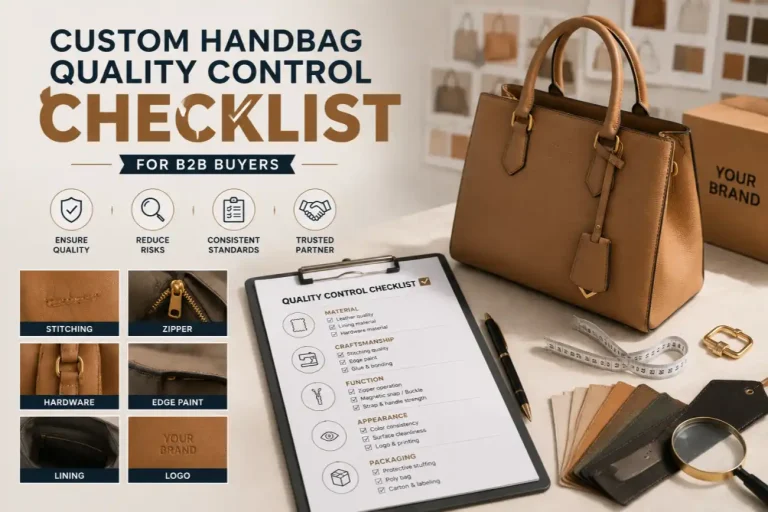
For the full QC framework that applies across all bag types, see our custom handbag quality control checklist. Adapt the material-specific tests to travel bag materials (nylon/polyester) rather than leather.
Step 7: Cost Breakdown, Packaging & Shipping
Understanding where the cost of a travel bag comes from helps you make better decisions about where to invest and where to save.
| Cost Component | Typical % of FOB Price | Notes |
|---|---|---|
| Materials (fabric, lining, hardware, thread) | 35–45% | Fabric + coating is the largest single line item |
| Labor (cutting, stitching, assembly) | 25–35% | Higher for complex designs with many pockets/features |
| Hardware (zippers, buckles, D-rings, wheels) | 8–12% | Quality zippers (YKK) add cost but reduce QC failures |
| Packaging (polybag, box, labels, tags) | 5–8% | Custom packaging adds 2–3% more |
| Overhead, QC & margin | 10–15% | Includes factory management, testing, certification |
Estimated FOB pricing for a standard nylon duffel (300–500 pieces): $15–$25 per piece for a mid-spec bag with 420D nylon, PU coating, YKK zippers, basic lining, and one-color logo (screen print or woven label). For a premium version with 1000D Cordura, custom lining, metal hardware, and embossed logo, expect $25–$40 per piece.
Packaging: Each travel bag should be packed in a polybag, then in a standard export carton (5–10 bags per carton depending on size). Custom-branded cartons are an option but require higher MOQ. Include desiccant packets for moisture control during sea freight.
Compliance: For EU markets, travel bags require REACH compliance for dyes and coatings (especially if the bag has printed patterns or colored zippers). For US markets, CPSIA compliance is required for children’s travel bags. Always ask your factory for compliance documentation before production begins.
Shipping: Sea freight is the most cost-effective for bulk orders (20–30 days transit). Air freight is faster (5–7 days) but 3–5× more expensive. Express courier (DHL/FedEx) works for urgent small orders or sample shipments.
Conclusion — Start Your Custom Travel Bag Project
Custom travel bag manufacturing follows the same basic process as other bag types, but the requirements are higher — better materials, stronger hardware, more rigorous QC, and design features that solve real travel problems. The brands that succeed in this category are the ones that invest in getting these details right from the start.
Here is where to start:
1. Decide which travel bag type fits your brand and target price point.
2. Choose your primary material — nylon 420D or 600D polyester are safe starting points.
3. Send an inquiry to 2–3 factories with your bag type, target quantity, and material preference.
Ready to develop your custom travel bag? Contact us with your requirements, and we will provide material recommendations and a sampling timeline based on your specific project.
References
- McKinsey — The State of Fashion Report 2026 — Industry analysis of the global travel and luggage market, including material trends and supply chain best practices for travel bag manufacturing.
- Statista — Luggage & Travel Bag Market Data — Market sizing data on travel bag segments including duffels, rolling luggage, and travel backpacks across global markets.
- YKK — Zipper Technical Specifications — Technical standards for zipper quality and cycle testing used by professional bag manufacturers in travel bag production.
- ISO 9001:2015 — Quality Management Systems — International quality management standard used by certified bag manufacturers for consistent production and QC processes.
- Intertek — Travel Goods & Luggage Testing Services — Third-party testing standards for travel bag durability, water resistance, and hardware reliability used by global brands.