Estimated Reading Time: 7 minutes
Should you choose genuine leather or PU leather for your handbag line? This is one of the most common questions we hear from brand owners and wholesale buyers — and the answer is rarely straightforward. The right choice depends on your target price point, brand positioning, customer expectations, and order volume. In this guide, we break down the real differences between genuine leather and PU leather so you can make a sourcing decision that fits your business.
H2-1: What Is Genuine Leather? What Is PU Leather?
Before comparing, let us first define each material clearly from a manufacturing perspective.
| Material | What It Is | How It Is Made | Common Applications |
|---|---|---|---|
| Genuine Leather | Real animal hide, typically cowhide, from the lower split layers | Split from top grain, then processed, dyed, and embossed with a artificial grain pattern | Mass-market handbags, belts, wallets, entry-level leather goods |
| PU Leather | Synthetic material made of a polyurethane coating on a fabric base (polyester or cotton) | PU resin is applied to a knitted or woven base fabric, then finished with texture and color | Fashion handbags, vegan bags, budget-to-mid-range accessories |
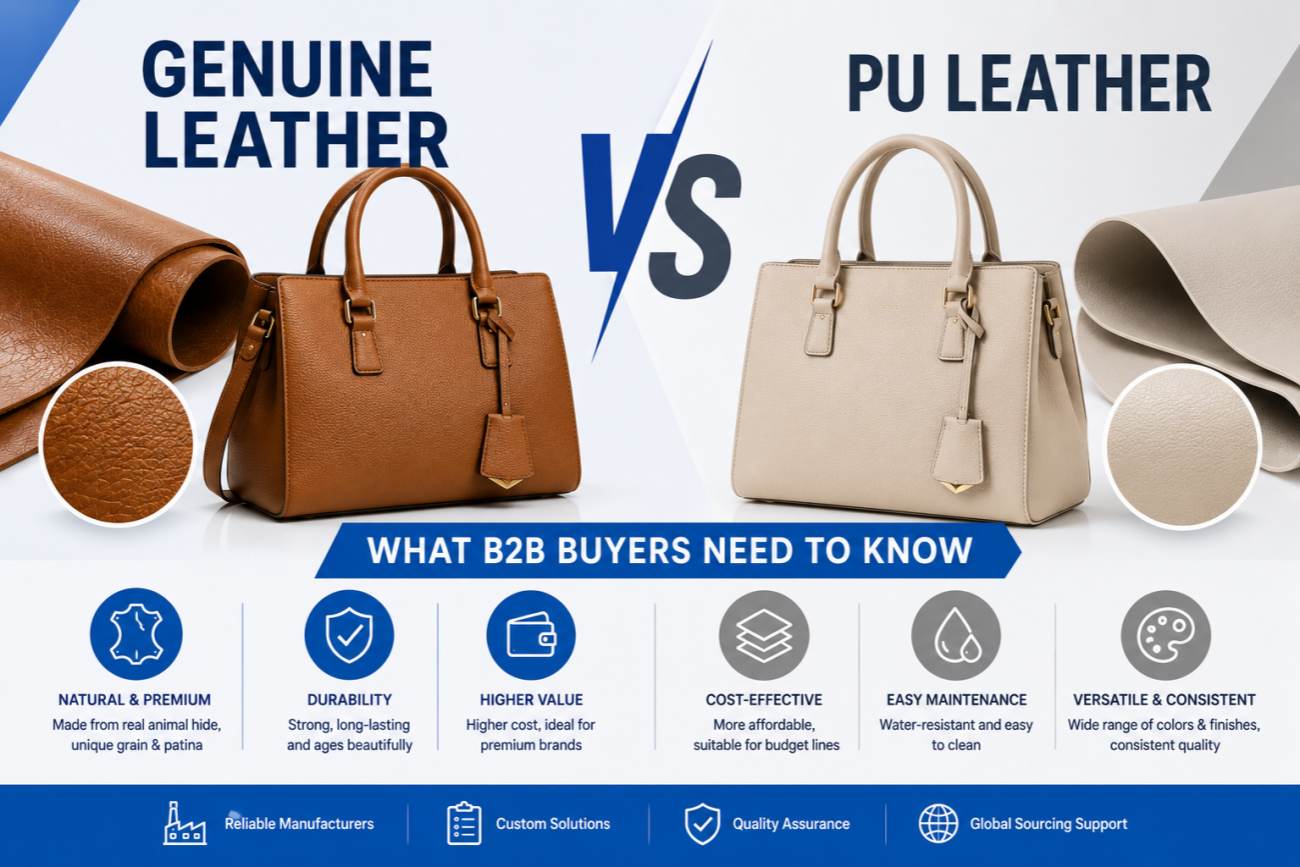
Genuine leather is a real animal product. It comes from the lower layers of the hide after the top grain layer has been removed. It is more affordable than full grain or top grain leather, but it is also less durable because the natural fiber structure has been disrupted. The surface is usually buffed and coated to create a uniform appearance.
PU leather, short for polyurethane leather, is entirely synthetic. A layer of PU resin is applied to a fabric base to create a material that mimics the look and feel of real leather. High-grade PU leather can feel surprisingly close to genuine leather, while lower grades are stiffer and more plastic-like.
H2-2: Genuine Leather vs PU Leather — 7 Key Differences Compared
Here is the most detailed comparison you will find from a manufacturer’s perspective. These seven factors directly affect your product cost, quality, and customer satisfaction.
| Factor | Genuine Leather | PU Leather | Why It Matters for B2B Buyers |
|---|---|---|---|
| 1. Material Origin | Animal hide (by-product of meat industry) | Synthetic polymers + fabric base | Impacts brand storytelling and labeling requirements |
| 2. Durability | 2–4 years with proper care | 1–3 years depending on grade | Affects warranty claims and brand reputation |
| 3. Appearance | Natural grain with slight variations | Uniform, consistent finish | Genuine leather = unique character; PU = predictable repeatability |
| 4. Consistency | Visible variations between hides and batches | Highly consistent batch to batch | Critical for large orders — PU offers uniformity; genuine leather requires tighter QC |
| 5. Breathability | Good (natural pores allow air circulation) | Low (synthetic surface traps heat) | Important for handbags that contact skin (tote handles, crossbody straps) |
| 6. Water Resistance | Poor — absorbs moisture, can stain | Good — water beads on the surface | Relevant for commuter bags, travel handbags, and outdoor use |
| 7. FOB Cost per Bag | $12–$30+ (material + labor) | $5–$15 (material + labor) | The single biggest factor in your margin calculation |
Many buyers focus on the material name first — genuine leather “sounds better” to end consumers. But from what we see in bulk production, the actual performance of high-grade PU leather can match or even exceed entry-level genuine leather in certain areas like water resistance and color consistency.
H2-3: Cost Breakdown — How Material Choice Affects Your FOB Price
To make this practical, let us look at a real scenario. Imagine you are sourcing a medium-sized tote bag in a quantity of 1,000 pieces. Here is how the FOB cost compares:
| Cost Component | Genuine Leather Version | PU Leather Version |
|---|---|---|
| Material cost per bag | $8–$18 | $3–$8 |
| Cutting & labor | $4–$7 (hide sorting + cutting) | $2–$4 (roll cutting, less waste) |
| Hardware & lining | $2–$5 | $2–$5 |
| Packaging | $1–$2 (dust bag recommended) | $0.50–$1.50 |
| Estimated FOB per bag | $15–$32 | $7.50–$18.50 |
One common mistake we see is brands choosing genuine leather for a product that needs to retail under $80. After accounting for wholesale markup (typically 2x–2.5x of FOB) and retail markup (2x–3x of wholesale), the margin simply is not there with genuine leather at that price point. PU leather, on the other hand, allows comfortable margins at the same retail price.
For wholesale orders, we usually suggest calculating your FOB target first, then working backward to determine which material fits. As a general rule of thumb, if your target FOB is under $12 per bag, PU leather is the more realistic option.
H2-4: Which One Should You Choose? A Decision Framework for Brands
Here is a simple way to decide, based on three common scenarios we see with our clients:
Scenario A: Entry-Level Brand (Retail $40–$80)
Choose PU leather. At this price range, genuine leather would either squeeze your margin or force your retail price too high. High-grade PU leather offers good quality and consistent color matching across production runs. A reliable manufacturer will offer PU with good abrasion resistance and a soft hand feel that surprises customers.
Scenario B: Mid-Market Brand (Retail $80–$150)
You have options. If your brand story is built around natural materials and craftsmanship, genuine leather adds authenticity that justifies the price. If your brand focuses on modern design, color variety, and cruelty-free values, high-grade PU leather is actually the better alignment. Both can work at this price point.
Scenario C: Premium Brand (Retail $150+)
Genuine leather is the expected choice. Customers paying over $150 expect natural material characteristics — the unique grain, the patina development, the smell of real leather. That said, we have seen successful premium brands use microfiber PU leather (ultra-high-grade PU) positioned as a “vegan luxury” alternative.
What this means for you as a buyer: do not think of this as “genuine is good, PU is cheap.” Think of it as two different tools for different jobs. Match the material to your brand positioning, not the other way around.
H2-5: How to Source Handbags in Genuine Leather or PU — Practical Tips
Whether you choose genuine leather or PU, the sourcing process has some important differences. Here is what to watch for:
| Sourcing Factor | Genuine Leather | PU Leather |
|---|---|---|
| Sample accuracy | Sample may differ slightly from bulk — natural hide variation | Sample matches bulk very closely — synthetic consistency |
| Lead time | Longer (4–6 weeks) — hide sourcing + sorting adds time | Shorter (3–4 weeks) — PU rolls are stock items |
| Color matching | ±5% variation accepted industry-wide | Within ±1% — highly repeatable |
| MOQ | Higher (500–1,000 pcs per color typically) | Lower (300–500 pcs per color) |
| QC focus | Check for surface defects, grain inconsistency, color variation | Check for peeling resistance, flex cracking at corners |
If you are ordering for the first time, we recommend asking your manufacturer for a material sample card with both genuine leather and PU options in your target colors. Seeing and touching the materials side by side will make your decision far easier than reading spec sheets. For a broader overview of OEM handbag production, see our complete leather materials guide.
Before confirming the sample, make sure you and your supplier agree on the QC standards. Organizations like SATRA provide standardized test methods for flex resistance, color fastness, and adhesion strength — referencing these standards during sample approval prevents disputes later.
Conclusion: Make the Right Choice for Your Handbag Line
There is no universal “better” material between genuine leather and PU leather. Genuine leather offers natural character and a premium story, but comes with higher cost, longer lead times, and material inconsistency. PU leather offers affordability, consistency, and design flexibility, but may not carry the same perceived value with certain customer segments.
The brands that succeed are the ones that match their material choice to their target market — not the ones that pick a material first and try to fit their brand around it. If you are planning a new handbag collection and would like material recommendations tailored to your price point and brand positioning, reach out to us. We can provide comparative samples and FOB quotes for both genuine and PU leather options.