Estimated reading time: 9 minutes
Material choice is the single most important decision in any custom gym bag project. It determines how much the bag weighs, how long it lasts, how well it handles sweat and rain, which logo methods are available, and ultimately how much it costs to produce. But here is what many first-time buyers miss: the best gym bag material for your brand depends on your target price point, the bag silhouette, and your customer’s expected usage pattern — not on which fabric sounds toughest on paper.
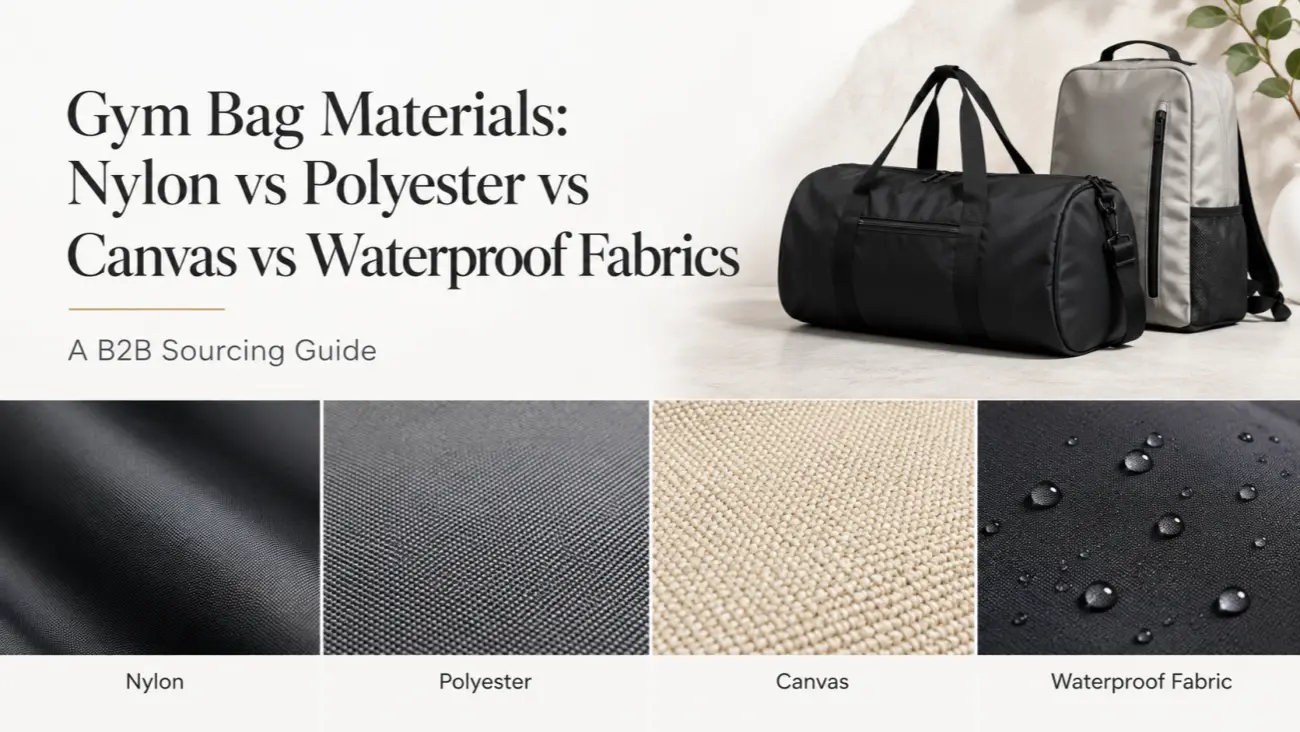
This guide compares four of the most common materials used in custom gym bag manufacturing — nylon, polyester, canvas, and waterproof fabrics — from a B2B sourcing perspective. For each one, we cover real performance data, cost range, MOQ, logo compatibility, and which bag types each material suits best.
Table of Contents
- Why Material Choice Matters for Custom Gym Bags
- Nylon — The Most Popular Gym Bag Fabric
- Polyester — The Cost-Effective Alternative
- Canvas — The Retro and Structured Option
- Waterproof Fabrics and Water-Resistant Technologies
- How Material Choice Affects Logo and Branding Options
- Material Decision Matrix — Which Fabric for Which Gym Bag Style
- Conclusion — Choose the Right Material for Your Custom Gym Bag
- References
Why Material Choice Matters for Custom Gym Bags
Material choice is not about aesthetics — it is a supply chain decision that affects every stage of your order, from sampling cost to shipping weight.
In our experience working with gym bag buyers, many start by picking a material based on what they think looks best, then discover later that it limits their logo options or pushes the unit cost above their retail target. A nylon gym bag costs roughly 20–30% more than an equivalent polyester bag in the same denier, but it also lasts longer and supports a wider range of logo methods. Canvas adds structure and a premium feel but increases shipping weight by 30–50% compared to synthetics. Waterproof fabrics solve a real customer need but add a production step (coating or lamination) that extends lead time by 5–7 days.
The right material for your brand is the one that balances these trade-offs against your target market. Below we walk through each option with the performance data and production realities you need to make that decision.
For a broader comparison of bag materials across different silhouettes, see our best materials for custom shoulder bags guide.
Nylon — The Most Popular Gym Bag Fabric
Nylon is the most widely used material in gym bag manufacturing for one reason: it offers the best balance of strength, weight, and water resistance.
Standard 600D nylon — the most common specification for gym duffels — withstands approximately 70 pounds of tensile force before tearing and survives over 100,000 abrasion cycles in lab tests (Martindale method). This makes it roughly 20–30% tougher than equivalent polyester, which tests at around 55 pounds and 60,000 cycles. For a bag that gets thrown into car trunks, dragged across locker room floors, and packed to capacity with gym gear, this durability margin matters.
Nylon is also naturally water-resistant. The fibers themselves absorb very little moisture, and most gym-grade nylon includes a DWR (durable water repellent) finish that causes water to bead and roll off the surface. This means a nylon bag can handle light rain, wet towels, and damp locker room floors without soaking through — a feature that gym bag customers consistently rank as their top priority.
Nylon Grades for Gym Bags — 420D, 600D, and 1680D
Not all nylon is the same. The denier (D) number tells you the thread thickness, and choosing the right grade for your bag type is critical.
- 420D nylon — Lightweight and packable. Suitable for gym sling bags, small drawstring bags, and foldable travel gym bags. The lightest option but also the least abrasion-resistant. Best for entry-level or promotional gym bags.
- 600D nylon — The industry standard for mid-range gym duffels. Balanced weight-to-strength ratio. What most gym bag OEM orders specify by default. This is what we recommend for first-time gym bag buyers.
- 1680D ballistic nylon — The heaviest and most durable. Originally developed for military body armor. Used in premium gym bags, heavy-duty team sports bags, and bag bottoms that need extra abrasion resistance. Adds noticeable weight and cost.
From what we see in bulk production, 600D nylon covers about 70% of gym bag orders. If you are ordering for the first time, 600D is the safest starting point. You can always upgrade to ballistic nylon on the bottom panel for added durability without increasing the cost of the whole bag.
Polyester — The Cost-Effective Alternative
Polyester is the most cost-efficient gym bag material. It costs roughly 20–30% less than nylon at equivalent denier and offers better UV resistance and color retention.
This makes polyester the preferred choice for promotional gym bags, budget-friendly product lines, and brands that need to hit a specific wholesale price point. 600D polyester Oxford fabric is the most common specification — it offers solid durability for daily gym use, holds color well even after repeated exposure to sunlight, and resists shrinking and stretching better than nylon.
The trade-off is that polyester is slightly less abrasion-resistant than nylon. In lab tests, 600D polyester Oxford shows visible wear after approximately 60,000 abrasion cycles compared to nylon’s 100,000+. For a gym bag that sees daily use, this means polyester bags may show surface wear 12–18 months sooner than equivalent nylon bags. However, for promotional gym bags, seasonal collections, or brands that refresh their product line annually, this lifespan difference is rarely an issue.
Polyester vs Nylon — Real Performance Data
Here is a quick comparison based on standard industry tests for 600D-grade materials:
| Property | 600D Nylon | 600D Polyester |
|---|---|---|
| Tensile strength | ~70 lbs | ~55 lbs |
| Abrasion resistance (Martindale) | 100,000+ cycles | ~60,000 cycles |
| UV resistance | Moderate (degrades faster in direct sun) | High (excellent color retention) |
| Water resistance (untreated) | Naturally higher (fibers absorb less) | Moderate (needs coating for performance) |
| Relative material cost | Baseline (1.0x) | ~0.7–0.8x |
| Best use | Daily-use gym bags, premium lines | Promotional bags, budget lines, seasonal products |
Many buyers focus on the cost difference first, but we usually suggest considering the customer’s expected usage frequency. If your target customer goes to the gym 5 times a week, nylon is the better long-term value. If the bag is a weekend-use or promotional item, polyester’s cost advantage makes more sense.
Canvas — The Retro and Structured Option
Canvas gym bags target a smaller but dedicated market segment – customers who prefer a traditional look, a well-designed shape, and products made from natural materials.
Canvas is significantly heavier than nylon or polyester. A standard 12 oz cotton canvas weighs roughly 2.5 to 3 times more than 600D nylon per square yard. This weight gives canvas bags their characteristic structure and durability, but it also increases shipping costs and reduces packability. For wholesale orders, this weight difference can add $0.50–1.00 per unit in ocean freight alone.
Canvas’s natural cotton fibers are breathable, which helps reduce odor buildup compared to synthetics — a real advantage for gym bags. However, untreated canvas has poor water resistance. A canvas gym bag left on a wet locker room floor will absorb moisture rapidly. Many canvas gym bags address this with waxed finishes, which add water resistance but also add weight and require periodic re-waxing by the end user.
Before confirming the sample, make sure your factory understands that canvas requires heavier-duty sewing equipment. Standard industrial sewing machines can handle canvas, but the thread tension, needle size, and walking foot pressure all need adjustment. A common mistake we see is factories treating a canvas order like a polyester order and ending up with skipped stitches at the stress points.
Waterproof Fabrics and Water-Resistant Technologies
Waterproofing is not a single feature but a system. The fabric coating, seam construction, zipper type, and closure method all determine how water-resistant the finished bag is.
For gym bags, there are three common levels of moisture protection:
- Water-resistant (DWR coating) — A chemical treatment applied to the fabric surface that causes water to bead and roll off. Suitable for light rain, sweat towels, and occasional spills. This is the standard on most nylon and polyester gym bags. DWR is the lightest option and adds minimal cost (typically $0.10–0.30 per bag). The trade-off is that DWR wears off over time and may need reapplication after 6–12 months of regular use.
- Waterproof coating (TPU or PVC lamination) — A continuous film of TPU or PVC bonded to the inner face of the fabric. This creates a true moisture barrier. TPU is the preferred choice for 2026 gym bags — it is more flexible at low temperatures, more environmentally friendly than PVC, and does not contain phthalates. A TPU-coated gym bag costs approximately $0.80–1.50 more per unit than a DWR-only version.
- Fully waterproof (welded seams + waterproof zippers) — Sealed construction where seams are welded rather than sewn, combined with water-resistant zippers (YKK AquaGuard or equivalent). This level is rare in standard gym bags but common in swim bags and adventure duffels. It adds significant cost ($2.00–4.00 per bag) and extends lead time by 5–7 days.
For most gym bag brands, the sweet spot is a DWR-coated exterior with a TPU-lined wet pocket for separating sweaty clothes and shoes. This combination gives you the best balance of cost and functionality. Our custom water-resistant gym bag with shoe compartment uses 600D polyester with a water-resistant coating and a separate shoe compartment — a practical example of this approach.
How Material Choice Affects Logo and Branding Options
Each material supports a different set of logo application methods, and choosing the wrong combination can ruin your brand presentation.
| Logo Method | Nylon | Polyester | Canvas | Waterproof Fabric |
|---|---|---|---|---|
| Heat transfer / sublimation | ✅ Excellent | ✅ Excellent | ⚠️ Moderate (fabric texture reduces sharpness) | ❌ Poor (coating prevents adhesion) |
| Embroidery | ⚠️ Moderate (fine weave can distort) | ⚠️ Moderate | ✅ Excellent (heavy fabric holds stitches) | ❌ Poor (coating cracks around needle holes) |
| Silicone / rubber patch | ✅ Excellent | ✅ Excellent | ✅ Good | ✅ Best option for coated fabrics |
| Metal nameplate / rivet | ⚠️ Needs reinforcement patch | ⚠️ Needs reinforcement patch | ✅ Good (thick fabric holds well) | ⚠️ Needs sealed rivets |
| Screen printing | ✅ Good | ✅ Good | ⚠️ Moderate (fabric texture can blur detail) | ❌ Poor (ink does not bond to coating) |
One common mistake we see is buyers choosing a waterproof fabric for a gym bag and then expecting vibrant screen-printed logos. The coating layer prevents ink from bonding to the fibers, and the print will peel within weeks. If you need a waterproof gym bag with a color logo, silicone patches or heat transfer on a fabric panel (designed into the bag) are the reliable routes.
Material Decision Matrix — Which Fabric for Which Gym Bag Style
The bag silhouette narrows your material options significantly. Here is a quick decision matrix based on what we see working in production:
| Gym Bag Style | Recommended Material | Why |
|---|---|---|
| Standard gym duffel (20–40L) | 600D Nylon or 600D Polyester Oxford | Best balance of weight, durability, and cost. Most MOQ-friendly. |
| Heavy-duty sports bag / team bag | 1680D Ballistic Nylon | Maximum abrasion resistance for team travel and equipment hauling. |
| Gym backpack / drawstring | 420D Nylon (lightweight) | Lightweight and packable. 420D is enough for lower-weight loads. |
| Heritage / retro gym bag | 12 oz Waxed Canvas | Structured look, natural feel. Appeals to lifestyle and vintage markets. |
| Swim bag / wet-dry bag | TPU-coated Polyester or Nylon | True moisture barrier needed. Welded seams recommended for full protection. |
| Premium / leather look gym bag | PU Leather or Microfiber Leather | Upscale appearance for lifestyle gym brands. Higher cost but higher retail margin. |
For context on how these material choices play out in real products, see which fabrics popular brands use. The Nike vs Adidas vs Under Armour gym bag comparison breaks down the material specifications behind their best-selling models — useful benchmarking when positioning your own product line.
Conclusion — Choose the Right Material for Your Custom Gym Bag
There is no single “best” gym bag material — only the best material for your specific price point, target customer, and bag silhouette.
If you are ordering for the first time, start with 600D nylon. It is the safest choice: durable enough for daily gym use, compatible with most logo methods, and well-understood by manufacturers, which means fewer sampling surprises. If your price target is aggressive, 600D polyester Oxford delivers 80% of the performance at 70% of the cost. If you are targeting a premium or heritage positioning, canvas adds real differentiation but comes with higher weight and production complexity.
This may sound like a small detail, but one of the most practical things you can do at the start of your order is request material sample swatches in 2–3 options before committing to one. A physical swatch tells you more about hand feel, stiffness, and color accuracy than any spec sheet.
Ready to start your custom gym bag project? Contact our team with your target specifications, and we will recommend the best material options for your production.
References
- Cordura Fabric Performance Guide — Industry reference for nylon fabric durability testing, including denier specs, abrasion resistance, and tensile strength data for 420D, 600D, and 1680D nylon grades.
- Understanding Fabric Performance Testing — Oecotextiles — Explains Martindale abrasion testing, tensile strength, and tear strength standards used in the bag and textile industry.
- Gym Bag Market Size Report — Grand View Research — Global gym bag market data showing market growth, material trends, and demand drivers relevant to OEM sourcing decisions.
- YKK Waterproof Zipper Guide — Technical specifications for water-resistant zipper types (AquaGuard) used in waterproof gym bag construction, including closure ratings and application guidelines.
- Polyester vs Nylon in Bag Manufacturing — iSpionage — Practical comparison of polyester and nylon performance in bag production, including cost analysis, durability testing, and applications in different bag types.