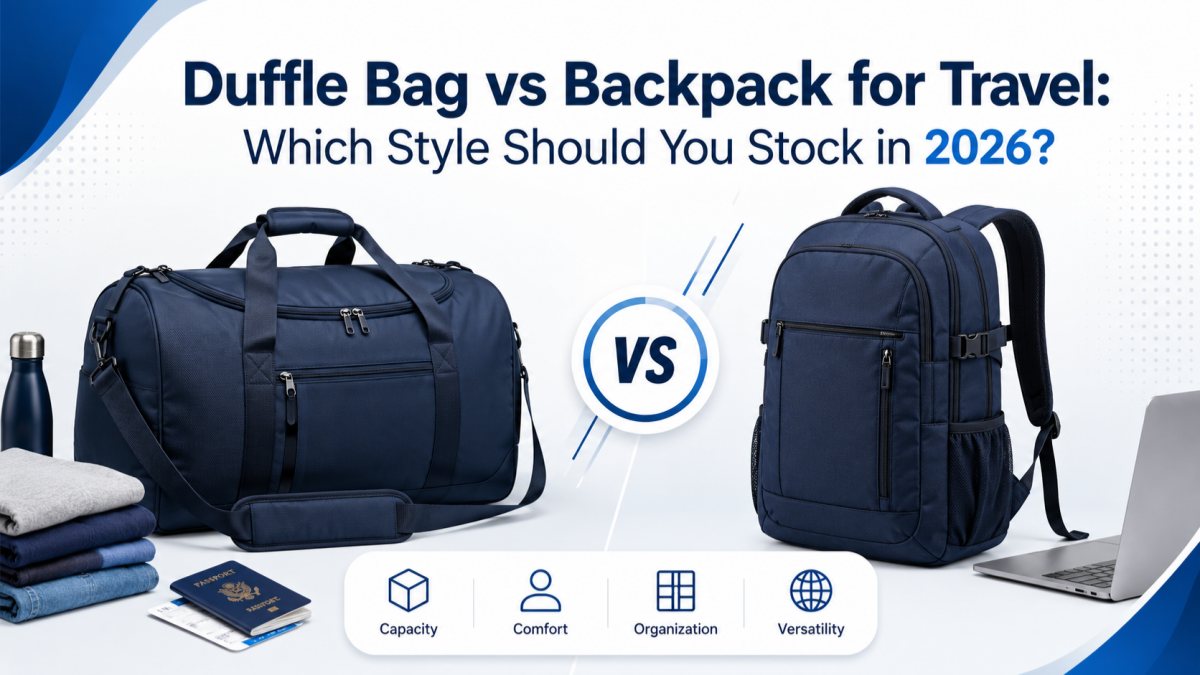
If you are sourcing bags for the travel market, the duffle bag vs backpack question comes up sooner or later. Both sell well. Both have loyal customer bases. But from a wholesale buyer’s perspective — when you are deciding where to put your inventory budget — they behave very differently in terms of target audience, production cost, customization flexibility, and logistics.
We have been manufacturing both styles for over 15 years, and we see the same pattern every season: buyers who understand the differences before they place an order end up with better sell-through rates and fewer markdowns. This guide walks you through each key difference so you can decide which style — or which mix — makes sense for your market in 2026.
H2-1. Market Snapshot: Why This Decision Matters Now
Both duffle bags and backpacks are seeing strong growth, but they are not growing in the same channels. In our experience working with retail buyers and brand owners across North America and Europe, the demand pattern shifted noticeably after 2023.
The global duffle bag market is growing at roughly 9.3% CAGR, driven largely by the fitness and weekend-travel segments (Grand View Research, 2024). The travel backpack segment is expanding at a similar pace but through different channels — primarily outdoor gear retailers and direct-to-consumer travel brands.
From what we see in bulk production orders, the key difference is not total volume but order behavior. Duffle bags tend to move in larger seasonal peaks — Q1 fitness push, Q4 holiday travel. Backpacks are more consistent year-round, with steady reorders from outdoor and education channels. If you are managing inventory, this matters: duffle bags require better peak-season planning, while backpacks reward year-round availability.
H2-2. Carrying Comfort & Ergonomics: One Strap vs Two Straps
This is the single biggest difference between the two styles, and it directly affects customer satisfaction and return rates. Many buyers focus on looks and price first, but the carrying experience is what drives repeat purchases — or refund requests.
A backpack distributes weight across both shoulders and the hips (if it has a hip belt). For a traveler walking more than 15-20 minutes with a loaded bag, this makes a noticeable difference in comfort. In our experience, backpack return rates related to comfort are significantly lower than duffle bag returns — roughly 1-2% vs 4-6% for duffles, based on feedback from our retail clients.
A duffle bag, by design, concentrates the weight on one shoulder or in the hand. For short trips — airport to taxi, car to hotel — this is perfectly fine. Many travelers actually prefer the quick-access convenience of a duffle for short stays. But for longer walks, multi-modal travel (train + subway + walking), or travel involving stairs, the single-strap design becomes a limitation.
What this means for you as a buyer: If your target customers are frequent flyers, digital nomads, or multi-destination travelers, prioritize backpacks. If your market is gym-goers, weekenders, or promotional buyers, duffle bags are the better fit. One common mistake we see is buyers trying to serve both use cases with one style — it usually ends with one segment being underserved.
H2-3. Packing Capacity & Organization: How They Differ
A backpack and a duffle bag pack very differently — and your customers will have strong preferences based on how they travel. This may sound like a small detail, but the internal layout is often the deciding factor for the end customer.
Backpacks typically have multiple compartments: a main compartment, a padded laptop sleeve, a front organizer panel for small items, and often a hidden pocket for valuables. This structure is ideal for travelers who need quick access to specific items without unpacking everything. From a manufacturing standpoint, this complexity means a backpack requires 15-25 more pattern pieces and 30-40% more sewing time compared to a basic duffle of similar volume.
Duffle bags use a single large compartment with a wide opening. This is better for bulkier items — a pair of boots, a packed jacket, sports equipment — and for travelers who prefer to unpack fully upon arrival. The simplicity also means lower production cost: a basic duffle can be assembled in about 25-30 minutes, compared to 45-55 minutes for a mid-range travel backpack.
For wholesale orders, we usually suggest thinking about it in terms of the packing style of your target customer: do they organize (backpack) or do they dump (duffle)? Both are valid, but they attract different buyers.
H2-4. Material, Durability & Weather Protection
Travel gear takes a beating. The material you choose needs to match the level of abuse — and the two styles face different kinds of wear.
Backpacks are worn on the body, so they benefit from lighter materials. Most travel backpacks use 300D-500D nylon ripstop or lightweight polyester. A typical 40L travel backpack weighs about 1.2-1.8 kg when empty. The fabric cost runs $4-8 per yard for quality nylon. Many buyers focus on the look first, but in our experience, the zipper quality and seam construction matter more for backpack longevity than the outer fabric weight.
Duffle bags, on the other hand, get thrown into car trunks, dragged across airport floors, and stacked under luggage. They need heavier materials: 600D-900D polyester, heavy canvas, or reinforced nylon. An empty 40L duffle weighs about 0.8-1.4 kg (lighter than a backpack because there is no frame or harness system), but the fabric needs to be 30-50% heavier. Fabric cost runs $3-6 per yard for durable polyester. The trade-off is that duffles typically last longer in high-abuse environments because of their simpler construction and heavier outer fabric.
Water resistance is another distinction. For wholesale orders, we usually suggest adding a PU coating on both styles if there is any chance the bag will be used outdoors. Backpacks worn in the rain need it more urgently since the contents press against the back panel. Before confirming the sample, make sure the water resistance level matches your target market’s climate.
H2-5. Customization & Branding: Which Is Easier to Customize?
If you are planning to put your brand on these bags, the customization experience is very different between the two styles.
Duffle bags are generally easier to customize. The large, flat side panels provide plenty of canvas — literally — for logo placement. Embroidery, screen printing, heat transfer, debossing — all work well because the fabric surface is uninterrupted by zippers, pockets, or straps. From what we see in bulk production, duffle bag customization has fewer rejection issues because the logo area is straightforward and predictable.
Backpacks have more customization points — front panel, straps, zipper pulls, even the back panel if you want — but each point requires more precision. The front panel may have a pocket seam running through it. The shoulder straps are narrow and curved, making embroidery alignment trickier. If you are ordering for the first time, we usually recommend starting with a duffle bag for your branded program unless you specifically need backpack functionality. The sample process is faster, and the odds of getting the logo exactly right on the first try are higher.
A reliable manufacturer will offer sample photos before you commit, but for backpacks, we strongly advise ordering a physical sample before approving bulk production. The way a logo sits on a curved shoulder strap or a padded front panel is hard to judge from photos alone.
H2-7. Quick Comparison Table: Duffle Bag vs Backpack for Travel
Here is how the two styles stack up across the most important dimensions for wholesale buyers:
| Dimension | Duffle Bag | Travel Backpack |
|---|---|---|
| Comfort (long carry) | ⚠️ Single-strap design limits comfort over 20 min walks | ✅ Dual straps distribute weight evenly. Better for longer travel |
| Organization | ⚠️ Single compartment. Simple but less organized | ✅ Multiple compartments. Laptop sleeve, organizer pockets standard |
| Durability | ✅ Heavier fabric (600-900D). Simpler construction = fewer failure points | ⚠️ Lighter fabric (300-500D). More seams and zippers = more potential issues |
| Customization ease | ✅ Large flat panels. Faster sampling (7-10 days). Lower rejection rate | ⚠️ Multiple curved surfaces. Slower sampling (10-15 days). Requires physical sample |
| Production cost (FOB) | ✅ $10-18/pc (basic). Less labor, simpler materials | ⚠️ $14-25/pc (mid-range). 30-40% more sewing time |
| Shipping density | ✅ Compressible. ~3,500 pcs per 20′ container | ⚠️ Semi-compressible. ~2,500 pcs per 20′ container (with frame) |
| Best customer fit | Gym, weekend travel, promotional, price-sensitive buyers | Business travel, digital nomads, outdoor, commuters |
✅ = advantage | ⚠️ = trade-off to consider
H2-8. Conclusion: Which Should You Stock?
There is no single right answer — but there is a right answer for your specific market and business model.
If your customers are fitness brands, promotional buyers, or retailers serving the weekend-travel crowd, duffle bags are the natural choice. They are easier to customize, cheaper to produce and ship, and appeal to a broad customer base looking for a simple, durable bag at a fair price point.
If your market is outdoor enthusiasts, business travelers, or the growing digital nomad segment, travel backpacks offer better margins and stronger brand differentiation. The higher production cost is offset by higher retail pricing and lower return rates.
One common mistake we see is buyers committing to one style exclusively. In our experience, the brands that perform best across seasons stock both — using duffle bags as their entry-to-mid price point and backpacks as their premium offering. This gives retailers a complete travel assortment and lets you capture customers at different budget levels. If you manufacture both styles with the same supplier, you can also negotiate better combined MOQ terms.
For a closer look at what we produce in both categories, explore our duffle bag collection or contact our team to discuss your 2026 sourcing plan.
References
- Grand View Research. (2024). Duffel Bags Market Growth & Trends. Accio market analysis.
- Future Market Insights. (2025). Travel Bags Market Outlook 2025-2035. futuremarketinsights.com.
- Mordor Intelligence. (2026). Travel Bag Market Analysis 2026-2031. mordorintelligence.com.