Introduction: The Real Risk Is the Wrong Mix
Estimated reading time: ~8 minutes
E-commerce sellers don’t fear competition as much as they fear dead stock. One wrong bulk buy can lock up cash, slow your ad
testing, and force heavy discounts that damage your brand. That’s why 2026 isn’t just about “what’s trending”—it’s about building a
duffle bag product mix that spreads risk across materials, price points, and use cases.
The good news: duffle demand is not one market. It splits into clear micro-segments—gym users, weekender travelers, parents, outdoor
travelers, commuters, and gift shoppers—each reacting differently to features like weight, water resistance, structure, and organization.
Your job as a seller is to stock the “right few” SKUs that cover the “most likely” buyers.
This guide translates 2026 duffle bag trends into a practical product plan: what to add, what to keep core, what to test, and what to
ask your factory so you can forecast demand instead of guessing. For assortment inspiration and how a cohesive collection can be presented,
browse lilalilabags.com and its
Collections.
2026 Trend Signals That Matter for Duffle Bags
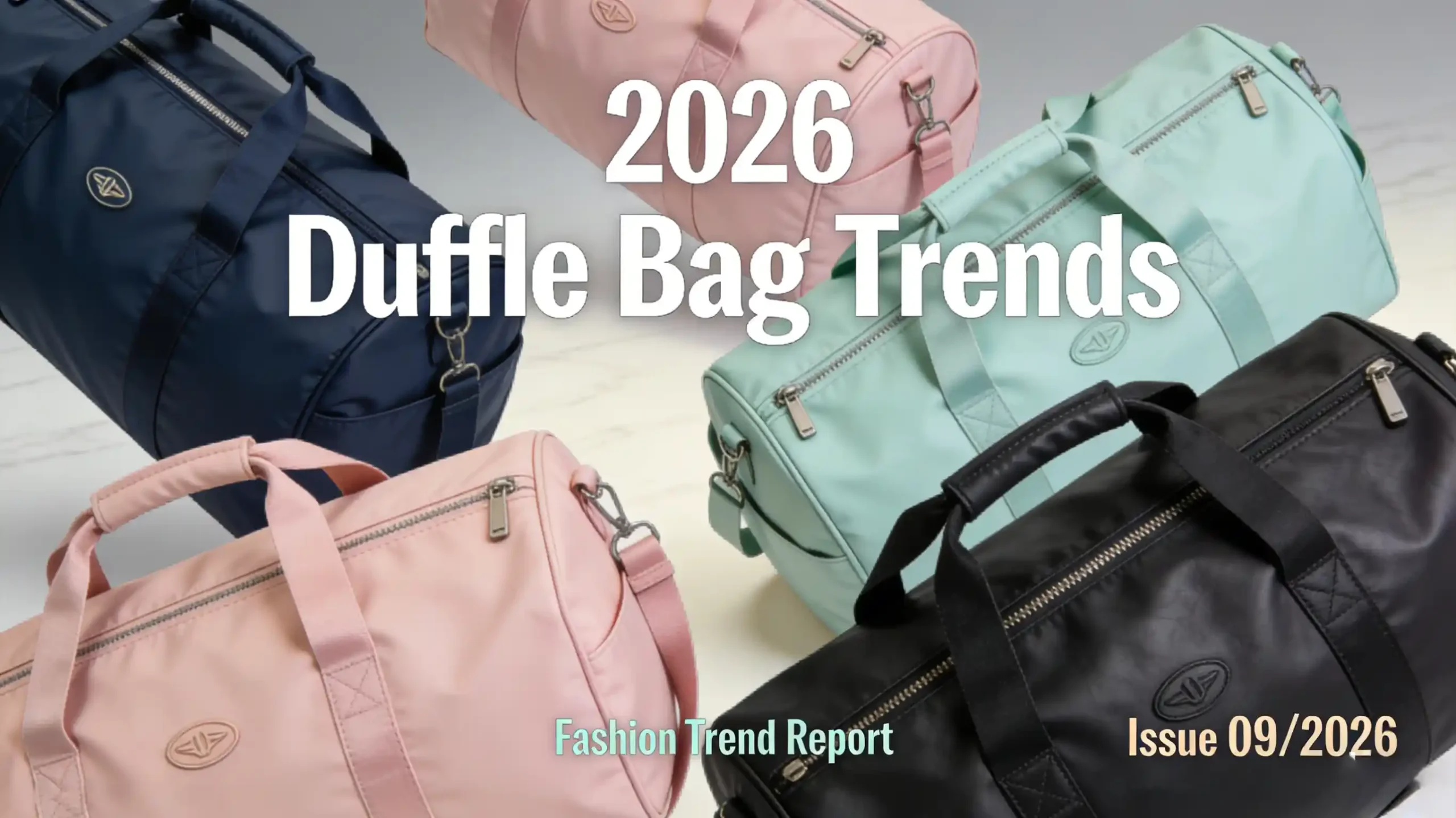
Trends are only useful when they change what customers buy. For 2026, the strongest purchase-driving signals cluster around three themes:
lighter materials, better weather resistance, and smarter carry modes.
- Recycled, technical fabrics becoming mainstream: Travel and gear editors repeatedly highlight recycled polyester and nylon
builds (often paired with laminates/coatings) as durable and practical choices for modern travel duffels.[1] - Packable + modular formats: Buyers want a “secondary bag” that folds down, or a duffle that adapts to gym/travel needs with
pockets, wide openings, or modular organization.[2] - PFAS-free water repellency language entering consumer conversations: More brands are shifting toward PFAS-free approaches,
including performance via fabric construction and newer coatings, which changes how sellers should describe materials and finishes.[3]
Seller takeaway: If your duffle line is only “one canvas weekender,” you’re exposed. A 2026-ready assortment should include at least one lightweight technical option and one classic, story-driven option (canvas or leather-trim), plus a travel-proof water-resistant hero.
Canvas vs. Nylon vs. Recycled Synthetics: Build a Material Portfolio
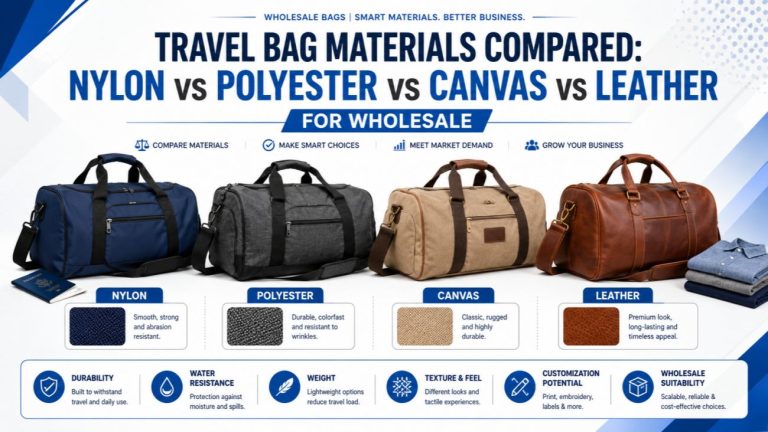
“多样化产品组合”不是随便上新,而是用不同材质覆盖不同人群与价格敏感度。最实用的做法是把材质当成一个“投资组合”:
稳健(帆布)、增长(尼龙/技术面料)、差异化(环保认证再生材料/皮革升级)。
| Material | Best for | Why customers choose it | How to position (listing angle) |
|---|---|---|---|
| Canvas (cotton / poly-cotton) | Weekender style, gifting, lifestyle brands | Classic texture, “heritage” vibe, easy styling, good structure | “Everyday weekender,” “timeless carry,” “structured opening + easy packing.” |
| Nylon (standard / high-density) | Gym, commuters, frequent travelers | Lightweight, low maintenance, often water resistant, sporty look | “Lightweight + water resistant,” “wipe-clean,” “carry-on friendly.” |
| Recycled nylon/poly + coatings/laminates | Outdoor/adventure travel, eco-minded shoppers | Durability and weather resistance with a sustainability story | “Recycled fabric build,” “abrasion-resistant,” “designed for hard travel.”[1] |
| Leather trims / leather duffle (premium) | Premium buyers, business travel, gifting | Elevated look, longevity, brand status | Use responsible sourcing language (e.g., LWG-aligned supply chain) when applicable.[4] |
The mistake sellers make is treating canvas vs. nylon as a style choice. It’s actually a segment coverage strategy:
canvas wins lifestyle and gifting; nylon wins performance and repeat use; recycled technical fabrics win “future-proof” positioning.
Cover More Buyer Segments Without Blowing Up Inventory
To scale safely, don’t add more SKUs—add more coverage. One duffle style can cover multiple segments if you design (or source)
with a few modular features: removable strap, luggage sleeve option, shoe compartment option, and a wide-mouth opening.
Start with five high-demand segments and assign each a “must-have feature set”:
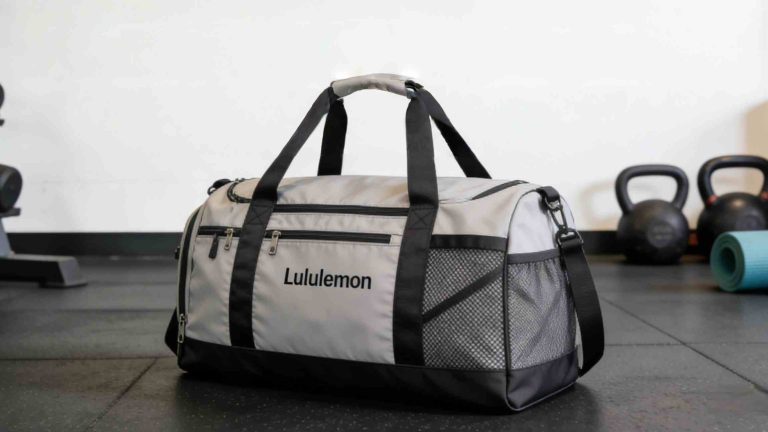
- Gym buyers: odor separation (shoe/laundry pocket), wipe-clean lining, lightweight nylon.
- Weekender travelers: structured opening, comfortable handles, fits 2–3 outfits, stylish canvas or nylon.
- Adventure travelers: abrasion resistance, weather resistance, reinforced base, reliable zippers.[1]
- Parents: wide-mouth access, easy-clean interior, external quick pockets, optional crossbody strap.
- Gift/premium: elevated trims, minimal branding, premium hardware, dust bag packaging.
Rule of thumb: If a new SKU doesn’t unlock a new segment (or a new price tier), it’s probably inventory risk—not growth.
The 3-Layer SKU Architecture (Core / Seasonal / Test)
Most stock mistakes come from treating all SKUs the same. In 2026, winners separate the assortment into three layers:
- Core (always-on): 3–5 SKUs you can reorder confidently (best-selling sizes/materials/colors).
- Seasonal (controlled refresh): 2–4 SKUs that rotate colors or trims, while keeping the same pattern and components.
- Test (small-batch experiments): 1–2 SKUs for trend bets (new fabric, new opening style, new pocket system).
This structure is what lets you say “yes” to trends without betting the warehouse. You scale by doubling down on Core, and you stay fresh
by rotating Seasonal and testing small.
If you want your store to look cohesive, present these layers clearly on your category page. A clean collection layout (like what you see
in many curated brands) reduces choice anxiety and improves conversion. If customers need help choosing size or material, make support easy:
Contact.
What to Ask Your Factory for Trend Forecasting (Not Just Quotes)
Your pain point is real: sellers fear stocking the wrong items, and factories are often the closest to material shifts, component lead times,
and what other brands are ordering. But you only get forecasting value if you ask the right questions.
Here are factory questions that produce useful “trend prediction” answers:
- Material demand shifts: “In the last 90 days, which duffle fabrics are requested most (nylon types, canvas weights, coatings)? What is increasing?”
- Component constraints: “Which zipper/hardware finishes have the longest lead times? Any upcoming price increases?”
- Construction preferences: “Are buyers choosing wide-mouth openings, shoe compartments, backpack straps more often? Which features cause quality complaints?”
- MOQ strategy: “Can we run one pattern across multiple materials/colors to keep MOQ low and scale replenishment?”
- Compliance readiness: “Can you support recycled content verification (GRS chain-of-custody) or leather sourcing aligned with LWG audits?”[5][4]
Best practice: Ask your factory to deliver a quarterly “trend memo” with: (1) top 5 requested fabrics, (2) top 5 requested features, (3) lead time changes, (4) defect/returns insights, and (5) what they recommend you test next.
A Simple Buying Plan to Avoid Over-Stocking
Here is a low-risk approach you can run every season:
- Pick 2 hero materials: one classic (canvas) + one technical (nylon or recycled nylon).
- Pick 3 sizes: 25–35L (gym/day), 40–55L (weekender/carry-on), 70–90L (checked/gear) for broader coverage.
- Pick 2 opening styles: classic zip-top + wide-mouth/doctor-bag opening for faster access.
- Start with a color rule: 70% neutrals (black/olive/navy/beige), 30% seasonal colors.
- Use replenishment triggers: reorder Core when sell-through hits a defined threshold (e.g., 60–70%).
The most important concept is shared patterns. If one pattern can run in both canvas and nylon, you unlock multiple segments
without multiplying development costs. You also simplify photography, listing content, and customer education.
Turn Product Mix Into Higher Conversion (Listing + Bundles)
Product mix only scales your store if customers can choose quickly. On your product pages, reduce friction with a simple “chooser” framework:
- Choose by scenario: “Gym / Weekender / Adventure.”
- Choose by weight: list exact grams/lbs and show what that feels like.
- Choose by maintenance: “machine-washable,” “wipe clean,” “spot clean.”
- Choose by weather: define “water resistant” vs “weatherproof” clearly (no exaggeration).
Bundles are also a smart way to increase AOV without new inventory risk. Examples:
- Travel set: duffle + toiletry pouch + packing cube set (same color story).
- Gym set: duffle + shoe bag + microfiber towel.
- Organizer add-on: clip-in pouch that fits multiple duffles (one accessory, many SKUs).
Compliance & Trust: Materials, PFAS-Free Finishes, and Proof
In 2026, “trust” is part of the product mix. When you offer recycled fabrics, customers and platforms increasingly expect proof.
Textile Exchange explains that GRS sets criteria for third-party certification of recycled materials and chain of custody, and it adds
processing-related social, environmental, and chemical requirements; it also notes thresholds for business-to-business use and labeling
expectations.[5]
For leather trims or leather duffles, Leather Working Group describes its audit standard as assessing responsible leather manufacturing
across areas like environmental management, traceability, chemical management, and social responsibility.[4]
For water repellency, customers increasingly ask what “DWR” means. Bluesign notes that PFAS-free alternatives and structural approaches
are emerging, and that brands are moving away from PFAS-based treatments.[3]
You don’t need to over-promise—just communicate clearly:
- Say what it does: “resists light rain and splashes,” not “waterproof,” unless it truly is.
- Say how it’s achieved: fabric density, coatings/laminates, seam design, zipper type.
- Say how to care: how to clean and how repellency can be maintained.
This proof layer doesn’t just reduce returns; it supports premium pricing and improves conversion when shoppers compare similar-looking
duffles.
Checklist: Your 2026 Duffle Bag Product Mix in One Page
- 2 hero materials: canvas + nylon/recycled nylon.
- 3 sizes: small (gym), medium (carry-on weekender), large (gear).
- 2 opening styles: zip-top + wide-mouth.
- 3 carry modes: hand carry + shoulder + optional backpack conversion for at least one SKU.
- 3 layers: Core / Seasonal / Test, with tight MOQ for Test.
- Proof: recycled chain-of-custody readiness (GRS), responsible leather sourcing alignment (LWG) where applicable.
Bottom line: You scale your online store not by guessing one “best seller,” but by building a balanced mix that matches multiple buyer segments—and by partnering with your factory to forecast shifts before you stock up.
References
- WIRED. 6 Best Duffel Bags We Tested While Traveling (2026).
- Wirecutter (The New York Times). The 6 Best Duffel Bags of 2026.
- bluesign. PFAS-Free Clothing: Safer, More Sustainable Alternatives.
- Leather Working Group. Leather Manufacturer Standard.
- Textile Exchange. Recycled Claim Standard (RCS) + Global Recycled Standard (GRS).