Estimated Reading Time: 6 minutes
Table of Contents
Introduction
1. Understanding Bulk Order MOQ Tiers
2. Volume Pricing: What Affects the Unit Price?
3. How to Negotiate Better Pricing
4. Shipping Optimization for Bulk Orders
5. Packaging Options for Bulk Orders
Conclusion
Bulk ordering shoulder bags is one of the most effective ways for brands and wholesalers to secure competitive pricing, build consistent inventory, and establish long-term supplier relationships. However, navigating the complexities of MOQ tiers, volume pricing structures, and international shipping can be daunting — especially for first-time importers.
Many buyers focus solely on the unit price and miss the bigger picture. Factors like packaging costs, shipping method selection, payment terms, and quality assurance all impact the true landed cost of your order. A well-planned bulk purchase strategy can save you 15-30% compared to piecemeal ordering.
This guide breaks down everything you need to know about placing a bulk shoulder bag order — from understanding MOQ tiers and pricing factors to shipping optimization and packaging decisions.
1. Understanding Bulk Order MOQ Tiers
Minimum Order Quantity (MOQ) is the foundation of any bulk purchasing strategy. In shoulder bag manufacturing, MOQs vary significantly based on the production model, material, and customization level. Understanding the typical tiers helps you plan your budget and negotiate effectively.
Three common MOQ tiers in shoulder bag production:
| Order Tier | Quantity Range | Unit Cost Level | Best For |
|---|---|---|---|
| Small Batch | 50-200 pcs per design | $$ (higher per unit) | Market testing, startups, limited editions |
| Mid Volume | 300-800 pcs per design | $ (moderate) | Growing brands, boutique retailers |
| Bulk Production | 1000+ pcs per design | $ (lowest per unit) | Large retailers, distributors, chain stores |
Why does the unit cost drop at higher volumes? Three reasons: tooling and mold costs are amortized across more units, raw material procurement gets bulk discounts from upstream suppliers, and production line efficiency improves with longer runs. For a more detailed breakdown of MOQ by material and style, refer to our Purse Manufacturing MOQ Guide.
2. Volume Pricing: What Affects the Unit Price?
Beyond quantity alone, several factors influence the per-unit price of custom shoulder bags. Understanding these variables helps you make informed trade-offs between cost and quality.
Six key pricing factors:
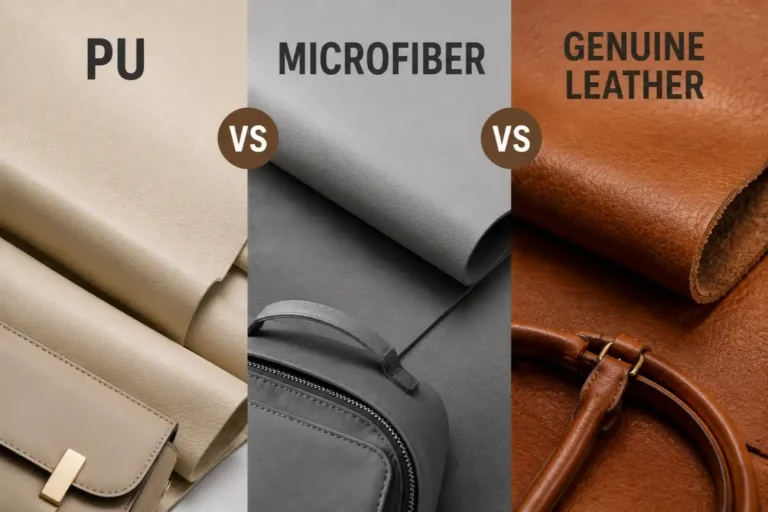
- Material Selection: PU leather is the most cost-effective option for mid-market bags. Genuine leather can increase unit cost by 200-300%. Nylon and canvas fall between the two, depending on quality grade.
- Design Complexity: More pockets, compartments, lining structures, and hardware pieces increase labor time and material consumption. A simple single-compartment shoulder bag costs significantly less than one with multiple zippered pockets and reinforced stitching.
- Customization Level: ODM orders (modifying existing designs) are more affordable than full OEM orders (custom tooling and new molds). OEM requires additional tooling fees of $100-$500 that are factored into the unit price.
- Packaging Requirements: Bulk packing in export cartons is the most economical option. Individual dust bags add $0.50-$1.50 per unit, and branded gift boxes can add $2-$5 per unit.
- Hardware Quality: Standard metal zippers and buckles vs. custom-engraved hardware with a logo — custom hardware incurs mold fees and slightly higher per-unit costs.
- Currency Fluctuation: Most Chinese manufacturers quote in USD or RMB. Exchange rate shifts can affect the final price, especially for large orders with longer production timelines.
If your primary material is vegan leather, our Best Vegan Leather for Handbags comparison can help you evaluate cost versus performance across different PU and microfiber options.
3. How to Negotiate Better Pricing
Negotiation in B2B bag manufacturing is not about aggressive bargaining — it is about demonstrating that you are a serious, long-term partner worth investing in. The best pricing comes from trust and volume commitment, not pressure tactics.
Practical negotiation strategies:
- Request tiered pricing upfront: Instead of asking “what is your price?”, ask “could you share your pricing at 200, 500, and 1000 units?” This shows you are planning for growth and helps you understand the discount curve.
- Consolidate your orders: If you need 200 pcs of three different styles, ask if they can be produced together as a 600-pc order to qualify for a higher volume tier.
- Simplify where possible: Reducing the number of hardware variations, standardizing lining colors, or choosing simpler packaging can meaningfully reduce unit cost.
- Offer favorable payment terms: Suppliers often discount 2-5% for larger deposits or faster payment schedules (e.g., 50% deposit instead of 30%).
- Build relationship before price: Suppliers prioritize clients who communicate clearly, pay on time, and show long-term potential. A first order at fair pricing often leads to better pricing on repeat orders.
4. Shipping Optimization for Bulk Orders
Shipping is often the most overlooked cost component in bulk ordering. Depending on your order size and destination, freight can account for 10-25% of your total landed cost. Choosing the right shipping method is essential for protecting your margins.
Shipping method comparison for bulk shoulder bag orders:
| Method | Transit Time | Cost Level | Best For |
|---|---|---|---|
| Express (DHL/FedEx/UPS) | 5-8 days | $$$ (highest) | Samples, urgent small orders under 50 kg |
| Air Freight | 7-12 days | $$ | 50-500 kg, time-sensitive restocking |
| Sea Freight (LCL) | 25-35 days | $ (lowest per unit) | 1-15 CBM, mid-to-large bulk orders |
| Sea Freight (FCL) | 25-35 days | $ (lowest per unit) | 15+ CBM, full container loads |
Tips for reducing shipping costs:
- Use LCL (Less than Container Load) for orders between 1-10 CBM — you only pay for the space you use.
- Compare DDP (Delivered Duty Paid) vs. FOB (Free on Board) terms. DDP simplifies customs but includes a premium; FOB gives you more control over freight costs if you have a reliable freight forwarder.
- Plan around Chinese New Year (January-February) when factories close for 2-3 weeks and shipping rates spike.
- Consolidate orders to fill shipping volume more efficiently — 8 CBM costs only slightly more than 5 CBM.
For a full overview of the shoulder bag manufacturing and shipping timeline, our Custom Shoulder Bags OEM/ODM Complete Guide covers lead times from design through delivery.
5. Packaging Options for Bulk Orders
Packaging serves two functions in bulk shoulder bag orders: protecting the product during transit and enhancing the unboxing experience for your customers. Your choice directly affects both cost and brand perception.
Common packaging options ranked by cost:
- Bulk Export Cartons (Lowest Cost): Standard corrugated boxes with inner dividers. Ideal for wholesale distributors who will repackage products themselves. No branding on individual bags.
- Individual Poly Bags ($): Each bag is wrapped in a clear or opaque poly bag for basic dust protection. Common for mid-tier wholesale orders where retail presentation is not required.
- Individual Dust Bags ($$): Non-woven or cotton dust bags with your brand logo printed or debossed. The standard for brands selling directly to consumers. Adds a professional touch.
- Branded Gift Boxes ($$$): Rigid paperboard boxes with custom printing, foam inserts, and ribbon. Suitable for premium/luxury shoulder bags and retail-ready presentation.
What to discuss with your supplier:
- MOQ for custom packaging (often different from bag MOQ)
- Whether packaging cost is included in the unit price or charged separately
- Lead time for packaging production (custom boxes typically add 1-2 weeks)
- Whether they offer kitting services — inserting hang tags, care cards, and authenticity certificates into each bag
For suppliers who can handle both product and packaging customization seamlessly, check our Women’s Shoulder Bag Suppliers: Top 10 Questions article for a complete supplier evaluation checklist.
Conclusion
Placing a successful bulk shoulder bag order requires more than just finding the lowest unit price. Understanding MOQ tiers, the factors that influence pricing, effective negotiation strategies, shipping optimization, and packaging options all contribute to a profitable wholesale operation.
Key takeaways:
- Match your order tier to your business stage — start with small batches (50-200 pcs) to test the market, then scale up as demand grows.
- Factor in the six pricing variables beyond quantity: material, design complexity, customization, packaging, hardware, and currency.
- Negotiate from a position of partnership, not pressure — suppliers reward clear communication and long-term potential.
- Choose your shipping method based on total landed cost, not just freight rate — a slower method often saves significantly.
- Don’t overlook packaging — it protects your product and represents your brand.
Ready to place your bulk shoulder bag order?
We offer factory-direct pricing with MOQ as low as 50 pcs. Get volume pricing tiers, free sample consultation, and end-to-end logistics support.
Email: lilalilan8@aliyun.com |
Phone: +86 19180670556
Jinniu District, Chengdu, China
Related resources:
- Custom Shoulder Bags: The Complete Guide to OEM/ODM for Your Brand (Pillar Page)
- Purse Manufacturing MOQ Guide: Minimums by Material, Style & Customization Level
- Women’s Shoulder Bag Suppliers: Top 10 Questions to Ask Before Placing an Order
- Best Vegan Leather for Handbags: PU vs. Microfiber Comparison
- Custom Women’s Shoulder Bag Product Page