Cover Image: how-to-start-handbag-brand.jpg — Alt: Seven illustrated steps showing how to start a handbag brand from concept to launch, with sketches, materials, and factory samples | Description: A visual roadmap of the seven steps covered in this guide — brand positioning, design, manufacturer selection, sampling, quality control, pricing, and launch. Designed for first-time handbag brand founders.
OG Image: how-to-start-handbag-brand-og.jpg
Estimated reading time: 8 minutes
Starting a handbag brand feels like a huge step, but the path from idea to your first shipment is more straightforward than most people think. You do not need a fashion degree, a million-dollar budget, or connections in Italy. What you need is a clear plan and the right manufacturing partner.
This guide walks through seven steps that every successful handbag brand goes through — whether you are planning a premium line or an entry-level collection. We work with founders at every stage, from first-time entrepreneurs to established brands launching a new category. The advice below comes directly from what we see work in real production.
Table of Contents
- Step 1: Define Your Brand Position & Price Tier
- Step 2: Research the Market & Identify Your Gap
- Step 3: Design Your First Collection
- Step 4: Find the Right Manufacturer
- Step 5: Navigate the Sampling Process
- Step 6: Set Up Quality Control
- Step 7: Price, Launch & Scale
- Conclusion — Your First 3 Steps This Week
- References
Step 1: Define Your Brand Position & Price Tier
Before you look at leather samples or sketch a single bag, you need to answer three questions.
Who is your customer? Are you selling to young professionals who want a stylish work bag under $100? Boutique buyers looking for handmade leather pieces at $200–$400? Corporate gift departments ordering 500 units of a branded tote? Each customer has different expectations for quality, packaging, and price — and your manufacturer needs to match those expectations.
What is your price range? Your target retail price determines almost every production decision that follows. A $60 retail bag needs different materials, different construction, and a different factory than a $300 bag. Many first-time founders come to us with a beautiful design and a target price that does not match the production cost. Being realistic about price from the start saves months of back-and-forth.
What is your brand’s identity in one sentence? “Modern handbags for the conscious professional.” “Bold colors for the fearless streetwear lover.” “Minimalist leather goods that age beautifully.” Your brand sentence guides every decision — from material selection to packaging design.
One thing we see often: Founders who skip this step end up with a collection that looks like five different brands, confusing both the factory and their customers. A clear position from day one makes everything easier.
Step 2: Research the Market & Identify Your Gap
You do not need to invent a completely new type of bag. You just need to find an angle that existing brands are not serving well.
Look at what is already selling. Search for handbag brands in your target price range and ask yourself: What do they all do the same way? What is the one thing none of them do that your customer would appreciate? Maybe all the affordable work totes use low-quality lining, and you can be the brand that does not. Maybe no one is making vegan leather crossbody bags with interior organization for the gym-to-office crowd.
The gap does not have to be big. It just has to be real to your customer.
Studying how successful brands built their supply chains can also help you avoid common early mistakes. Our guide to top luxury bag supply chains breaks down what brands like LV, Gucci, and Prada do differently — and how you can apply the same logic at a smaller scale.
Step 3: Design Your First Collection
Here is the most common mistake first-time founders make: designing too many styles.
We see founders show up with a lookbook of 15 different bags — totes, backpacks, clutches, crossbodies, evening bags — and ask for a quote on all of them. A first collection should be 3 to 5 styles maximum, focused on one or two bag types. Here is why:
- Each new style requires its own pattern, its own sample, and its own approval cycle. 15 styles can take 6 months to sample.
- Factories give better pricing when you focus on fewer styles with higher quantity per style.
- A tight, focused collection tells customers exactly what your brand stands for. A scattered collection confuses them.
Start by deciding which bag type fits your brand. A tote says “everyday professional.” A satchel says “structured & classic.” A sling says “modern & mobile.” For a full breakdown of each type, see our types of shoulder bags guide.
When you send your design to a factory, you do not need professional sketches. A clear drawing with measurements, material notes, and reference photos is enough for an experienced factory to work with. The key is being specific: “Handle drop length: 10 inches,” “Zipper: YKK #5 nickel,” “Lining: 210T polyester in cream.”
Step 4: Find the Right Manufacturer
This is the most important decision you will make in the entire process. A good manufacturer does not just produce your bags — they help you improve your design, suggest better materials, and flag potential problems before they become expensive mistakes.
Many first-time founders do not know that there are two basic ways to work with a handbag factory:
OEM (Original Equipment Manufacturing) — You provide the complete design, and the factory produces exactly what you specify. This gives you full control and a unique product that no one else can copy. It also requires more upfront work — tech packs, material sourcing, and multiple sample rounds.
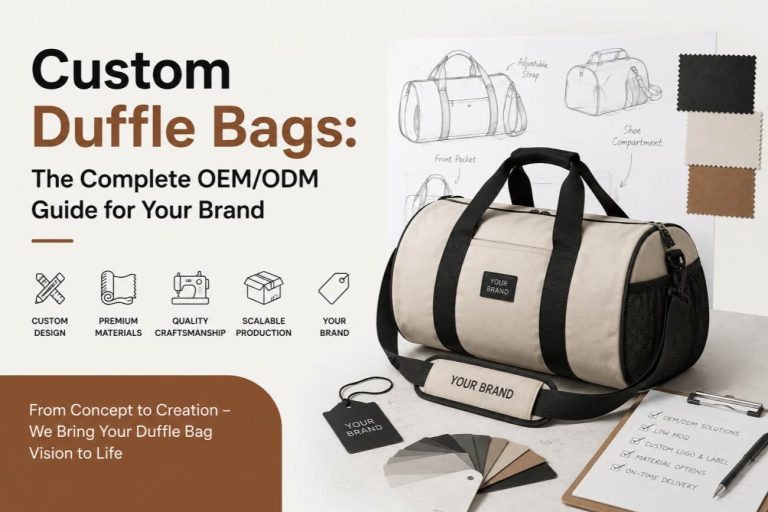
ODM (Original Design Manufacturing) — The factory already has existing bag designs in their catalog. You choose a style, customize the material and color, and add your logo. This is faster, cheaper, and lower risk, which makes it the most common starting point for first-time founders. Many successful brands started with ODM to test the market before investing in custom designs.
For a detailed comparison of both models, see our OEM vs ODM guide for custom handbags.
When evaluating factories, here are five things to check before committing:
- Ask for photos or videos of their actual workshop. A factory that hesitates to show you where the work happens is usually not a factory — it is a trading company.
- Request samples of similar products they have made. A good factory will have examples that match your quality level.
- Check their minimum order quantity (MOQ). For first-time founders, 100 to 300 units per style is a reasonable range.
- Ask about certifications. BSCI, ISO 9001, or Sedex are good signs that a factory operates professionally.
- Test their communication responsiveness. If it takes them a week to reply to an inquiry, it will take them just as long to reply when there is a production issue.
For a complete walkthrough of the selection process, including sample questions to ask and red flags to watch for, see our complete guide to choosing a custom handbag manufacturer.
Step 5: Navigate the Sampling Process
Sampling is where your design becomes real. It is also where most first-time founders learn that their design needs adjustments.
The typical sampling process goes like this:
- You send your design brief to the factory.
- The factory quotes a sample fee — typically $100 to $500 per style, depending on complexity.
- You pay the sample fee and wait 7 to 15 days for the first physical sample.
- You receive the sample, check it against your specifications, and note any changes needed.
- The factory revises and sends a second sample (sometimes free, sometimes at a reduced fee).
- Once the sample is approved, it becomes your “golden sample” — the standard that bulk production will be measured against.
One thing to plan for: Almost every first sample needs at least one revision. The strap is 2 cm shorter than expected. The zipper color does not match the swatch. The interior pocket is slightly smaller than your laptop. This is normal — it is why sampling exists. Budget for at least two sample rounds in your timeline.
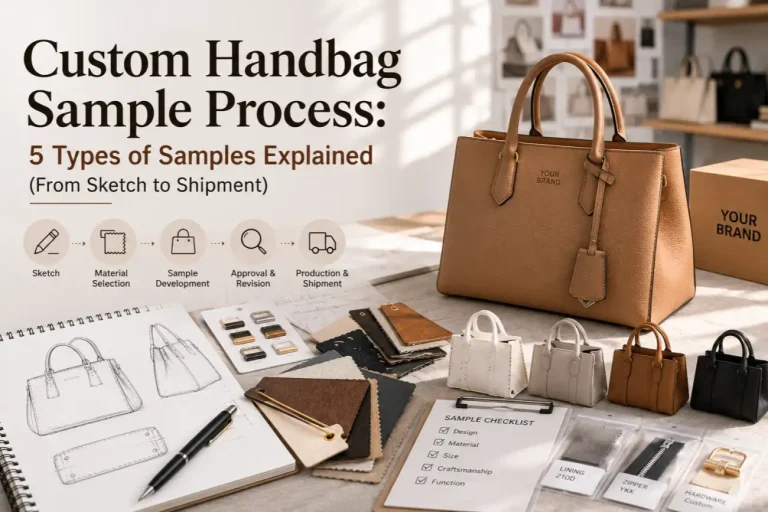
For a complete breakdown of each sample type and what to check at each stage, see our custom handbag sample process guide.
Step 6: Set Up Quality Control
Many new brand owners treat quality control as something that happens at the end of production. In reality, it should happen at four different points.
Here is the simple version of what to check at each stage:
- Before production starts — Confirm that the materials the factory sourced match your specifications. The leather thickness, the zipper type, the thread color — all should match the approved sample before a single panel is cut.
- During production — The first bag off the production line should be inspected 100% before the rest of the run continues. This catches setup errors before they multiply across hundreds of units.
- After production (final inspection) — A sample of finished bags is checked against your standards. For a typical first order of 300 pieces, inspecting 20 to 32 bags (AQL Level II) gives you reliable data on the whole batch.
- Before shipment — Confirm packaging, labels, carton quantities, and shipping marks. This is the last gate — once the container leaves, fixing anything costs significantly more.
If your order involves genuine leather, pay extra attention to leather quality and grade consistency — see our leather quality grades guide for what to look for. For a full QC framework that works for any bag type, our custom handbag quality control checklist covers each stage in detail.
Step 7: Price, Launch & Scale
Pricing your handbag correctly is the difference between a brand that grows and one that struggles.
Here is a simple pricing structure that works for most direct-to-consumer brands:
| Item | Typical Multiplier | Example |
|---|---|---|
| Factory unit price (FOB) | — | $25.00 |
| Shipping, duties & handling | + 15–20% | ~$30.00 landed |
| Wholesale price (to retailers) | 2–2.5× landed cost | $60–$75 |
| Retail price (DTC to consumers) | 3–5× landed cost | $90–$150 |
For a more detailed breakdown of all the cost components involved — materials, labor, hardware, packaging, shipping — see our private label bag cost breakdown guide.
Launch tips from what we see work:
- Start with a small batch — 100 to 300 units. You want to test the market before placing a 1,000-unit order.
- Build your launch around one or two hero products, not the full collection. Let your customers tell you which styles to expand.
- Track your sell-through rate. If you sell 60% of your first batch in 3 months, you are ready to reorder. If not, use customer feedback to adjust before the next run.
Scaling signals: You know it is time to scale when your first batch sells out, your reorder rate from wholesale customers is above 15%, and you have a list of customers asking for styles you have not made yet. That is when you go back to your factory, place a larger order, and negotiate better pricing per unit.
Conclusion — Your First 3 Steps This Week
Starting a handbag brand does not require a perfect plan — it requires taking the first three steps and adjusting as you go.
Three things you can do this week:
- Write your brand position in one sentence. “I make [type of bag] for [customer] at [price range].” Keep it pinned above your desk.
- Identify 3 market gaps. Look at existing brands and write down three things you would do differently.
- Send inquiries to 3 factories. Include your target bag type, estimated quantity, and material preference. Compare their responses — the factory that asks smart questions is usually the one you want to work with.
Once you have those three steps done, you are further along than most people who say they want to start a handbag brand. The rest is just iteration.
Ready to take the next step? Contact us with your initial requirements, and we will help you move from concept to your first sample.
References
- Entrepreneur — How to Start a Handbag Line: A Complete Guide — Overview of business planning, branding, and production considerations for handbag startups.
- McKinsey — The State of Fashion Report 2026 — Industry research on fashion startup trends, consumer behavior shifts, and supply chain best practices for emerging brands.
- Shopify — How to Start a Handbag Business: 10-Step Guide — E-commerce focused guide covering branding, sourcing, pricing strategy, and online store setup for bag businesses.
- ISO 9001:2015 — Quality Management Systems — International standard for quality management frameworks used by professional bag manufacturers to standardize production and inspection processes.
- Statista — Handbag Market Overview — Market data on handbag industry growth, consumer segments, and pricing trends across global markets.