Estimated reading time: 8 minutes
If you are planning to launch a custom handbag line, the sample stage is where your idea becomes a real product. It is also where most first-time buyers run into surprises — unexpected costs, long delays, or samples that do not look anything like the photo they sent. Understanding the sample process before you start saves you time, money, and frustration.
In this guide, we walk through the five types of samples in a typical custom handbag project, what each one costs, how long it takes, and exactly what you should check before moving to the next stage.
Table of Contents
- Why the Sample Process Matters for Your Handbag Project
- The 5 Types of Samples in Custom Handbag Manufacturing
- Sample Timeline & Cost: How Long and How Much?
- What Buyers Should Prepare Before Starting the Sample Process
- Common Sample Mistakes and How to Avoid Them
- Conclusion — Start Your Custom Handbag Sample Process
- References
Why the Sample Process Matters for Your Handbag Project
The sample stage is the bridge between your design on paper and the finished product in your customer’s hands. Many buyers focus on finding the right factory or negotiating the best unit price, but the quality of your samples determines the quality of your entire production run.
In our experience, skipping or rushing the sample stage is the number one reason for bulk production failures. A rushed PP sample leads to wrong materials being ordered. A skipped revision round means a structural issue gets baked into thousands of units. The sample process is your last chance to catch problems before they become expensive.
Understanding the custom handbag sample process also helps you communicate better with your factory. It also helps you decide which manufacturing model — OEM or ODM — fits your situation before you start the sampling journey. When you know what a development sample vs. a PP sample is, you can ask the right questions at the right time — and avoid the confusion that causes most sourcing delays.
The 5 Types of Samples in Custom Handbag Manufacturing
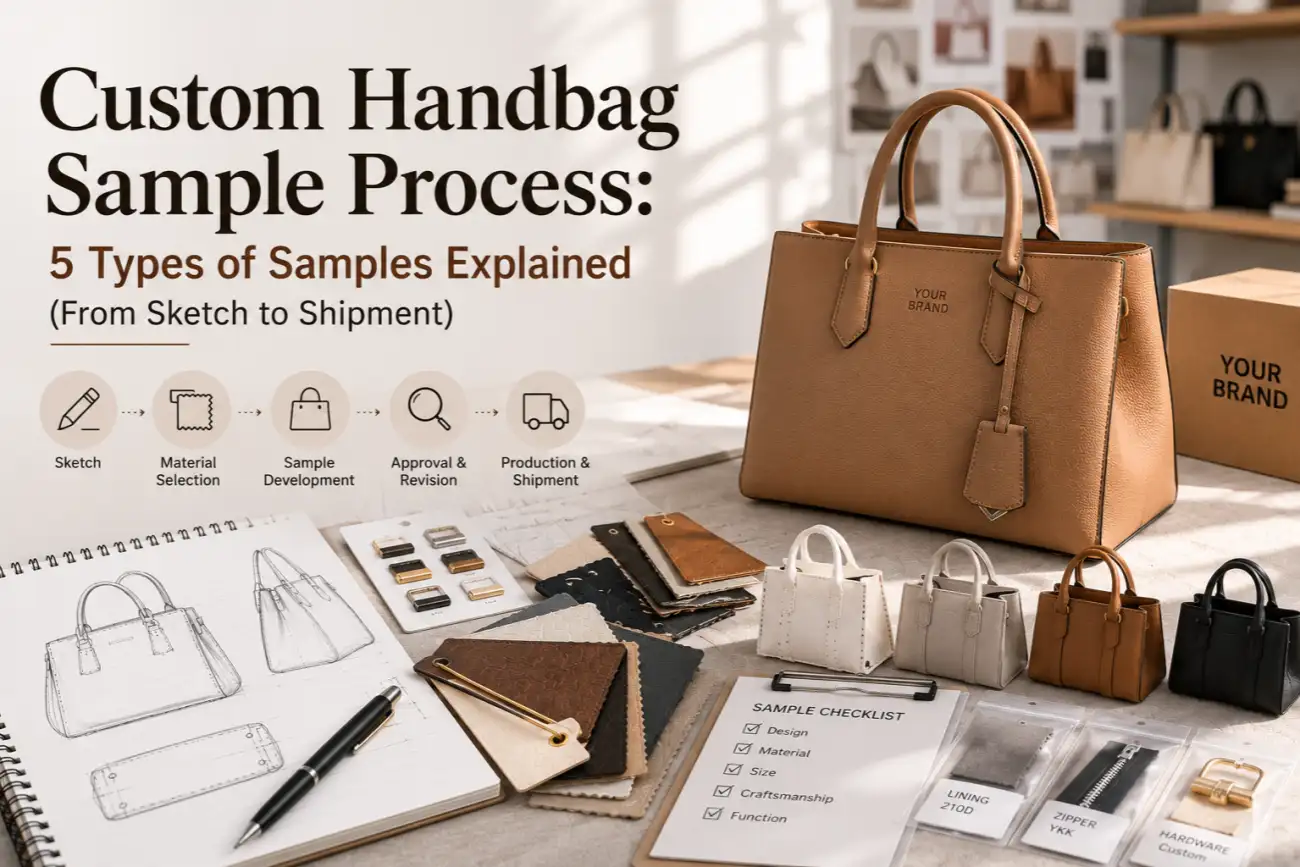
Every custom handbag project follows the same general sample path, from a 2D drawing to the final approved product. Here are the five sample types you will encounter, in order, with what to expect at each stage.
Type 1 — Design Sketch / Concept Drawing
A design sketch or CAD drawing is the first visual representation of your bag idea. It is not a physical sample — it is a 2D drawing that confirms proportions, structure, and detail placement before any material is cut. Most factories provide this free of charge as part of the quotation process. You should expect to receive front, back, and side views, along with key dimension callouts. At this stage, check that the overall silhouette and compartment layout match what you have in mind. If the factory cannot produce a clean concept sketch, that is often a warning sign about their design capability.
Type 2 — Development Sample (First Prototype)
This is the first physical sample the factory creates based on your approved sketch. The factory drafts a pattern, cuts the material, and sews a complete prototype. Many first-time buyers expect a perfect sample on the first try — in reality, it is common to need 2 to 3 revision rounds before the shape, size, and construction are correct. At this stage, focus on the structure — does the bag hold its shape? Are the proportions right? Do the pockets line up? The finish details (stitching perfection, edge paint, hardware alignment) usually improve in later rounds. Development samples typically cost $200–$800 and take 10–20 business days.
Type 3 — Revision / Correction Sample
After reviewing the development sample, you provide feedback and the factory makes adjustments. This may include correcting the size, adjusting a pocket position, changing the strap length, or swapping hardware. Revision samples are usually less expensive than the first development sample — often $50–$200 per round — and take 5–10 business days. One common mistake we see is buyers giving vague feedback like “make it look better” or “this feels off.” The more specific you are — use photos with circled annotations, mention exact measurements, reference a Pantone color — the fewer revision rounds you will need. For wholesale orders, we usually suggest budgeting for at least one revision round upfront.
Type 4 — Pre-Production Sample (PP Sample)
This is the most critical sample in the entire process. The PP sample is made using the exact materials, hardware, trims, and production processes that will be used in your bulk order. Unlike earlier samples that may use substitute fabrics or temporary hardware, the PP sample must match your final product 100%.
Before confirming the PP sample, make sure you check every detail — zipper pull length, thread color, stitch density (SPI), hardware finish, lining material, label placement, and packaging. Once you sign off on the PP sample and production starts, changes are expensive and cause delays. PP samples typically cost $100–$300 and take 7–14 business days. Many factories deduct this cost from your bulk order if you proceed with production.
Type 5 — TOP Sample & Shipment Sample
A TOP sample is the first unit taken off the production line once bulk manufacturing begins. It confirms that the factory’s production setup is correct — the cutting die, sewing stations, and assembly line are producing exactly what the PP sample showed. The factory usually sends you photos or a video of the TOP sample within the first 2–3 days of production.
A shipment sample (or pre-shipment sample) is pulled from the finished production batch for final quality inspection. This is typically done by a third-party QC inspector following AQL sampling standards (ISO 2859-1). The inspector checks dimensions, workmanship, hardware function, and packaging. You can use our wholesale handbag QC checklist to prepare your own inspection criteria. Only after the shipment sample passes does the order ship.
Sample Timeline & Cost: How Long and How Much?
The full sample process typically takes 5 to 9 weeks from initial sketch to approved PP sample. Here is a breakdown of the typical timeline and cost for each stage:
| Sample Type | Typical Timeline | Typical Cost |
|---|---|---|
| 1. Design Sketch / CAD | 1–3 business days | Free (included in quotation) |
| 2. Development Sample | 10–20 business days | $200–$800 |
| 3. Revision Sample (per round) | 5–10 business days | $50–$200 |
| 4. Pre-Production (PP) Sample | 7–14 business days | $100–$300 |
| 5. TOP / Shipment Sample | Included in production | Included in QC fee |
Total estimated sample budget: For a typical custom handbag project with one revision round, you should budget $450–$1,300 for the full sample process. For first-time buyers, we usually suggest planning for $800–$1,500, which comfortably covers the sketch, first development sample, one revision, and the PP sample. For a detailed look at how material choices and bag types affect pricing, see our private label handbag cost breakdown guide.
This may sound like a small detail, but ask your factory whether they deduct the PP sample cost from the bulk order. Many established manufacturers offer this, which effectively reduces your total development cost if you proceed to production.
What Buyers Should Prepare Before Starting the Sample Process
The more information you provide upfront, the closer the first sample will be to your vision — and the fewer revision rounds you will need. Factory sample teams work best when they have clear, specific direction. If you are ordering for the first time, prepare the following before reaching out to a manufacturer:
- Product description and target use — What type of bag? Who will use it? Where will it be sold? Whether you are sourcing gym bags, travel duffles, or fashion handbags, having a clear product brief helps the factory start on the right track.
- Reference photos or a physical sample — Show examples of styles, details, and proportions you like.
- Target size range — Even approximate dimensions help the pattern maker start in the right ballpark.
- Material preferences — Leather, vegan leather, canvas, nylon? Any specific finish or feel in mind?
- Hardware and logo direction — Zipper type, buckle style, logo method (embossed, metal plate, woven label).
- Target price point — This helps the factory recommend material options that fit your budget.
- Estimated order quantity — Affects pattern construction and material sourcing decisions.
What many buyers do not realize is that the information you share before the first sketch directly determines the quality of the first sample. A clear brief can save you weeks of back-and-forth and hundreds of dollars in unnecessary revision rounds.
Common Sample Mistakes and How to Avoid Them
After working with hundreds of buyers on custom handbag projects, we see the same mistakes surface again and again. Here are three to watch for:
- Skipping the PP sample to save time. Many buyers under pressure to hit a launch date approve the development sample and jump straight to production. This is risky — the PP sample is the only confirmation that the production materials and processes will work correctly.
- Approving a sample without checking packaging. The bag might look perfect, but if the inner wrapping, polybag, or carton specifications are wrong, your shipment could arrive damaged. Confirm packaging during the PP stage.
- Giving feedback only by text. Saying “the strap feels a bit short” is much less effective than taking a photo, drawing an arrow to the strap, and writing “please increase by 2 inches.” Visual feedback reduces miscommunication.
A reliable manufacturer will proactively ask you the right questions at each stage. If the factory moves from one sample stage to the next without seeking your confirmation, that is a red flag.
Conclusion — Start Your Custom Handbag Sample Process
The custom handbag sample process is the most important step in your entire sourcing journey. It is where your product idea becomes real, where you build trust with your factory, and where you catch problems before they cost you thousands. By understanding each of the five sample types — sketch, development, revision, PP, and TOP/shipment — you can manage your timeline, budget, and expectations with confidence.
Ready to start sampling? Contact us with your product idea and target requirements. We will walk you through each step of the process, from the first sketch to the final shipment sample.
References
- ISO 2859-1 — Sampling Procedures for Inspection by Attributes — International standard for AQL-based quality inspection, used for shipment sample inspection in bag manufacturing.
- ISO 9001:2015 — Quality Management Systems — Quality management framework used by professional handbag manufacturers to ensure consistent sample and production quality.
- International Trade Administration — Importing Textiles and Apparel — U.S. government resource covering import regulations and compliance for textile and bag products.