Estimated reading time: 6 minutes
The type of leather you choose for your handbag line determines more than just the look — it sets your cost structure, your target retail price, and how long your customers will keep your bag. Yet many first-time buyers choose leather based on name alone, assuming “genuine leather” is premium or that “bonded leather” is good enough. In our experience working with handbag brands, these assumptions often lead to mismatched pricing, unhappy customers, and costly product revisions.
In this guide, we explain the four main types of leather used in handbag manufacturing from a supplier’s perspective — what each type actually means, how it affects your production cost and MOQ, and how to choose the right one for your brand.
Table of Contents
- H2-1: Why Leather Type Matters When Sourcing Handbags
- H2-2: The 4 Main Types of Leather for Handbags
- H2-3: Full Grain vs Top Grain vs Genuine — What’s the Difference for Your Bag Line?
- H2-4: Cost, MOQ & Lead Time Comparison by Leather Type
- H2-5: How to Choose the Right Leather for Your Handbag Brand
- References
- H2-6: Conclusion — Start Your Custom Handbag Project with Confidence
H2-1: Why Leather Type Matters When Sourcing Handbags
Leather type matters because it directly impacts three things every bag buyer cares about: cost, durability, and brand fit.
From what we see in bulk production, the cost gap between the cheapest and most expensive leather type can be 4-5 times per square foot. That difference adds up fast across a production run. Durability follows a similar curve — a full grain leather handbag can last decades with proper care, while a bonded leather bag may start peeling within two to three years. And for your brand positioning, using the wrong leather type can confuse customers. If your handbag retails at $150 but uses genuine leather, your customers may expect top grain quality at that price point and feel disappointed.
One common mistake we see is buyers finalizing a design before deciding on the leather type. The material should drive the design, not the other way around.
If you are ordering for the first time, start by defining your target retail price and brand tier. That will naturally narrow down which leather types are viable for your project.
H2-2: The 4 Main Types of Leather for Handbags
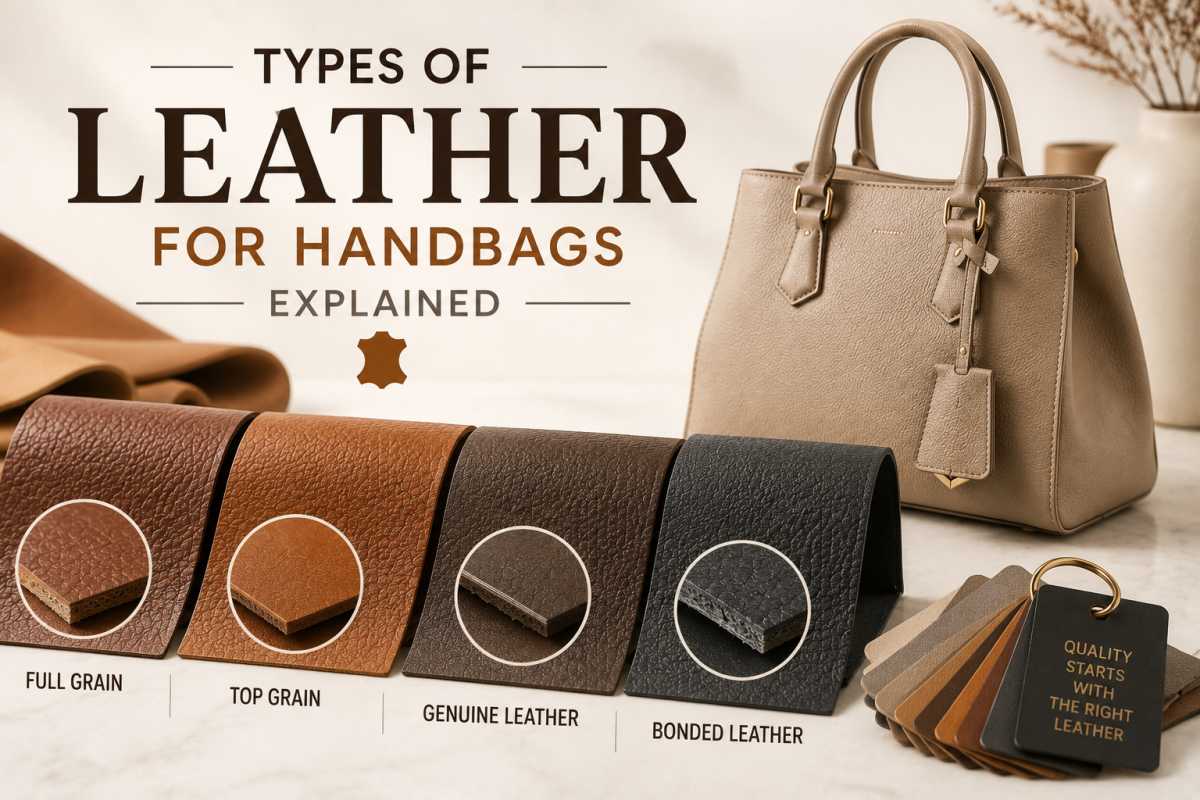
There are four leather types commonly used in handbag manufacturing. Each has a different sourcing cost, durability profile, and best-use scenario. Below is what you need to know about each one before placing your order.
Full Grain Leather — The Premium Choice
Full grain leather is the top layer of the hide, kept intact with its natural grain untouched. It is the strongest and most durable leather available. Over time, it develops a natural patina that many premium customers love. However, it also retains natural markings — scars, wrinkles, and insect bites — which not every brand wants.
Best for: High-end handbag lines, limited editions, luxury brand collections.
Sourcing note: Expect the highest material cost (3-5× that of PU leather). MOQ typically starts at 500+ pieces. If you choose full grain, request “selected cut” or “top cut” hides to reduce the rate of visible natural flaws. This adds cost but ensures more consistent surface quality across your production run.
Top Grain Leather — The Most Practical Choice for Mid-Range Brands
Top grain leather is full grain hide that has been lightly sanded to remove surface imperfections. The result is a uniform, consistent surface at a lower cost. This makes it the most popular choice for OEM handbag orders. It offers excellent durability — though not as long-lasting as full grain — and accepts surface treatments like embossing and printing well.
Best for: Mid-to-premium brand lines, core collection pieces, wholesale orders.
Sourcing note: MOQ typically starts at 300+ pieces. Top grain strikes the best balance between quality and cost for most handbag brands. For wholesale orders, we usually suggest top grain as the starting point for discussion.
Genuine Leather — The Entry-Level Natural Leather
Despite its name, genuine leather is actually the lowest grade of real leather. It comes from the layers below the top grain and is heavily sanded, buffed, and coated to create a uniform surface. The coating is what gives it a leather-like appearance, but it also means the material is less breathable and less durable than top grain or full grain.
Best for: Budget-friendly lines, promotional items, small leather goods like wallets and belts.
Sourcing note: Genuine leather costs about 30-40% less than top grain, but the lower durability means a higher risk of returns. Many buyers focus on the low price first, but the long-term cost of customer dissatisfaction can outweigh the savings. If your brand is positioned at mid-range or above, we recommend using genuine leather only for accessories, not mainline handbags.
Bonded Leather — The Lowest Cost Option
Bonded leather is not a natural leather in the traditional sense. It is made from leather scraps and fibers that are ground up, mixed with polyurethane binders, and pressed into sheets. It has a leather-like appearance initially but significantly lower durability. In our experience, bonded leather bags often start peeling or cracking after 2-3 years of regular use.
Best for: Ultra-low-cost products, single-season fast fashion lines.
Sourcing note: This may sound like a small detail, but bonded leather cannot be repaired or reconditioned like natural leather. If a customer damages a bonded leather bag, replacement is the only option. We do not recommend bonded leather for brand owners who expect repeat purchases or want to build long-term customer relationships.
H2-3: Full Grain vs Top Grain vs Genuine — What’s the Difference for Your Bag Line?
The three natural leather types sit on a quality spectrum. Here is how they compare directly for handbag production:
The short version: if your target retail price allows it, top grain is the safest choice for most new handbag brands. It gives you consistent quality without the cost and natural variation challenges of full grain. Go with full grain if you are building a premium brand that can command $200+ retail. Choose genuine only if your price point leaves no room for top grain and your customers have low expectations for longevity.
Here is a quick production reference based on common OEM order parameters:
Real leather adds time because of manual hide inspection, grain direction matching, and more complex cutting. If you are working with a tight product launch timeline, factor in these additional days when planning your production schedule.
H2-5: How to Choose the Right Leather for Your Handbag Brand
The simplest way to choose is to work backward from your target retail price:
- Under $50 retail: Genuine leather or PU. Your margin does not support premium leather.
- $50-$150 retail: Top grain leather. This is the sweet spot for most handbag brands.
- $150+ retail: Full grain leather. Your customers expect premium quality and are willing to pay for it.
Beyond price, consider your brand story. If you are positioning as a sustainable or heritage brand, full grain leather supports that narrative because of its longevity and natural character. If you are a fast-fashion brand launching seasonal styles, genuine or top grain gives you more flexibility at lower cost.
Before confirming the sample, make sure to request a pre-production sample in your chosen leather type. We have seen cases where a sample made in one grade looks identical to mass production in a lower grade — but the durability difference only shows after months of use. Keep a leather swatch card from your approved sample for reference during production.
H2-6: Conclusion — Start Your Custom Handbag Project with Confidence
There is no single “best” leather for handbags. The right choice depends on your brand’s price positioning, target customer, and order volume. Full grain gives you premium quality and a compelling brand story but requires higher investment. Top grain offers the best balance of quality and cost for most brands. Genuine and bonded leather serve specific low-price-point needs but come with trade-offs in durability.
The key is to start your sourcing conversation with a clear idea of your target retail price and brand tier. When you share this with your manufacturer, they can recommend the most cost-effective leather type that delivers the right customer experience for your market.
Ready to start your handbag project? Contact us for a free leather type consultation and sample swatch kit. We work with all four leather types and can help you match the perfect material to your brand.
References
- Steel Horse Leather — Grain Leather Definition: What is Grain Leather? — Comprehensive breakdown of full-grain, top-grain, and genuine leather grades with durability and patina comparisons.
- Yukon Bags — Types of Leather Explained: The Ultimate Buyer’s Guide — Detailed leather grade guide from a premium leather bag brand, covering full-grain to bonded leather.
- Anuent — Full-Grain vs Top-Grain vs Genuine Leather — Practical comparison of the three main natural leather types with lifespan and cost-per-year analysis.
- FYBagCustom — Genuine Leather for Custom Bags: The B2B Guide to Sourcing Luxury & Craftsmanship — B2B manufacturer’s perspective on leather grades, tanning methods, and sourcing considerations.
- Alibaba Product Insights — Understanding Genuine Noble Leather Handbags: Material Properties, Technical Standards, and Uses — Industry-level overview of leather types used in handbag manufacturing with material property comparisons.