Breadcrumb Title: MOQ vs Mass Production Guide
Category: Sourcing Guide
WordPress Tags: Small MOQ, Mass Production, Handbag Manufacturing, OEM vs ODM, Bag Brand Startup, Production Scale, Factory Sourcing
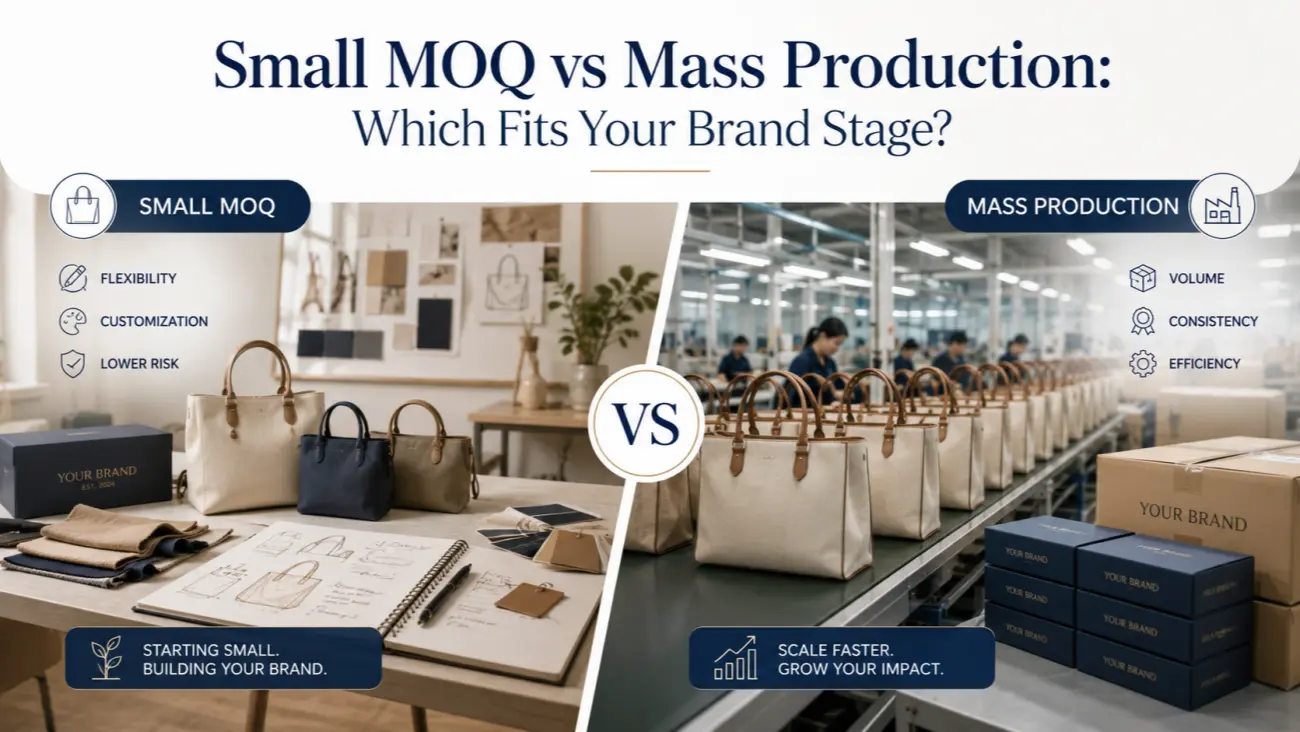
Cover Image: small-moq-vs-mass-production.jpg — Alt: Two production lines side by side — small batch handbag workshop and large-scale factory production — comparing MOQ and scale for B2B buyers | Description: A comparison visualization showing small-batch handbag production on one side and mass production on the other, helping brand owners decide which manufacturing model matches their current growth stage.
OG Image: small-moq-vs-mass-production-og.jpg
Small MOQ vs Mass Production: A 3-Phase Guide for Handbag Brands
Estimated reading time: 8 minutes
If you are starting a handbag brand, one of the first questions you will face is: should I order a small batch or go straight to mass production?
It sounds like a simple choice, but framing it as “either/or” is misleading. The real question is not which model is better — it is which phase your brand is in right now. Every successful handbag brand moves through a predictable journey: start small to test the market, grow gradually, and scale only when the data says yes.
This guide breaks that journey into three phases. For each phase, we cover what your order should look like, what it costs, and how to know when it is time to move to the next one.
If you are still mapping out your brand foundation, start with our step-by-step guide to starting a handbag brand.
Table of Contents
- Why This Isn’t an Either/Or Choice
- Phase 1: Testing — Why You Start with Small MOQ
- Phase 2: Growth — The Transition Zone
- Phase 3: Scale — When Mass Production Makes Sense
- Cost Comparison: Small MOQ vs Mid-Scale vs Mass Production
- How to Choose the Right Factory for Your Current Phase
- Conclusion — Grow at Your Own Pace
- References
Why This Isn’t an Either/Or Choice
Many first-time founders treat small MOQ and mass production as two separate paths. In practice, they are two stages of the same journey.
Think of it like this: you would not rent a warehouse before you know whether your product sells. You would test it first. Small MOQ is your test. Mass production is your scale. They serve different purposes at different times, and knowing when to use each one is what separates brands that grow steadily from brands that burn cash on unsold inventory.
In our experience, the brands that succeed are not the ones who pick the “right” model from day one. They are the ones who start small, learn fast, and increase their order size only when the market tells them to.
Phase 1: Testing — Why You Start with Small MOQ
A small MOQ (Minimum Order Quantity) is not “ordering less.” It is buying data instead of buying inventory.
Your first order’s real purpose is not to make a profit — it is to answer three questions:
- Does the product sell? Will customers actually pay for your bag at your target price?
- Does the market want more? Do people come back, share, or ask where to buy?
- Is the design right? Does the size, color, or material need adjustment?
A small MOQ order — typically 100 to 300 units per style — gives you answers to these questions for a fraction of the risk of a large order. You pay a slightly higher per-unit price (maybe $18–$25 instead of $12–$15), but your total investment stays manageable — typically $5,000 to $8,000 for a first run. Compare that to $30,000+ for a 1,000-unit order of a product you have never tested.
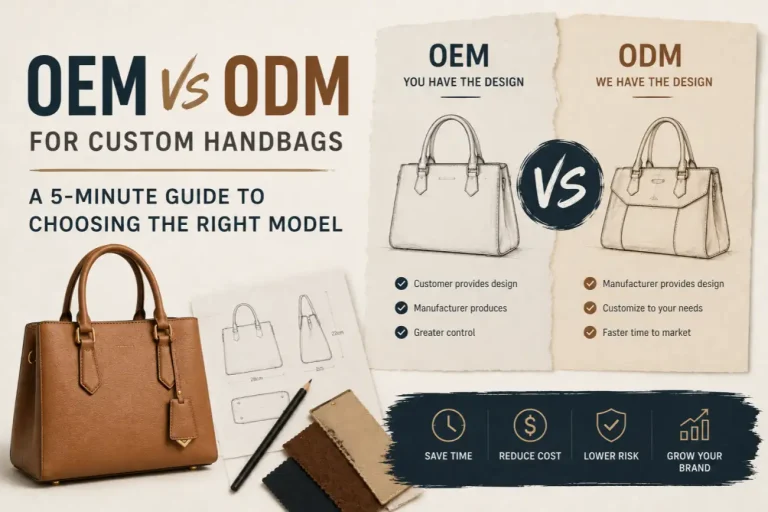
For most first-time founders, the smartest path is ODM (Original Design Manufacturing): choose an existing bag style from the factory, customize the material and color, and add your logo. This keeps MOQ low and sampling fast. For a full comparison of manufacturing models, see our OEM vs ODM guide for custom handbags.
One thing we see often: founders who skip this phase and go straight to a large order regret it. They end up with 800 unsold units in a warehouse and a design they wish they could change. A small batch is insurance against that mistake.
Phase 2: Growth — The Transition Zone
Your first small batch sold out — congratulations. Now comes the tricky part: scaling without overcommitting.
The growth phase is where most brands make their biggest mistake. They get excited by the first success and jump straight to 5,000 units. It works if demand is real, but if that first batch sold because of friends and family support, a 5,000-unit order will hurt.
The safer approach is gradual scaling: 300 → 1,000 → 3,000 units. Each step gives you a new data point about demand. Going too fast is the most common reason growing brands run into cash flow problems.
4 Signs You Are Ready to Move to the Next Level
Not sure if you are ready for a larger order? Look for these signals:
| Signal | What It Looks Like | Action to Take |
|---|---|---|
| Your first run sells out within 3 months | You are turning customers away or running backorder campaigns | Order 2× the previous quantity for the next run |
| Wholesale or retail partners ask to carry your bags | You receive inbound requests from boutiques or online retailers | Ask for their expected monthly volume and add it to your forecast |
| Your design is finalized with no further changes | You have not revised the pattern, material, or hardware in 2+ months | This is the right time to commit to a larger batch — you will not be stuck with a design you want to change |
| Repeat customers account for 15%+ of your sales | People are buying your bags more than once or recommending them | This is the strongest signal that demand is real and sustainable |
If three out of four signals apply to you, it is time to talk to your factory about mid-scale production. For guidance on evaluating whether your current factory can handle larger volumes, see our complete guide to choosing a custom handbag manufacturer.
Phase 3: Scale — When Mass Production Makes Sense
Mass production is not just “a bigger order.” It is a different production method with different economics, different timelines, and different requirements.
When you move to mass production (typically 1,000+ units per style), your factory shifts from flexible, multi-style production lines to dedicated, streamlined runs. The benefits are significant — your per-unit cost can drop by 30% to 50% — but the requirements also change:
- Higher material minimums. Factories must order larger rolls of fabric and more hardware components, which increases their own MOQ commitment.
- Longer lead times. A 300-unit order might take 25 days. A 5,000-unit order takes 40 to 55 days because material sourcing and production scheduling take longer.
- QC becomes a system, not a checklist. At scale, quality control moves from “check each bag” to “AQL sampling with dedicated QC staff.”
Mass production is right for you when: your small batches sell out consistently across multiple runs, you have wholesale accounts that require steady supply, and you have the working capital to fund a larger order. It is wrong for you when: you are still testing designs, your demand is seasonal and unpredictable, or you are not yet sure which styles will be your long-term sellers.
For the QC systems that become critical at this stage, see our custom handbag quality control checklist.
Cost Comparison: Small MOQ vs Mid-Scale vs Mass Production
The table below shows typical cost ranges across three production scales. These are real-world figures based on PU leather shoulder bags of similar complexity.
| Scale | Order Qty | Per-Unit Cost (FOB) | Total Investment | Typical Lead Time | Risk Level |
|---|---|---|---|---|---|
| Small MOQ | 100–300 pcs | $18–$25 | $1,800–$7,500 | 20–30 days | Low (small investment) |
| Mid-Scale | 500–1,000 pcs | $12–$18 | $6,000–$18,000 | 30–40 days | Medium |
| Mass Production | 2,000–5,000+ pcs | $8–$12 | $16,000–$60,000+ | 40–55 days | Higher (larger upfront) |
Key takeaway: Mass production cuts per-unit cost by roughly half compared to small MOQ, but your total investment jumps 3× to 8×. That is a worthwhile trade — but only if you have confirmed demand at the lower scale first.
How to Choose the Right Factory for Your Current Phase
Not every factory is right for every phase. A factory that is excellent for small MOQ may not be efficient for mass production, and vice versa.
For Phase 1 (Small MOQ): Look for factories that specialize in low MOQ production. Ask directly: “Can you do 200 units with custom materials and logo?” The right factory will say yes and explain how they handle small runs efficiently. Many factories are set up for mass production only; they are not a good fit for a 200-unit test run, and they will quote you a high price to discourage small orders.
For Phase 2 (Growth): This is the time to evaluate whether your current small-batch factory can handle larger volumes. Some can — they have flexible production lines that scale. Others cannot — they are optimized for small batches and will struggle with consistency at 1,000+ units. Have an honest conversation with your factory operator about their capacity before placing the next order.
For Phase 3 (Mass Production): You need a factory with dedicated QC systems, certified processes (ISO 9001, BSCI), and the ability to lock in material supply. Small-batch flexibility matters less at this stage; reliability and consistency matter most.
Regardless of your phase, the sampling process remains critical. You should always request and approve a physical sample before committing to bulk production, at any scale. See our custom handbag sample process guide for the full workflow.
Conclusion — Grow at Your Own Pace
Small MOQ and mass production are not competing strategies. They are tools for different stages of your brand’s growth. Use small MOQ to test and learn. Use mid-scale to confirm and build. Use mass production to scale and profit.
Here is a simple way to decide where you are today:
- If you have not placed your first order yet → Start with 100–300 units through ODM or a small OEM run. Do not skip this step.
- If your first run sold out and you have 2+ of the 4 scaling signals → Move to 500–1,000 units. Do not jump to 5,000.
- If you have successfully scaled through 2+ rounds and demand is stable → Talk to your factory about mass production pricing.
Ready to discuss your current phase? Contact us with your target quantity and bag type, and we will recommend the best production approach for where you are right now.
References
- McKinsey — The State of Fashion Report 2026 — Industry research on emerging brand production strategies, inventory management, and scaling best practices in the global fashion industry.
- ISO 9001:2015 — Quality Management Systems — International standard for quality management frameworks used by professional bag manufacturers in mass production settings.
- Entrepreneur — Scaling Production: A Guide for Small Business Owners — Practical framework for knowing when and how to scale from small-batch to volume manufacturing.
- Statista — Handbag Market Overview & Consumer Segments — Market sizing data on handbag brand growth stages and production volume distribution across market tiers.
- NC State Supply Chain Resource Cooperative — Economic Order Quantity Model — Academic framework for calculating optimal order quantities that balance setup costs and inventory carrying costs.