Estimated Reading Time: 7 minutes
If you are planning to launch a private label leather bag line, the first question is almost always the same: how much will it actually cost per bag? The short answer is that a private label leather bag typically ranges from $9 to $55 per unit (EXW, excluding shipping), depending on material choice, order quantity, and customization depth. But understanding where each dollar goes — and which costs you can control — makes the difference between a profitable first order and a margin-eating mistake. In this guide, we break down every component of the cost so you can evaluate factory quotes with confidence.
Table of Contents
The 3 Factors That Determine Your Bag’s Final Unit Cost
Before diving into specific numbers, it helps to understand the three variables that drive virtually every dollar of your quote. In our experience working with first-time buyers, these three factors account for 80% of the price variation between different factory quotes.
1. Material Grade. This is the single biggest cost driver. The difference between PU leather and full-grain cowhide can be 3–5x per square foot. Since a medium-sized handbag uses about 3–5 square feet of material, this gap alone can swing your unit cost by $10–20. Many buyers compare prices across different material grades without realizing it — a $12 quote on PU simply cannot be compared to a $28 quote on top-grain leather.
2. Order Quantity (MOQ). Factories purchase materials and schedule production lines in bulk. A 200-piece order might cost 30–40% more per unit than a 1,000-piece order for the same bag. The difference comes from material procurement (factories get volume discounts from tanneries) and production efficiency (longer production runs mean fewer machine changeovers).
3. Customization Depth. There are three levels: white label (pick a stock design, add your logo), private label (modify materials and hardware on an existing design), and full OEM/ODM (develop a completely new design). Each step up adds 15–40% to the unit cost plus one-time development fees. Your choice here determines both your cost structure and your product’s uniqueness in the market.
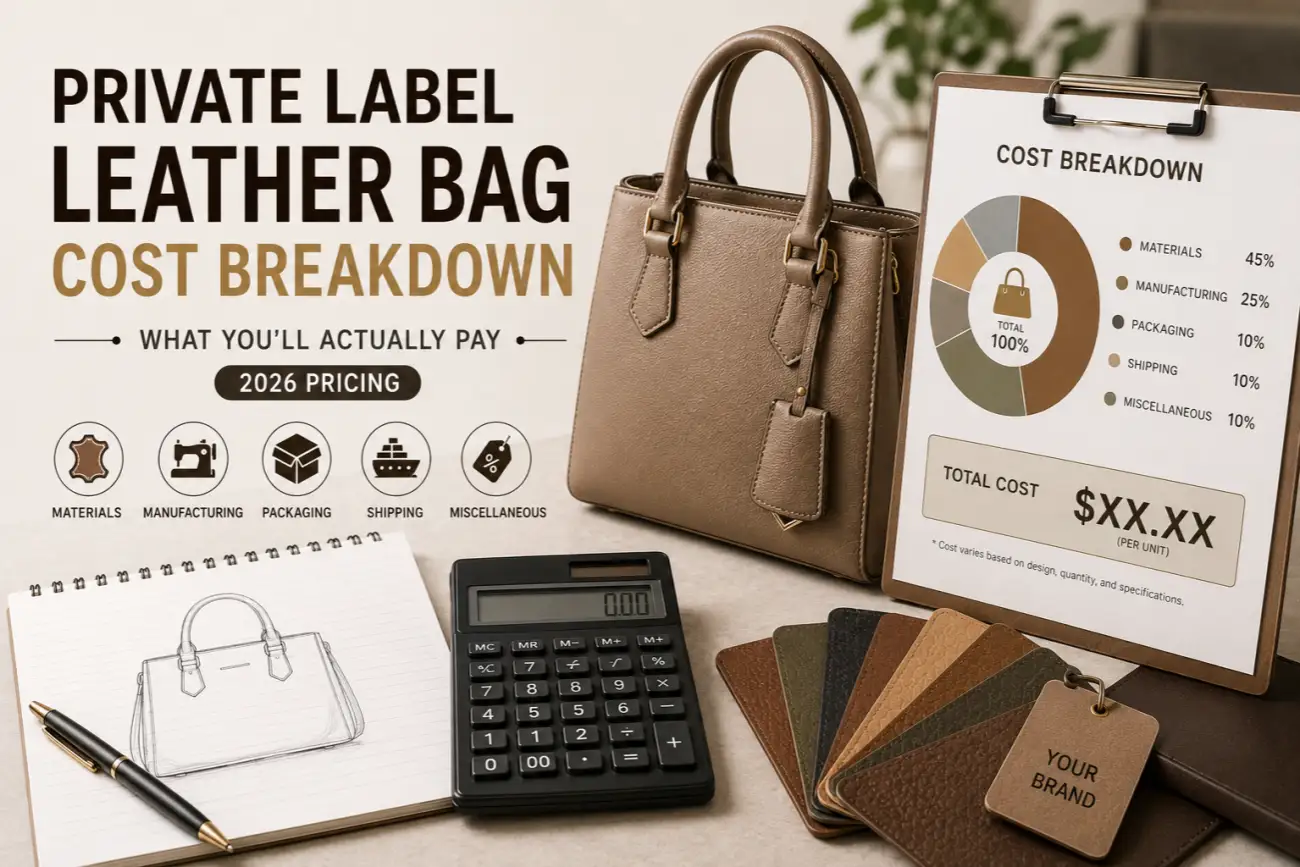
As a rough framework, the total cost of a private label leather bag typically splits as: materials 35–40%, manufacturing labor 25–30%, hardware and findings 8–12%, packaging 5–8%, mold and development 5–10%, and factory overhead and profit covering the remainder.
Breaking Down Material & Manufacturing Costs
Materials and manufacturing together represent roughly 65–70% of your total unit cost. Getting this part right — and knowing where to compromise and where not to — is the most important budgeting decision you will make.
Leather & Material Cost by Grade
Leather is priced per square foot, and the grade you choose sets the baseline for everything else. Here are typical factory-procurement ranges in 2026:
- PU leather (polyurethane): $0.80–$1.50 per sqft — the most cost-effective option, consistent in texture and color. Best for entry-level price points and fashion-forward styles that change seasonally.
- Microfiber/synthetic leather: $1.20–$2.50 per sqft — more durable than PU with a leather-like feel. A good middle ground for mid-range brands.
- Genuine leather (split/corrected): $1.50–$3.00 per sqft — real leather but with the surface sanded and embossed. Acceptable for budget leather lines but limited durability.
- Top-grain leather: $3.00–$5.00 per sqft — the top layer sanded and finished. Better durability and a more consistent appearance.
- Full-grain leather: $4.00–$8.00 per sqft — the highest grade, retaining the natural grain. Each hide is unique and develops a patina over time. Premium positioning only.
From what we see in bulk production, many first-time buyers overspend on leather grade out of fear of “low quality.” A mid-range PU or microfiber is perfectly appropriate for a first collection — it lets you test market response without committing $8/sqft material costs to an untested design. For a deeper comparison of leather types, read our Types of Leather for Handbags guide and the Leather Quality Grades guide.
Hardware & Findings
Hardware is a smaller line item but one where the price-to-perception ratio is extremely favorable. A YKK zipper costs about $0.60 per bag versus a generic zipper at $0.30, but customers notice smooth zipper action immediately. Key hardware components and their typical per-bag costs: main zipper ($0.30–0.80), zipper pull ($0.10–0.30), D-rings and swivel clips ($0.05–0.20 each), magnetic snap ($0.15–0.40), and logo plate or branded rivet ($0.30–1.50).
Manufacturing Labor by Process
Labor is the second-largest cost component. The complexity of your bag design directly controls this number. A simple tote with minimal internal pockets costs about $5–7 in labor. A structured handbag with multiple compartments, piped edges, and reinforced handles can cost $10–16 in labor alone. The breakdown typically includes cutting and skiving ($1.50–3), machine stitching and assembly ($3–8), edge painting and finishing ($1–3), and final assembly and packing ($0.50–1.50). One common mistake we see is adding too many internal pockets on a first order — each extra pocket adds roughly $0.50–1.00 in stitching labor. For a guide on what to check when your bags arrive, see our Wholesale Leather Handbags QC Checklist.
One-Time Costs First-Time Buyers Often Forget
These are the expenses that do not appear in your per-unit price but show up as separate line items on your invoice. Many first-time buyers focus entirely on the unit cost and are surprised when the total invoice is 15–25% higher than expected.
Mold & Tooling Costs. If your design requires custom hardware — a branded zipper pull, a unique clasp, a custom logo plate — the factory needs to make a mold first. Stamping molds (for logo plates) run $80–200 per set. Die-cast molds (for 3D hardware like clasps and buckles) run $200–800 per set. Cutting dies for leather pieces run $50–150 per design. Savings tip: choose from the factory’s existing hardware catalog for your first order. This alone can save $200–800 in mold costs. Read our Private Label vs OEM vs ODM guide for how these costs differ by production model.
Sample Development. Most factories charge $150–500 per style for the first sample. This covers pattern making, manual cutting, sample stitching, and material sourcing in small quantities. Reputable factories will deduct the sample fee from your bulk order if you proceed to production — always confirm this policy before paying.
Packaging & Branding. Packaging costs vary by the impression you want to make. An OPP poly bag costs $0.02–0.05 per unit. A non-woven dust bag costs $0.30–0.80. A custom-printed rigid box with foam insert costs $1.50–3.50. One thing to consider: customers keep and reuse dust bags, while boxes go in the trash. Spending your packaging budget on a quality dust bag and a well-designed hang tag often delivers better perceived value than an elaborate box.
3 Real Cost Scenarios: Budget vs Mid-Range vs Premium
To make this concrete, here are three scenarios for a standard 14-inch tote bag produced in 2026. All prices are EXW (Ex-Works, excluding shipping and duties).
In our experience, the mid-range scenario is the most common choice for a first private label order. It gives you genuine leather, quality hardware that customers notice, and packaging that supports a mid-tier retail price. Once you validate demand with the first sell-through, you can expand into premium or budget extensions. For a list of factories that work with first-time brands, see our Top 10 Private Label Manufacturers review.
Know Your Budget, Start Your Quote
A private label leather bag will cost you somewhere between $9 and $55 per unit depending on five variables: leather grade, hardware quality, packaging level, order quantity, and whether you need custom molds. The single most important takeaway is this: know your target retail price first, then work backward to find your allowable manufacturing cost.
If you are ready to get a ballpark quote for your specific bag design, the next step is to contact 3–5 factories with the same spec sheet — material type, quantity, target price, and packaging requirements — and compare their line-item breakdowns. A factory that gives you a transparent cost breakdown (not just a lump sum) is a factory you can trust.
We can give you a rough idea within 24 hours. Send us your target specs — style, material preference, target quantity, and target price range — and we will respond with a detailed cost estimate.
References
- HanLin Bags — How Much Does It Cost to Manufacture a Handbag in 2026? — Industry cost ranges for PU, genuine leather, and premium handbag manufacturing tiers.
- China Handbag Factory — Material Cost Breakdown: Hardware vs Leather vs Labor — Detailed percentage breakdown of handbag cost structure by component.
- Bags Rain — How Much Does It Cost to Manufacture a Handbag? — Practical cost guide for fashion brands covering materials, hardware, and labor.
- Bags Plaza — Leather Bag Cost Breakdown (Factory Pricing Explained) — Factory-level breakdown of leather bag cost drivers including MOQ effects.
- SourcifyChina — Sourcing Brand Bags Manufacturers in China: The Ultimate Guide 2026 — Regional cost comparison across China’s bag manufacturing clusters.