This guide gives you a clear baseline for what most people mean by a “standard backpack,” plus practical rules for choosing the right size for commuting, school, weekend trips, and flights.
Quick Answer: What Is a Standard Backpack Size?
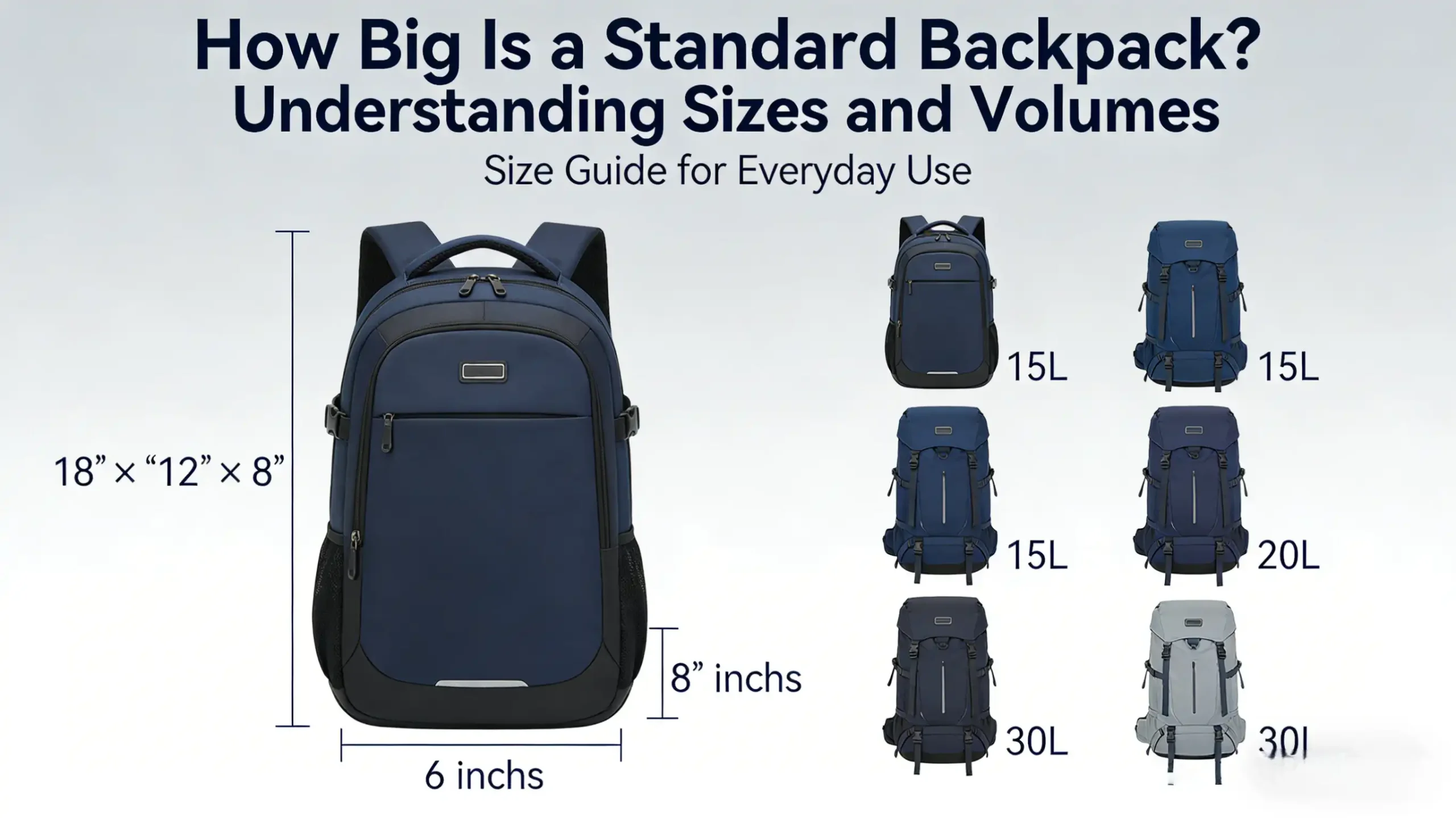
A “standard backpack” usually means an everyday backpack that works for commuting, school, and general daily use. In practical terms, that’s typically:
- Capacity: about 20–30 liters
- Outer dimensions (typical range): around 45–50 cm tall, 30–35 cm wide, 15–20 cm deep (roughly 18–20 in tall, 12–14 in wide, 6–8 in deep)
That range fits a laptop, charger, water bottle, a light jacket, and everyday essentials without feeling bulky on public transit or in an office.
[Image suggestion: A simple infographic showing 20L vs 25L vs 30L silhouettes with typical dimensions in cm and inches.]
Liters vs. Dimensions: Why Both Matter
Here’s the simplest way to think about it:
- Liters (L) tell you “how much stuff” the bag can hold in total.
- Dimensions (H × W × D) tell you “where the bag can go” (under a seat, in a locker, inside an overhead bin, under your desk).
When shopping, liters are great for comparing bags in the same category. But dimensions are what matter most if you care about air travel or tight spaces.
Quick rule: If you fly often, treat liters as a rough hint and use dimensions as the final decision.
How Backpack Volume Is Measured (and Why It Varies)
Not every brand measures volume the same way. Some include all pockets. Others mainly count the main compartment and a few zip pockets. That’s why two “30L” backpacks can feel very different in real life.
To compare volumes across regions, you’ll also see cubic inches used in some markets. A helpful conversion is:
- Liters ≈ cubic inches ÷ 61
- Cubic inches ≈ liters × 61
This isn’t something you need to calculate every day, but it’s useful when you’re comparing older U.S. specs to liter ratings.
Why “shape” matters: A tall, narrow backpack might technically be 28–30L, but it can pack awkwardly because bulky items don’t stack well. A boxier bag of the same volume often feels larger because you can use more of the space efficiently.
[Image suggestion: A side-by-side photo: tall/narrow backpack vs boxy backpack, both labeled 30L, showing how packing cubes fit differently.]
What Fits in 20L, 25L, 30L, 35L, 45L (Examples)
Use these as real-world expectations, not strict rules:
20L (minimal daily carry)
- 13″ laptop or slim 14″ laptop
- Charger + small accessories pouch
- 500–750 ml bottle
- Light jacket or compact umbrella
25L (most “standard” for commuters)
- 15″ laptop + notebook/folder
- Lunch box + bottle
- Extra layer (hoodie) with less “bulge”
- Space left for daily items (keys, headphones, small camera)
30L (school + gym + busier days)
- 15″ laptop + thicker books
- Gym clothes/shoes (depending on compartment layout)
- Better for people who carry more “just in case” items
35L (borderline travel territory)
- 2–3 days of clothing with packing cubes
- Toiletries pouch + tech pouch
- Often too deep when overpacked, so check dimensions
40–45L (one-bag travel / carry-on style packs)
- 3–5 days of clothing (or more with minimalist packing)
- Works best with clamshell opening and compression straps
- More likely to hit airline size/weight limits depending on carrier
If your product line includes both everyday and travel backpacks, it helps to separate them clearly: “Standard daily backpacks (20–30L)” vs “Carry-on travel backpacks (35–45L).”
Standard Backpack vs. Carry-On Backpack: What to Check
Many people assume “TSA size” is a single universal rule. It isn’t. The airline decides cabin baggage size limits, and they can vary by route and aircraft. TSA notes that carry-on size dimensions allowed in the cabin vary by airline and recommends contacting your airline for what fits overhead or under-seat (TSA FAQ).
That said, one common benchmark in the U.S. market is around 22 × 14 × 9 in for carry-on. For example:
- Delta states carry-on items may not exceed 22″ × 14″ × 9″ (Delta Carry-On Baggage).
- American Airlines lists carry-on maximum size as 22 × 14 × 9 in including handles and wheels, and it must fit in the airport sizer (American Airlines Carry-on bags).
Practical takeaway: If you want a backpack that’s “carry-on safe” for most situations, keep an eye on depth. Depth is the easiest dimension to fail once you overpack or use expandable panels.
[Image suggestion: A photo showing how to measure a backpack including handles and the “bulge” from front pockets; highlight depth as the common failure point.]
How to Measure Your Backpack Correctly (at Home)
You don’t need special tools—just a tape measure and a realistic packing test.
- Pack it like you actually travel: Don’t measure an empty, flat bag if you’ll use it full.
- Measure the outer shell: Height, width, and depth at the widest points.
- Include what sticks out: Top handle, rigid back panel curve, and stuffed front pockets.
- Check where it must fit: Under-seat needs smaller depth; overhead bin needs overall limits by airline.
If you’re buying online and can’t test, prioritize brands that show both dimensions and capacity, and that include photos of the bag next to a person for scale.
Common Shopping Mistakes That Make a Backpack Feel Smaller
- Over-trusting liters: “30L” doesn’t always mean roomy if the main compartment is split into many thin sections.
- Ignoring the opening: A narrow top opening makes packing frustrating even if the volume is decent.
- Not checking laptop fit: Laptop screen size isn’t the same as laptop body size. A “15-inch” sleeve can vary by brand.
- Forgetting weight distribution: A bag can be the right size but uncomfortable if the straps and back panel are weak.
- Choosing deep bags for commuting: Deep bags hit people on trains and feel clumsy in offices.
Choosing the Right Size by Use Case (Simple Cheat Sheet)
- Office commute: 20–25L, slim profile, protected laptop sleeve, easy-access pocket.
- School: 25–30L, stronger zippers, better organization, comfortable straps.
- Day hike / city walk: 20–30L, breathable back panel, bottle pockets.
- Weekend trip: 30–35L if you pack light; 35–45L if you want one-bag travel style.
- Frequent flights: Choose by dimensions first, then liters; keep depth conservative.
Need help selecting the right structure and size for your market? Explore our backpack options and manufacturing support:
custom backpack,
backpack manufacturer,
custom travel bags,
contact us.
[Image suggestion: A “size chooser” graphic: use-case icons (work, school, travel, hiking) mapped to recommended liters and typical dimensions.]
For Brands: How to Spec a “Standard Backpack” for OEM/ODM
If you’re building a backpack line (not just buying one), the word “standard” can mean different things depending on your customer and sales channel. Here are practical specs that make your product easier to market and easier for customers to choose.
1) Define your “standard” customer
- Commuter standard: 20–25L, slim depth, laptop-first design.
- Campus standard: 25–30L, heavier load comfort, larger main compartment.
- Travel standard: 35–45L, clamshell opening, compression straps, carry-on focus.
2) Write specs in a way customers can understand
- Show capacity (L) and outer dimensions (cm/in) on the same line.
- List laptop size fit and the actual sleeve dimensions when possible.
- Be honest about pockets: customers care more about usable space than a long pocket list.
3) Don’t promise “fits every airline”
Airline rules can change and vary. Instead, use language like: “Designed around common carry-on benchmarks; always check your airline’s current limits.” This aligns with TSA guidance that size dimensions vary by airline (TSA FAQ).
References