Estimated Reading Time: 7 minutes
This guide breaks down the real differences between cowhide, sheepskin, and goatskin from a wholesale manufacturing perspective. By the end, you will know exactly which leather fits your handbag style, budget, and order volume.
Table of Contents
What Makes Cowhide, Sheepskin & Goatskin Different?
Cowhide, sheepskin, and goatskin come from different animals, and each has a distinct fiber structure that determines how it behaves in bag production.
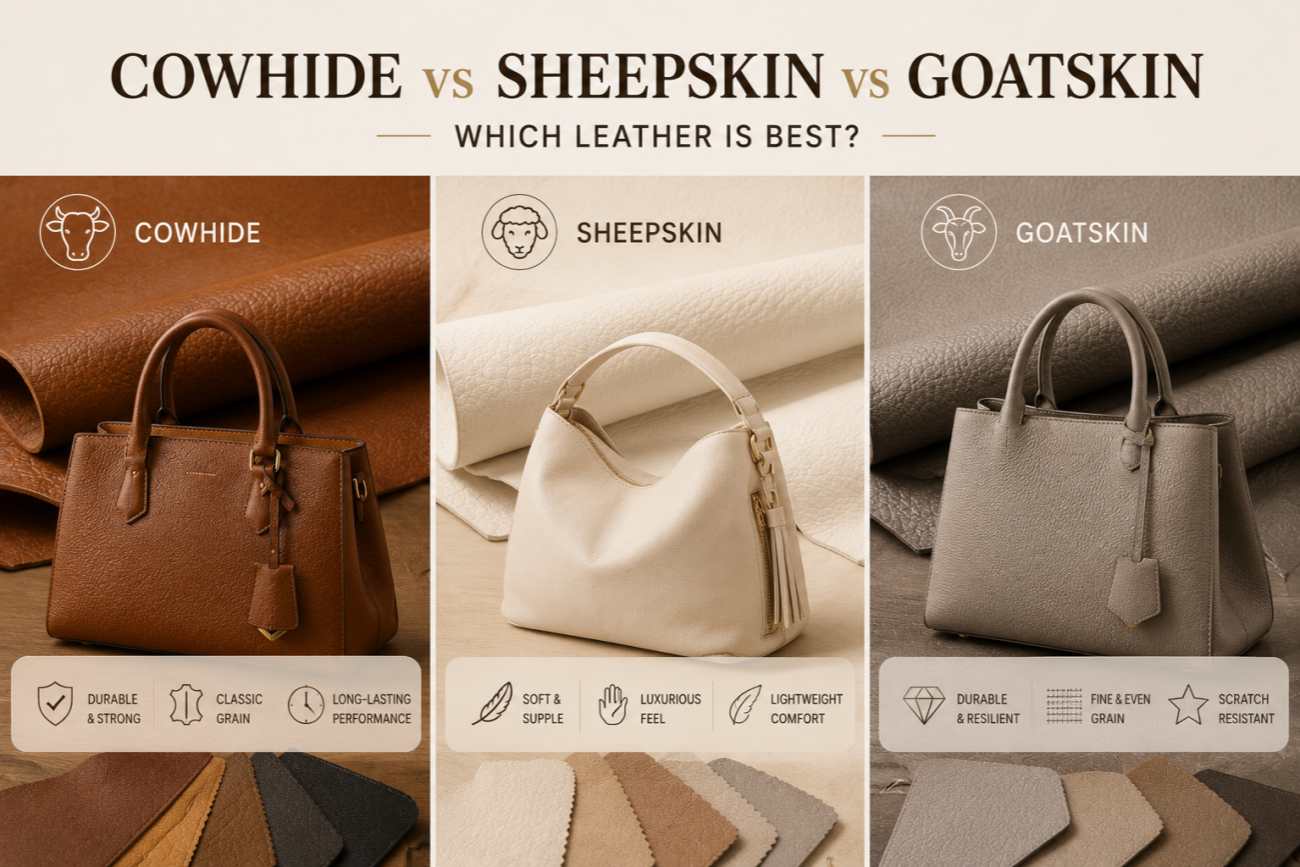
Cowhide is the thickest and most durable of the three. It comes from mature cattle and has a dense fiber structure with a pronounced natural grain. Cowhide typically ranges from 1.2 mm to 2.0 mm in thickness and is the most widely used leather in the world, accounting for roughly 65% of global leather production.
Sheepskin is the softest and lightest option. Its fibers are fine and loosely woven, giving it a supple, almost fabric-like drape. Sheepskin is thinner — usually 0.8 mm to 1.2 mm — and is prized for its comfort and elegant feel rather than its structural strength.
Goatskin sits in a sweet spot between cowhide and sheepskin. It has a naturally pebbled grain, high natural oil content, and a tight fiber structure that gives it remarkable tear resistance despite being thinner than cowhide. From what we see in bulk production, goatskin is often chosen for premium handbags where both durability and a refined finish are required.
Side-by-Side Comparison: Cowhide, Sheepskin & Goatskin for Handbags
The table below summarizes the key differences at a glance. These are the dimensions that matter most when evaluating leather for wholesale handbag production.
| Property | Cowhide | Sheepskin | Goatskin |
|---|---|---|---|
| Thickness | 1.2 – 2.0 mm | 0.8 – 1.2 mm | 0.9 – 1.3 mm |
| Durability | Excellent | Fair | Very Good |
| Softness | Medium | Excellent | Good |
| Scratch Resistance | High | Low | High |
| Tear Strength | High | Low – Medium | High |
| Weight per sq ft | Heavy | Light | Medium – Light |
| Price per sq ft (wholesale) | $2 – $4 | $3 – $6 | $4 – $8 |
| Best Bag Application | Structured totes, backpacks, travel bags | Soft hobos, slouchy shoulder bags, evening clutches | Premium handbags, crossbody bags, logo-embossed styles |
Many buyers focus on price first, but the real cost of a leather choice shows up in production yield and customer returns. For wholesale orders, we usually suggest looking at durability and cutting yield first, then narrowing down by price.
How to Match Leather Type to Your Handbag Collection
Choosing the right leather is not about which is “best” overall — it is about which is best for a specific handbag style and target customer. Here is how we typically match leather to bag type for our buyers.
Cowhide: Best for Structured, Everyday Carry Bags
If your collection includes tote bags, structured shoulder bags, or travel duffles, cowhide is the most practical choice. Its thickness and rigidity help these bags hold their shape over years of daily use. Cowhide also resists scratches and scuffs better than other leathers, which matters for bags that go through airport security or busy commutes.
One common mistake we see is choosing sheepskin for a structured tote and then needing heavy interfacing to compensate. This adds cost and changes the hand feel. If the design requires structure, start with cowhide. It is also the most cost-effective option for bulk production — cowhide hides are large (45–55 sq ft each), which means fewer cuts and less waste per order.
Sheepskin: Ideal for Soft, Draped Silhouettes
Sheepskin shines in bags that are meant to be soft and unstructured — hobo bags, slouchy shoulder bags, and delicate evening clutches. Its lightweight feel and natural drape make it a favorite for brands targeting a feminine, luxury aesthetic.
However, sheepskin requires careful handling in production. Its lower tear strength means seams need reinforcement, and it is not ideal for bags that will carry heavy loads daily. For wholesale orders, we usually suggest sheepskin for smaller bags or lined designs where the outer leather is protected from direct abrasion. If you are ordering for the first time, request a cutting test first — sheepskin yield can vary significantly by hide.
Goatskin: The Premium Choice for Durability & Texture
Goatskin is increasingly popular among handbag brands targeting the $200+ retail price point. Its natural pebbled texture gives bags a distinctive look without needing embossing, and its tight fiber structure makes it highly resistant to tearing and abrasion.
A reliable manufacturer will tell you that goatskin also performs exceptionally well with detail work. In our bulk production, goatskin takes edge paint, foil stamping, and embossed logos more cleanly than cowhide — the surface is dense enough to hold crisp lines without bleeding. This makes it an excellent choice for bags with prominent branding or intricate stitching details.
This may sound like a small detail, but goatskin also develops a beautiful patina over time while maintaining its structural integrity. For buyers building a premium handbag line, this combination of durability, texture, and aging behavior is hard to beat.
Wholesale Cost & Ordering Considerations
Price matters, but unit cost is only one part of the equation. The table below gives a realistic view of what to expect when ordering these leathers in bulk.
| Factor | Cowhide | Sheepskin | Goatskin |
|---|---|---|---|
| Wholesale price / sq ft | $2 – $4 | $3 – $6 | $4 – $8 |
| Typical MOQ (sq ft) | 500 – 1,000 | 300 – 800 | 300 – 800 |
| Common thickness for bags | 1.4 – 1.8 mm | 0.8 – 1.0 mm | 1.0 – 1.2 mm |
| Custom finishing options | Wide (embossed, glazed, waxed, matte) | Moderate (aniline, semi-aniline, nappa) | Wide (pebbled, smooth, glazed, embossed) |
| Sampling lead time | 7 – 14 days | 10 – 18 days | 10 – 18 days |
| Bulk production lead time | 25 – 40 days | 30 – 45 days | 30 – 45 days |
Cowhide offers the best price-to-performance ratio for high-volume orders, especially for everyday bag styles. Goatskin commands a premium but can justify a higher retail price point. Sheepskin sits in the middle — its cost is moderate, but its lower durability means you may face more customer service issues over time.
If you are sourcing for the first time, we always recommend requesting a sample set in all three leathers. This allows you to physically compare hand feel, weight, and color accuracy before committing to a full production run. For pricing tailored to your specific order volume and finishing requirements, reach out with your bag specs and target quantity.
Conclusion: Build Your Handbag Line with the Right Leather
There is no single “best” leather for handbags — only the best fit for your specific collection. Cowhide delivers unmatched durability and value for structured everyday bags. Sheepskin offers luxury softness for elegant, low-impact designs. Goatskin provides the ideal balance of toughness, texture, and premium appeal.
What this means for you as a buyer is simple: define your target bag style and retail price point first, then work backward to the leather that fits. A reliable manufacturer should be able to guide you through the trade-offs and provide sample swatches for comparison before you commit to bulk production.
Ready to start your handbag line?
Contact us to request a leather swatch set — we will send you samples of cowhide, sheepskin, and goatskin with pricing tailored to your order volume.
References
- Szoneier Leather — Cowhide vs Goat vs Sheepskin for Leather Goods: What’s Stronger and What Feels Better — Detailed comparison of leather types from a handbag manufacturer’s perspective.
- Alibaba Product Insights — Inside Raw Animal Skins and Hides: Key Features, Material Standards, and Application Guidelines — Industry overview of common leather types, their properties, and best-use applications.
- Lauburu Spain — Types of Leather Used in Leather Goods and Their Characteristics — Expert guide on leather selection for bag and accessory manufacturing.
- Himalayan Bits — Cow, Goat, Sheep or Buffalo Leather: Which Animal Leather Is Best for Bags? — Comparison of leather qualities for bag production, covering strength and style factors.
- Gionar — What Is Sheepskin Leather? How Is It Made? Is It Durable, Waterproof? — In-depth analysis of sheepskin leather properties, durability, and manufacturing considerations.