Estimated reading time: 7 minutes
If you are researching how to launch a handbag line, you have probably seen these four terms — private label, OEM, ODM, and white label — used interchangeably. But they describe very different relationships between you and the factory, and choosing the wrong model can cost you thousands in unnecessary tooling costs or leave you with a product that looks just like everyone else’s. In this guide, we break down each model from a manufacturer’s perspective so you can pick the right one from day one.
Table of Contents
- What Do These Terms Actually Mean?
- The 4 Models Compared at a Glance
- Four Business Scenarios — Which Model Fits Your Situation
- Cost & MOQ Breakdown by Model
- How to Choose the Right Model for Your Handbag Line
- References
- Conclusion — Start Your Handbag Sourcing with Clarity
What Do These Terms Actually Mean?
Here is what each term means in the context of handbag manufacturing, from the lowest to highest level of customization:
- White Label: The factory produces a standard handbag design and sells it to multiple buyers. You add your brand label and sell it as your own. No design changes — simply pick from the catalog and brand it. This is the fastest and least expensive way to start.
- Private Label: You select existing designs from the factory’s catalog and request modifications — changing the material, color, hardware, or size — before branding it with your logo. You get a more distinct product than white label without the cost of full custom development.
- ODM (Original Design Manufacturing): The factory presents their own original designs, and you choose one to develop further. You can adjust the specifications, but the core design belongs to the factory. This is common for brands that have a style direction but no in-house design team.
- OEM (Original Equipment Manufacturing): You provide the complete design — tech pack, sketches, material specs — and the factory produces it exactly to your specifications. You own the design. This gives you the most control and the highest level of product uniqueness.
From what we see with first-time buyers, one common mistake is assuming “private label” and “white label” mean the same thing. They do not — and the difference affects your pricing flexibility and brand differentiation. If you walk into a conversation using the wrong term, the factory may quote you for the wrong service.
The 4 Models Compared at a Glance
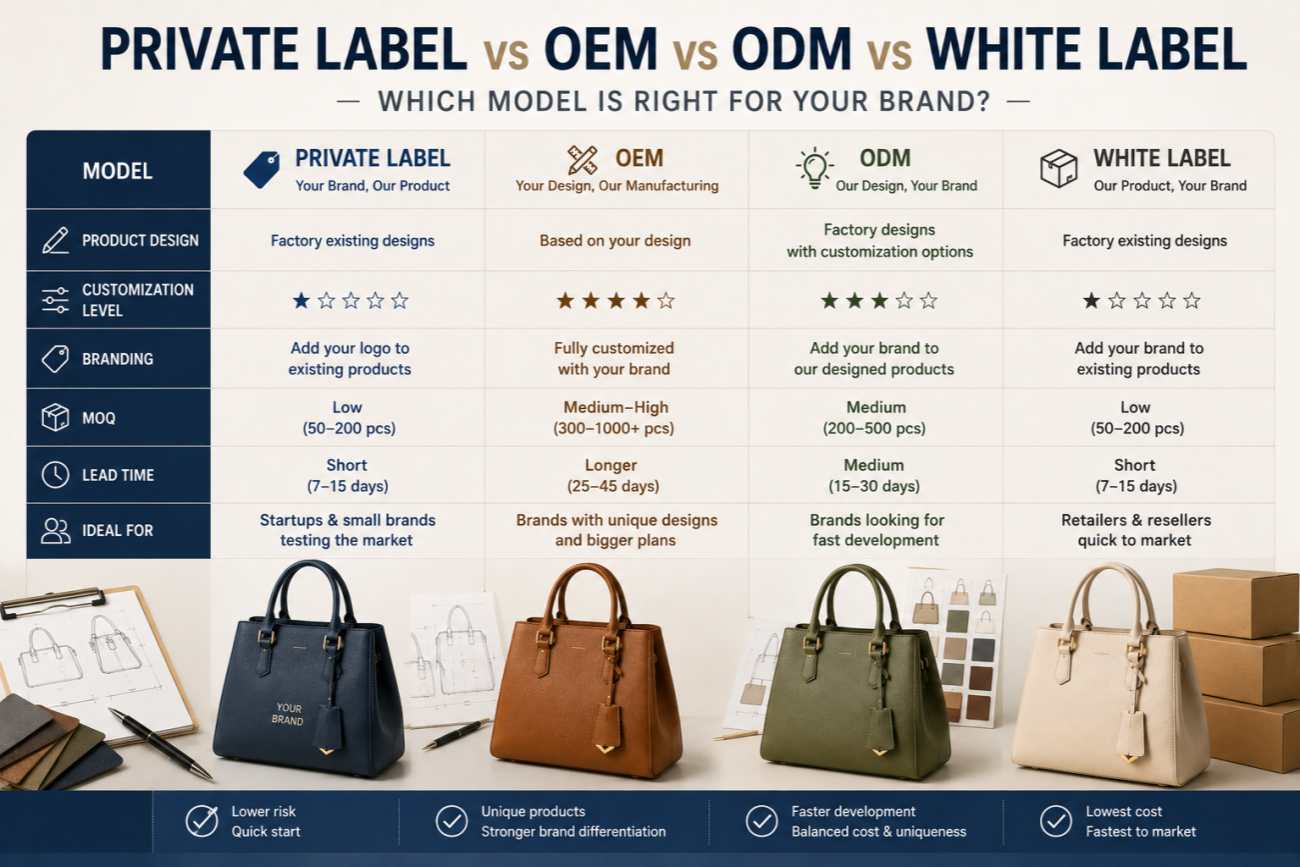
Here is how the four models stack up across the factors that matter most when making your sourcing decision:
This table gives you a quick overview, but the right choice depends heavily on where your brand is today. The next section walks through the most common scenarios.
Four Business Scenarios — Which Model Fits Your Situation
Rather than thinking in abstract terms, let us look at real situations we see regularly from our clients. Find the one that matches your current stage.
Scenario 1: You Are a Startup Testing the Market
White label or private label is your best starting point. You do not need exclusive designs yet — you need to validate that your target customers will buy your handbag. Pick 2-3 styles from a factory’s existing collection, add your branding, and launch a small batch. The total investment is low, and the time to market is the shortest of all four options.
Sourcing tip: With a white label or private label order at 50-100 pieces, you can test your pricing, packaging, and product-market fit before committing to larger volumes.
Scenario 2: You Have an E-Commerce Brand and Want Differentiation
If you have already validated the market and now need products that stand out from competitors, private label or ODM is the next step. Keep the proven silhouette from the factory’s catalog but change the material — switch from PU to genuine leather, adjust the hardware finish from silver to gold, or add a custom lining color. Your customers will see a distinct product without you paying for full custom tooling.
Sourcing tip: For wholesale orders, we usually suggest starting with 200-300 pieces per SKU. This gives you room to test 2-3 variations without overcommitting inventory.
Scenario 3: You Are an Established Brand with a Design Team
OEM is the natural choice when you have in-house designers who can create complete tech packs. You own the design, which means no other brand can sell the same product. The factory follows your exact specifications for materials, dimensions, stitching, hardware, and packaging. This is the highest-investment option but also the one that builds the strongest brand equity.
Sourcing tip: OEM requires a prototype sample before bulk production. Budget 7-10 days for sample making and allow for 1-2 rounds of revisions. Expect production lead time of 35-50 days depending on order complexity.
Cost & MOQ Breakdown by Model
Understanding the cost structure helps you match the model to your budget. Note that these are general reference ranges — your actual quote will depend on design complexity, material choice, and order volume:
This may sound like a small detail, but the upfront development cost is often the deciding factor for new brands. White label and private label keep your initial cash outlay low, while OEM requires a larger upfront investment before you see a single finished bag.
How to Choose the Right Model for Your Handbag Line
If you are still unsure, ask yourself these four questions. Your answers will point you to the right model:
- Do you have complete design specifications (tech pack, sketches, measurements)?
➜ Yes → OEM. No → Go to question 2. - Do you have a specific style direction but no complete design?
➜ Yes → ODM. No → Go to question 3. - Do you want to modify existing designs (change material, color, hardware)?
➜ Yes → Private label. No → Go to question 4. - Do you want the fastest and most affordable way to start selling?
➜ Yes → White label.
Many buyers focus on the unit cost first, but the total cost of getting to market — including development fees, sampling rounds, and the time investment — is what really matters. If you are ordering for the first time, white label or private label lets you learn the process without a major financial commitment.
When you contact a manufacturer, be specific about your situation. Tell them your target market, your budget range, and whether you have existing designs. A good manufacturer will recommend the most suitable model rather than pushing you toward the most expensive option.
Conclusion — Start Your Handbag Sourcing with Clarity
There is no single “best” model — only the one that matches your brand’s current stage, budget, and design needs. White label gets you to market fastest with the least risk. Private label gives you differentiation without full custom costs. ODM works well for brands with style direction but no complete design. OEM is the gold standard for established brands with full design control.
The most important step is to start the conversation with a clear understanding of what you need, and choose a manufacturer who is transparent about their capabilities across all four models.
Ready to start your handbag line? Contact us for a free model consultation. We work across white label, private label, ODM, and OEM and can help you choose the most cost-effective path for your brand.
References
- Synberry — How to Find a Manufacturer for Purses and Handbags: A Complete Sourcing Guide — Step-by-step guide covering the differences between OEM, ODM, and private label models from a manufacturer’s perspective.
- Omaska — Start Private Label Bag Brand: The Ultimate OEM/ODM Guide — Detailed comparison of private label, OEM, and ODM models with practical advice for first-time buyers.
- Bagfactorys — Top 15 Private Label Leather Goods Manufacturers in 2026 — Industry overview of private label manufacturing with key factors to evaluate when choosing a factory.
- International Trade Administration — Leather Goods Market Overview — Official US government market data on the leather goods industry, including import trends and sourcing regulations.