Estimated Reading Time: 7 minutes
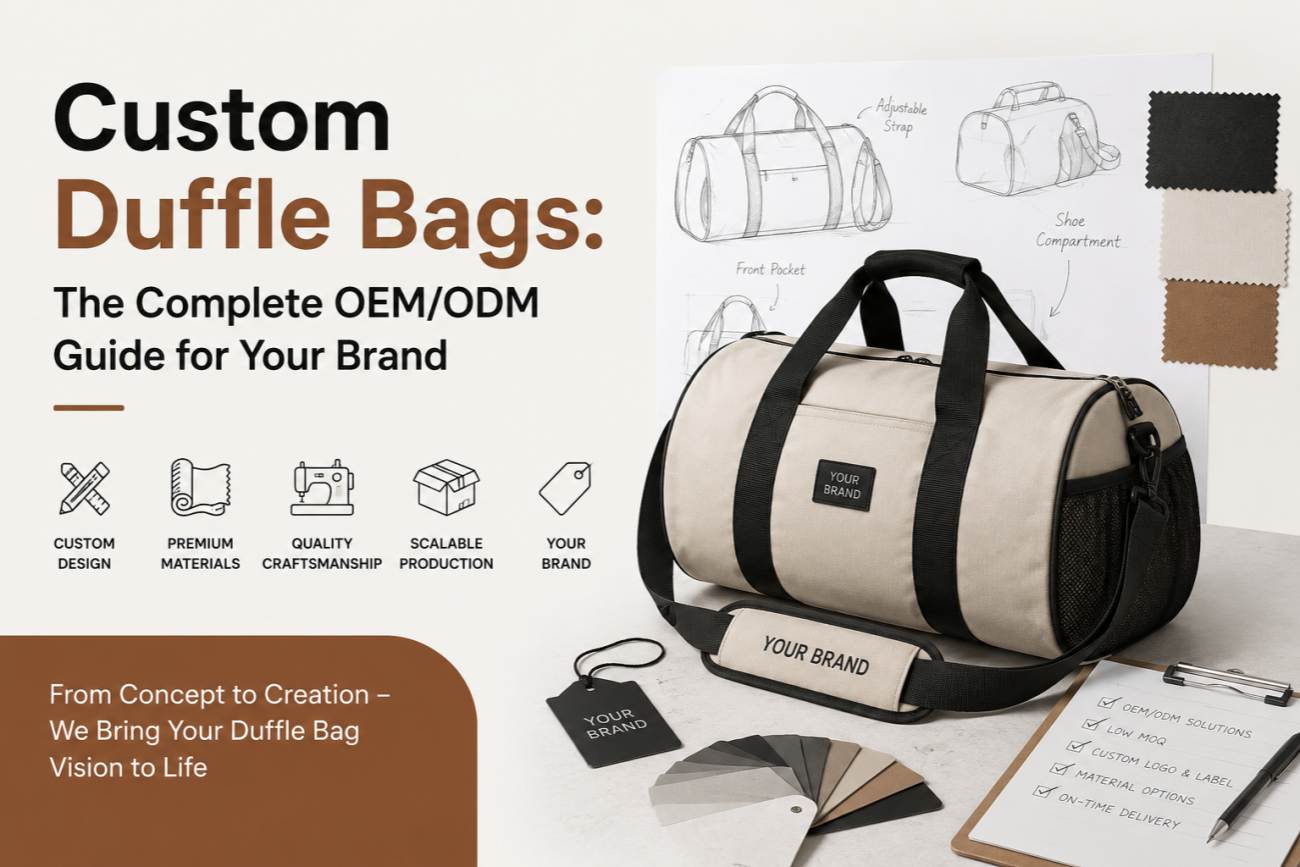
Custom Duffle Bags: The Complete OEM/ODM Guide for Your Brand
Whether you are launching a sportswear brand, sourcing promotional gear for a corporate program, or expanding your retail product line with custom duffle bags — the decision to customize is the easy part. The hard part is navigating the OEM/ODM process: choosing the right model, making the right design decisions, and finding a partner who can deliver at scale.
The duffle bag market is projected to grow at a CAGR of 9.3%, driven by the fitness boom, rising travel demand, and corporate gifting programs (Grand View Research, 2024). This makes custom duffle bags a smart category for brands looking to enter or expand in the bag space. But success depends on understanding how the customization process works — and where the hidden pitfalls are.
This guide walks you through every stage — from deciding between OEM and ODM to placing your first order — so you can source with confidence and avoid costly mistakes.
H2-1. OEM vs. ODM: Which Model Is Right for Your Brand?
Your first and most important decision is choosing between OEM and ODM. These two models define everything that follows — your timeline, your budget, your MOQ, and your level of design control.
OEM (Original Equipment Manufacturing) means you provide the design and the manufacturer produces it. You control every detail: dimensions, materials, hardware, internal compartments, stitching patterns. This is the right choice if you have an established brand, an in-house design team, or a specific product vision that existing designs cannot fulfill. OEM requires more time upfront (the sampling process typically takes 10-15 working days) and a higher MOQ — usually 800 to 1,000 pieces per style. But the payoff is a truly exclusive product that competitors cannot easily replicate.
ODM (Original Design Manufacturing) means you select from the manufacturer’s existing designs and customize them with your colors, materials, and logo. This is faster (sampling takes 5-7 working days), more affordable (MOQ as low as 200-500 pieces), and lower risk. ODM is ideal for first-time importers, Amazon sellers testing a new category, promotional product buyers, or brands that need to launch quickly.
The decision framework is simple: If you have a unique design and want full control, start with OEM. If you want to get to market fast with a proven product, start with ODM. Many successful brands begin with ODM to build their customer base, then transition to OEM for later seasons once they have sales data and confidence.
H2-2. Key Design Decisions Before You Start
Before contacting any manufacturer, you need to answer five design questions. These decisions directly affect your production cost, lead time, and the final product’s market fit.
- Capacity (Size): What volume does your target customer need? 20L-30L bags suit day trips and gym visits. 40L-60L bags work for weekend travel and sports gear. Your choice determines the amount of fabric, webbing, and hardware required — directly impacting the FOB price. Each size jump typically adds $1-3 per unit.
- Compartment structure: Single compartment (simple, cheaper) or multi-compartment with shoe pocket, wet/dry separation, or laptop sleeve? Each additional compartment adds 2-5 pattern pieces and increases sewing time by 15-25%.
- Closure type: Full-length zipper is the standard for duffle bags. Drawstring or roll-top closures are less common but offer a unique look. Zipper quality matters most here — specify YKK #8 or #10 for durability.
- Carry system: Does your bag need a padded shoulder strap, reinforced handles, backpack straps, or a convertible carry system? Each option adds hardware and assembly steps. A duffle with backpack straps costs $2-4 more to produce than a simple shoulder-strap-only version.
- Interior features: Mesh pockets, key clips, zippered interior pockets, compression straps. These add perceived value but also add cost and assembly time.
Document these decisions in a simple spec sheet before reaching out to suppliers. The more clarity you provide upfront, the fewer revision rounds you will need during sampling — saving you weeks of back-and-forth.
H2-3. Choosing the Right Material for Your Custom Duffle Bag
Your material choice defines your bag’s durability, weight, cost, and brand perception. There is no single “best” material — the right choice depends on your target price point and the bag’s intended use.
| Material | Best For | Fabric Cost/yd | Logo Compatible | Durability |
|---|---|---|---|---|
| 600D Polyester | Budget-friendly, mass market | $3 – $4 | Embroidery, Screen print, Heat transfer | 3/5 |
| 900D Polyester | Mid-range, heavy use | $4 – $6 | Embroidery, Screen print | 4/5 |
| Nylon Ripstop | Lightweight, travel-friendly | $4 – $8 | Heat transfer, Screen print | 4/5 |
| PU Leather | Premium, fashion-forward | $6 – $12 | Deboss, Metal plate, Heat transfer | 3/5 |
| Canvas | Casual, vintage aesthetic | $5 – $9 | Embroidery, Deboss, Screen print | 4/5 |
| Recycled Polyester (RPET) | Sustainable product lines | $4 – $7 | Embroidery, Heat transfer | 3/5 |
Also confirm the fabric weight (GSM — grams per square meter) with your manufacturer. For duffle bags, 600-900 GSM for polyester or 400-600 GSM for nylon is typical. Going too light saves money but risks premature wear at stress points.
H2-4. Custom Logo & Branding: 7 Techniques Compared
Your logo is the most visible element of your custom duffle bag. Choosing the right technique affects not just appearance but also cost, MOQ, and durability. Here are the seven most common options available from a professional custom duffle bag manufacturer:
| Technique | Visual Effect | Durability | Relative Cost | Best Material Match | Typical MOQ Impact |
|---|---|---|---|---|---|
| Embroidery | Textured, premium | 5/5 | $$ | Polyester, Canvas, Nylon | Minimal |
| Heat Transfer | Full color, smooth | 4/5 | $ | PU Leather, Nylon | Minimal |
| Debossing | Elegant, subtle | 5/5 | $$$ | PU Leather, Canvas | Low |
| Screen Printing | Bold, flat color | 3/5 | $ | Polyester, Canvas | Minimal |
| Metal Plate | High-end, shiny | 5/5 | $$$$ | All (riveted) | Medium |
| Woven Label | Detailed, fine | 4/5 | $$ | All | Minimal |
| Silicone Patch | Modern, 3D | 4/5 | $$$ | Nylon, Polyester | Low |
If you are unsure, start with embroidery for polyester and canvas bags, or heat transfer for PU leather bags — these are the most cost-effective pairings with the widest supplier experience.
H2-6. The Sample Development Process
The sample phase is where your custom duffle bag goes from an idea to a physical product. A professional manufacturer follows a structured process with clear milestones.
Step 1 — Design review and tech pack confirmation (1-3 days): Your manufacturer reviews your design files or reference images. They flag potential production issues — for example, a curved seam that cannot be sewn consistently at scale, or a pocket placement that conflicts with the zipper track.
Step 2 — Pattern making and sample cutting (3-5 days): The pattern maker drafts the digital pattern based on your dimensions. For an ODM duffle bag, this step is significantly faster since the pattern already exists.
Step 3 — Sewing and assembly (3-5 days): Skilled sample makers sew the first prototype. A duffle bag typically involves 25-50 individual pieces of fabric and hardware.
Step 4 — Inspection and revision (2-3 days): Both you and the manufacturer review the sample. Revisions may include adjusting strap length, tightening zipper tolerance, or repositioning logo placement.
Timeline summary: 7-10 working days for ODM (existing design with modifications) / 10-15 working days for OEM (fully custom). Sample fees: USD 50-200, typically refundable upon bulk order. Most manufacturers include two rounds of revisions as standard.
H2-8. MOQ, Pricing & Payment Terms
Understanding MOQ and pricing structure upfront prevents budget surprises. Here is what to expect when sourcing custom duffle bags:
MOQ by customization level:
- ODM (stock design, custom color + logo): 200-500 pcs per style
- OEM (custom design, existing hardware): 500-800 pcs per style
- OEM (custom design + new hardware mold): 1,000-3,000 pcs per style
FOB price structure: A typical custom duffle bag FOB price range is USD 8-20 per piece, broken down as:
- Raw materials (fabric, lining, hardware): 40-50% of total cost
- Labor (cutting, sewing, assembly, QC): 25-35%
- Packaging and logistics prep: 5-10%
- Manufacturer margin and overhead: 10-20%
Key price drivers: Material choice is the single biggest variable — switching from 600D polyester to PU leather can add $4-8 per unit. Structure complexity is next: each additional compartment adds $1-3. Hardware upgrades (YKK zippers, custom buckles) add $0.50-2 per unit. Logo technique has minimal cost impact (usually $0.20-0.80 per piece) but affects production speed.
Payment terms: Standard terms are 30% deposit by T/T (bank transfer) at order confirmation, 70% balance before shipment. L/C (Letter of Credit) is available for large orders over USD 50,000. Many manufacturers also accept PayPal or Alibaba Trade Assurance for first orders under USD 5,000.
H2-10. Conclusion: Your 5-Step Action Plan
You now have everything you need to start your custom duffle bag project. Here is the step-by-step plan to go from idea to production with minimum friction:
- Define your requirements. Write down: target quantity, preferred MOQ, target price range, and desired delivery timeline. This becomes your brief for all supplier conversations.
- Choose your model. OEM if you need a unique, proprietary design. ODM if you want to move fast with lower commitment. Unsure? Start with ODM — you can always develop an exclusive design for your next season.
- Source and vet manufacturers. Look for a manufacturer with specific duffle bag experience, not just general bag production. Ask for their client portfolio, ISO certifications, and a sample of their work before committing.
- Request samples. Order 1-2 samples before committing to bulk production. Use the sample phase to verify material quality, logo placement accuracy, and overall construction. Confirm the sample fee refund policy.
- Place your order and plan the timeline. From sample approval, expect 4-6 weeks for production and 2-4 weeks for sea freight. Plan your inventory accordingly — factor in a 2-week buffer for unexpected delays.
To see examples of what a professional manufacturer can produce and start your sourcing journey, explore our duffle bag collection or contact our team with your project requirements.
References
- Grand View Research. (2024). Duffel Bags Market Growth & Trends. Referenced via Accio market analysis. accio.com
- Future Market Insights. (2025). Travel Bags Market Outlook 2025-2035. futuremarketinsights.com
- Mordor Intelligence. (2026). Travel Bag Market Analysis 2026-2031. mordorintelligence.com