Estimated Reading Time: 10 minutes
This guide will take you behind the factory curtain. We will define the industry-standard dimensions for different backpack categories and, more importantly, explain how to choose the right size to optimize both user experience and your bottom line.
Table of Contents
The Metric Confusion: Liters vs. Dimensions
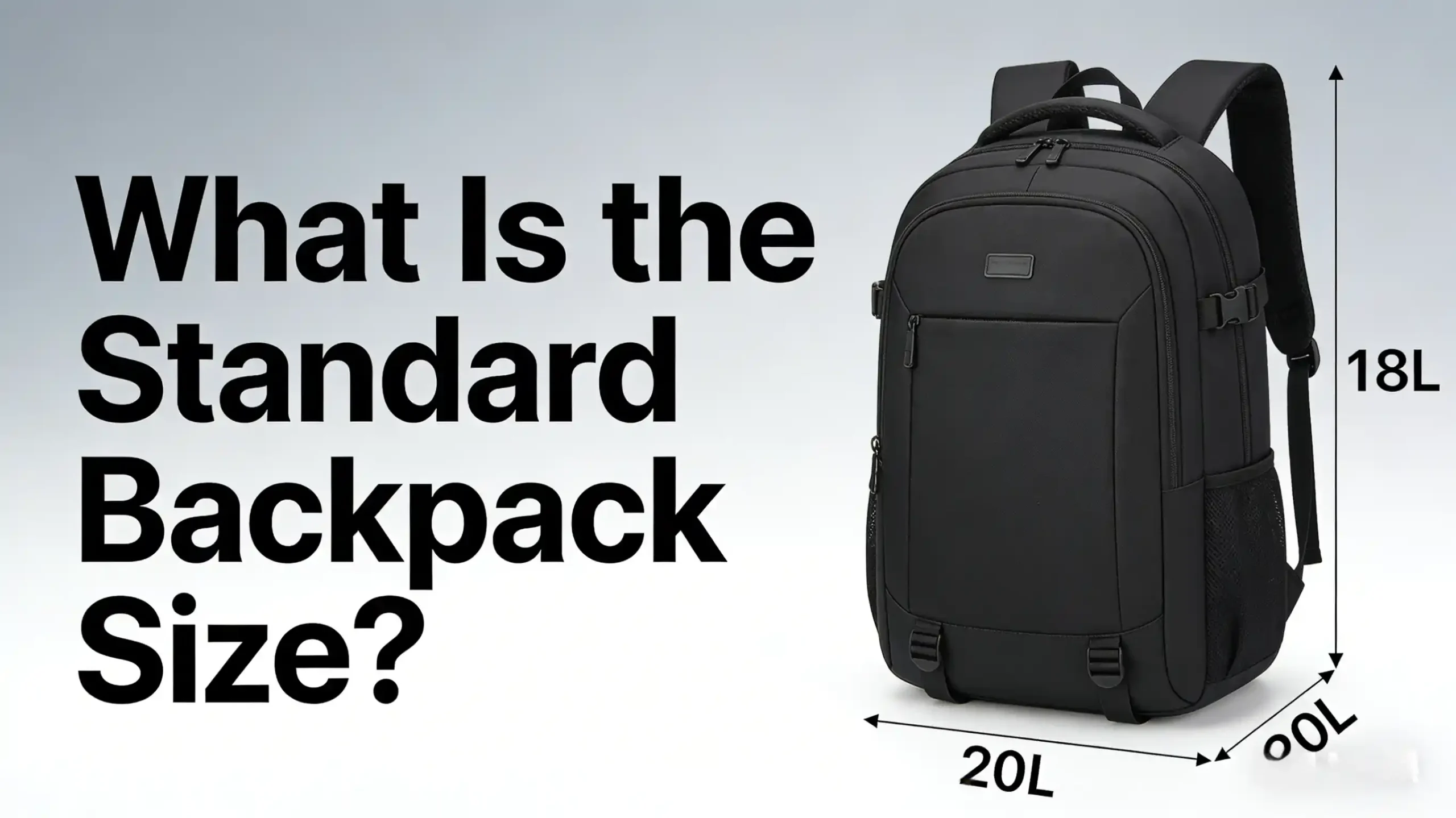
First, let’s clear up a common misunderstanding. Backpack size is measured in two ways:
- Capacity (Volume): Measured in Liters (L). This tells you how much stuff fits inside.
- Dimensions (Linear): Measured in Height x Width x Depth (cm or inches). This tells you if it fits the user’s back (or the airline carry-on bin).
Manufacturer’s Tip: Two bags can both be 25L but look completely different. A tall, thin hiking bag and a short, wide school bag might have the same volume but serve very different purposes. When sending a tech pack to your bag manufacturer, always specify both.
Standard Backpack Sizes by Category (Chart Included)
While “custom” means you can do anything, deviating too far from these standards risks alienating customers who expect certain functionalities. Here is the industry standard breakdown:
1. Daypacks / Commuter Bags (Small to Medium)
These are your everyday carry (EDC) bags. They need to fit a laptop, a water bottle, and a light jacket.
- Capacity: 15L – 25L
- Standard Dimensions: 43cm (H) x 30cm (W) x 15cm (D)
- Target Audience: Office workers, students, city travelers.
- Key Constraint: Must fit under an airline seat and accommodate a 13-16 inch laptop.
2. Weekend / Travel Backpacks (Medium to Large)
Designed for 2-3 day trips. These often function as “Carry-On” luggage.
- Capacity: 30L – 45L
- Standard Dimensions: 55cm (H) x 35cm (W) x 20cm (D)
- Target Audience: Digital nomads, short-trip travelers.
- Key Constraint: Must comply with TSA/airline carry-on size limits (typically 22″ x 14″ x 9″).
3. Hiking / Trekking Packs (Large to Extra Large)
Technical gear designed for carrying heavy loads over long distances.
- Capacity: 50L – 80L+
- Standard Dimensions: 70cm+ (H) x 30cm (W) x 25cm (D)
- Target Audience: Campers, backpackers, hikers.
- Key Constraint: Torso length adjustability is crucial here, not just overall bag size.
How Size Impacts Your Manufacturing Cost
This is the section most designers ignore, but business owners love. The size of your backpack directly dictates your Material Yield Rate.
Fabric rolls typically come in widths of 58-60 inches (approx. 150cm). When we cut pattern pieces for your backpack, we try to fit them like a Tetris puzzle to minimize waste.
The “Awkward Size” Problem:
If your backpack panel is 36cm wide, we can fit exactly 4 pieces across a 150cm roll (36cm x 4 = 144cm), with very little waste.
However, if you increase the width to 39cm, we can only fit 3 pieces (39cm x 3 = 117cm). The remaining 33cm is scrap waste that you still pay for.
Pro Tip: Ask your manufacturer, “Can I adjust the dimensions slightly to improve fabric yield?” Often, shaving off 1-2cm can save you 10-15% in material costs without the end user ever noticing.
The “Invisible” Cost: Size and Shipping Logistics
The cost of your backpack isn’t just the factory price (FOB); it’s the Landed Cost (price at your warehouse door). Shipping is a huge part of this.
Backpacks are bulky. Even empty, they take up space. Shipping companies charge by Volumetric Weight, not just actual weight. A backpack that is structured and rigid (cannot be folded) will cost significantly more to ship than a soft, collapsible duffel bag.
- Optimization Strategy: Design your backpack so it can be laid flat or nested (stacking one inside another) during shipping.
- Packaging: Avoid over-stuffing the bag with paper stuffing. Use minimal packaging to reduce the carton size.
Ergonomics: Why “Standard” Doesn’t Fit All
While dimensions impact cost, they also impact comfort. A “standard” 50cm tall backpack might be too long for a petite woman (torso length < 40cm) and too short for a tall man.
If you are a mass-market brand, aiming for the “average” torso length (approx. 46-51cm) is safe. However, if you are targeting a niche (e.g., Women’s Fashion Backpacks), you should adjust your “standard” dimensions accordingly.
Did you know? Women’s backpacks often feature shorter torso lengths and S-curved shoulder straps to accommodate different body shapes. Don’t just “shrink it and pink it”—design for the anatomy.
Conclusion: Designing for Profit and Comfort
So, what is the standard backpack size? It depends on who you are asking. For a user, it’s about what fits inside. For a manufacturer, it’s about fabric width and shipping cartons.
To succeed in the custom bag business, you need to balance these two views. Don’t design in a vacuum. Work with your manufacturer early in the design process to optimize your dimensions for production efficiency.
Ready to turn your backpack design into a profitable product? Contact Lila Lila Bags for a free consultation on sizing, materials, and cost optimization.
References