If you’re shopping for an everyday carry backpack—or building a product line—this guide will help you choose an rPET backpack for the right reasons: performance, transparency, and real-world durability.
[Image suggestion: “Bottle-to-Backpack” infographic showing: PET bottle → flakes → pellets → yarn → fabric → backpack.]
What Is rPET (and Why It Matters for Backpacks)?
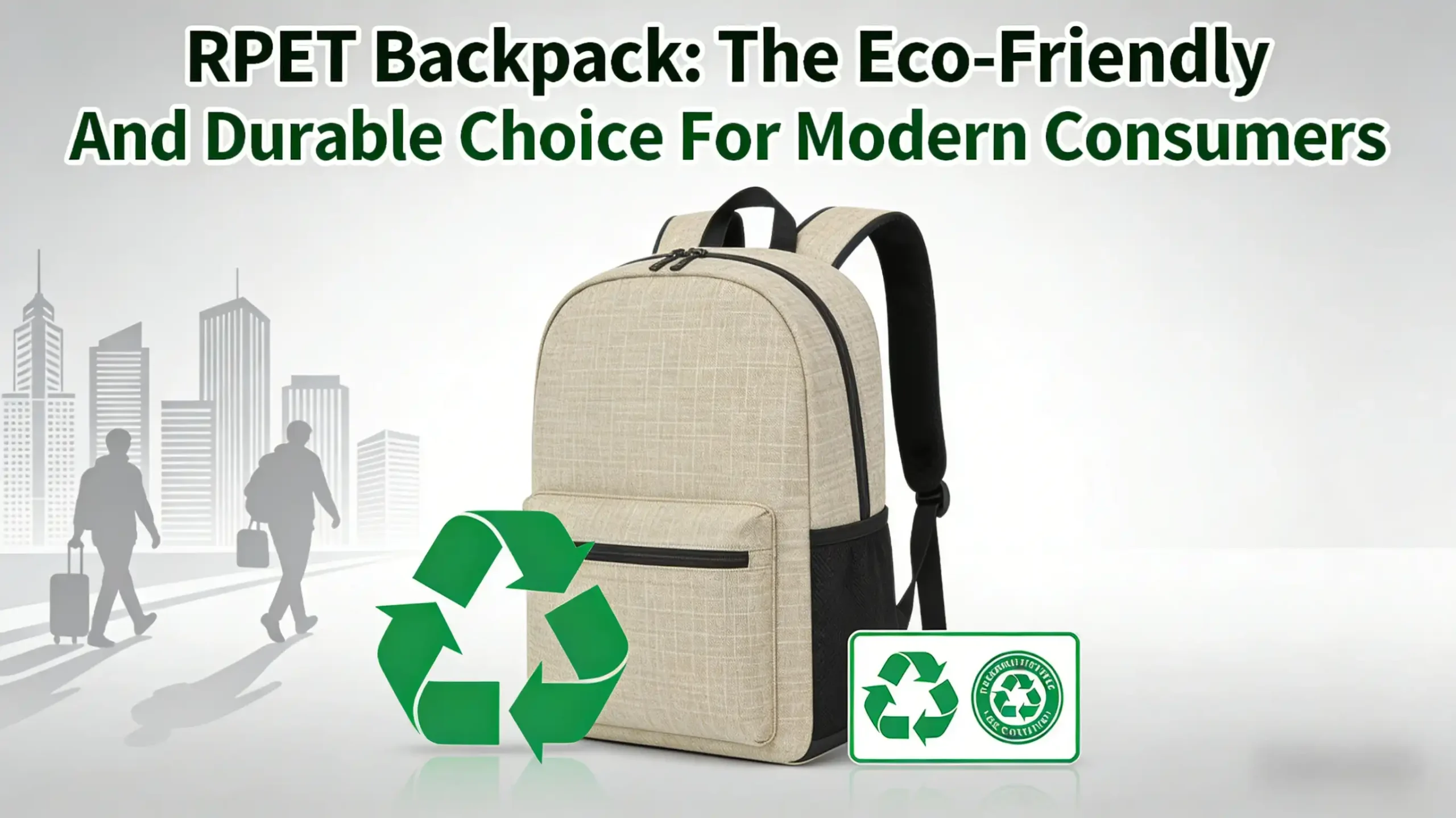
rPET stands for recycled polyethylene terephthalate. PET is the same plastic commonly used in beverage bottles and food containers. When PET is collected, cleaned, and mechanically reprocessed, it can be turned into polyester yarn—then woven into bag fabrics often marketed as “rPET fabric.”
In plain terms: an rPET backpack is usually a backpack made with polyester fabric derived (in part) from recycled PET waste, rather than virgin fossil-based polyester. This matters because polyester remains the biggest fiber category globally, and most recycled polyester is still made from plastic bottles rather than old textiles (Textile Exchange Materials Market Report).
How an rPET Backpack Is Made: Bottle to Fabric
The “bottle-to-bag” story is popular because it’s easy to understand—and the basic steps are real. A typical mechanical recycling pathway looks like this:
- Collection & sorting: PET bottles are collected and sorted (often by color/type).
- Shredding & washing: bottles are cleaned and chopped into flakes to remove labels, glue, and residue.
- Pelletizing: flakes are melted and formed into pellets or chips.
- Spinning into yarn: pellets are melted again and extruded into fibers, then spun into yarn.
- Weaving/finishing: yarn becomes fabric, which may receive coatings/finishes for water resistance and abrasion performance.
- Cut & sew: fabric becomes backpacks with zippers, foam, webbing, lining, and trims.
This is similar to the process described in the competitor article, including steps like sorting, shredding/cleaning, melting to flakes/pellets, spinning into yarn, weaving, then final finishing and assembly (Kingsons rPET Backpack article).
[Image suggestion: A close-up photo set of rPET fabric textures (e.g., 600D/900D looks) with labels for “plain weave,” “twill,” and “ripstop.”]
Is rPET Actually Durable? What to Expect in Daily Use
Durability is where many consumers hesitate: “Is recycled fabric weaker?” In practice, an rPET backpack can be very durable—but durability is driven by construction and specs, not just the recycled claim.
What makes an rPET backpack durable
- Fabric denier and weave: 600D+ fabrics typically feel tougher for commuting and travel; ripstop helps resist tear propagation.
- Coating/finish: water resistance usually comes from PU coating or similar finishes, not from “rPET” itself.
- Stress-point reinforcement: bartacks at shoulder straps, handle box-stitching, and stronger seams matter more than the fiber origin.
- Hardware quality: zippers, sliders, buckles, and webbing are often the first failure points on cheap bags.
- Foam and structure: shoulder strap foam density and back panel design affect comfort and long-term shape retention.
What “waterproof” usually means (and what it doesn’t)
Many articles call rPET backpacks “waterproof,” but most are better described as water resistant. If a brand claims waterproof performance, ask for the fabric coating details and testing approach. For coated fabrics, standards like ASTM D751 include test methods such as hydrostatic resistance (ASTM D751 listing).
The Real Sustainability Upside: What rPET Can Improve
rPET doesn’t automatically make a backpack “sustainable,” but it can support meaningful improvements in a few areas when done well.
1) Less dependence on virgin fossil-based polyester
Textile Exchange reports polyester as the most widely produced fiber, and notes that the majority of recycled polyester is currently made from plastic bottles (Materials Market Report). Choosing rPET can help reduce demand for virgin polyester in the supply chain.
2) Lower energy and emissions potential (depending on system boundaries)
Life-cycle results vary by region and methodology, but many LCAs show that producing postconsumer recycled resins uses less energy than producing virgin resins from basic chemicals. One widely cited industry LCA comparing virgin vs. postconsumer recycled plastic resins provides energy profile differences for PET (APR/Franklin Associates LCA summary). For brands, the practical takeaway is: rPET can be a carbon and energy improvement, but you should avoid overconfident “X% greener” claims unless you can back them with a documented LCA for your product.
3) A clearer story customers understand
Consumers recognize “recycled bottle” messaging quickly. That makes rPET a useful entry point for sustainability—especially when paired with transparency: recycled content certification, supplier traceability, and care guidance that extends product life.
[Image suggestion: A comparison table graphic: “Virgin Polyester Backpack vs rPET Backpack” with categories: material source, traceability options, recycled content certification, care tips.]
The Trade-Offs (and How to Handle Them Honestly)
Top-ranking articles often focus only on benefits. A better buying guide also covers limitations.
Microfiber shedding is still a concern
Whether virgin or recycled, polyester is still a plastic-based fiber. Synthetic textiles are recognized as a significant source of primary microplastics, including microfiber release associated with washing and wear (IUCN report on primary microplastics). For backpacks, washing is less frequent than apparel, but abrasion over time can still release fibers—especially from low-quality fabrics and heavy use.
“Recycled” does not automatically mean recyclable
Most backpacks are multi-material products (coated fabric + foam + lining + zippers + buckles). Even if the fabric is rPET, end-of-life recycling can be limited. The strongest sustainability lever is often durability + repairability—keeping one backpack in use longer.
Greenwashing risk
If a label says “eco-friendly” but can’t tell you the recycled content percentage, certification, or supplier traceability, treat it as marketing, not proof.
How to Choose a Good rPET Backpack: A Buyer’s Checklist
Use this checklist when you’re comparing products online or in-store.
Material and construction
- Ask the recycled content %: “made with rPET” is vague; “fabric contains 50% recycled polyester” is clearer.
- Check fabric spec if available: denier (e.g., 600D), ripstop, and coatings.
- Look for reinforced stress points: bartacks at strap anchors, strong handle stitching, clean seam finishing.
- Inspect zippers: smooth run, solid zipper tape, strong end-stops.
Performance fit
- Carry comfort: strap width, foam thickness, and breathable back panel matter for daily use.
- Organization: laptop sleeve structure, quick-access pocket, and internal compartments reduce wear from overstuffing.
- Water resistance expectations: prefer “water resistant” plus a rain cover option for heavy rain.
Proof and credibility
- Prefer third-party recycled standards: Textile Exchange’s RCS/GRS provide chain-of-custody frameworks; GRS adds additional processing and chemical requirements and has a higher recycled content threshold than RCS (Textile Exchange: RCS & GRS overview).
- Look for transparency: supplier location, audit approach, and clear product specs.
For Brands: How to Source rPET Backpacks with Less Risk
If you’re developing an rPET backpack line, you’re not only choosing a fabric—you’re choosing a supply chain. Here’s a simple sourcing approach that avoids common pitfalls found across many top “rPET backpack” articles.
1) Define “what sustainability means” for your product
- Recycled content target (e.g., rPET outer fabric + rPET lining)
- Durability target (abrasion, seam strength, zipper cycle expectations)
- Packaging plan (reduced plastic, recycled cartons, etc.)
- Claims policy (what you will and won’t say without proof)
2) Request documents early
- RCS/GRS scope certificates (if claiming certified content)
- Material data sheets for coatings and trims
- QC plan: inline + final inspection, defect tolerance, corrective action
3) Build a “golden sample” system
Approve a final sample and keep it as the reference standard for future bulk production. This prevents “spec drift” over time.
4) Choose the right development partner
If you need private label or custom development support, these pages are a good starting point for sampling, customization, and manufacturing discussions:
custom backpack,
backpack manufacturer,
contact us.
[Image suggestion: Factory-style photo: stitching reinforcement at shoulder strap anchor, showing bartack/box-stitch detail with labels.]
Care Tips: Make Your rPET Backpack Last Longer
- Spot clean first: mild soap + soft brush reduces unnecessary full washes.
- Avoid high heat: hot dryers can damage coatings and foam.
- Don’t overload: overstuffing strains seams, zippers, and strap anchors.
- Store dry: moisture can degrade coatings and create odors over time.
- Repair early: fix zipper pulls and seam openings before they become failures.
FAQs
Is an rPET backpack always better for the environment?
Not always. It can be better—especially if it reduces virgin material demand and is verified with credible standards—but the biggest win is often buying a backpack that lasts longer and gets used more years.
How many bottles are in an rPET backpack?
It depends on size, fabric weight, and what parts use rPET. Some brands cite a “bottles saved” number, but it can vary widely. Use it as a storytelling metric, not a scientific comparison unless the calculation method is disclosed.
What certifications should I look for?
For recycled content verification and chain of custody, look for Textile Exchange standards such as RCS or GRS, and verify certificate status through official channels when possible (Textile Exchange standards overview).
References
- Kingsons Bags — RPET Backpack: The Eco-Friendly And Durable Choice For Modern Consumers
- Textile Exchange — Materials Market Report (latest listing page)
- Textile Exchange — Recycled Claim Standard (RCS) & Global Recycled Standard (GRS)
- IUCN — Primary Microplastics in the Oceans: A Global Evaluation of Sources (2017)
- Association of Plastic Recyclers (APR) — Recycled vs. Virgin Plastic LCA Energy Profile (Franklin Associates/ERG summary)
- ASTM D751 — Standard Test Methods for Coated Fabrics (ANSI listing)