Estimated Reading Time: 10 minutes
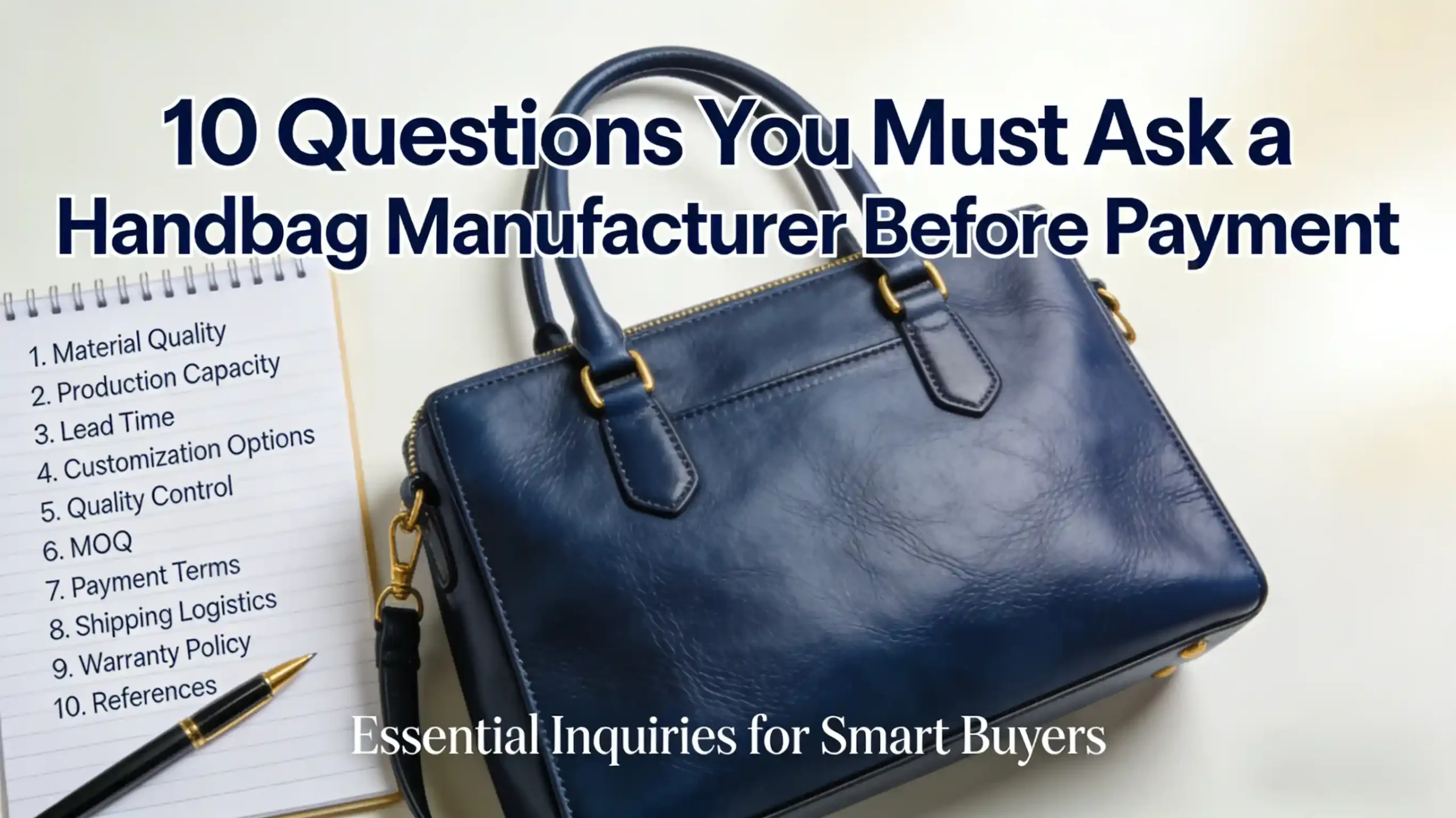
Before you wire that deposit, you need to be 100% sure. Here are the 10 essential questions you must ask to vet your supplier, protect your investment, and ensure your custom bags are retail-ready.
Table of Contents
Phase 1: Legitimacy & Financial Safety (The “Trust” Check)
Before talking about zippers and pockets, you need to know if the company is real and financially stable.
1. “Can you provide your business license and a recent factory audit report?”
Why ask this: Scammers often pose as factories but are actually one-person trading companies working from a laptop. A legitimate factory will have a business license and, ideally, a third-party audit report (like BSCI or ISO 9001).
Red Flag: If they get defensive or say, “Trust us, we are big,” run away.
2. “What are your specific payment terms for deposit and balance?”
Why ask this: Never pay 100% upfront. The industry standard is typically a 30% deposit to start production (to cover materials) and a 70% balance paid only after the goods pass inspection but before shipping.
Insider Tip: If a supplier insists on 100% T/T upfront for a first order, it’s a major risk.
Phase 2: Hidden Costs & Pricing (The “Wallet” Check)
The unit price is just the tip of the iceberg. You need to uncover the hidden costs that kill your margins.
3. “Is the sample fee refundable if I place a bulk order?”
Why ask this: Sampling is expensive (often $100-$300 per bag) because it involves pattern making and material sourcing. Most professional factories will deduct this fee from your bulk invoice once you meet the MOQ (Minimum Order Quantity).
Red Flag: If they charge an exorbitant sample fee and refuse to refund it even for a large order.
4. “Does the quoted price include packaging, hangtags, and polybags?”
Why ask this: You might think you’re paying $10.00 for a finished retail product, only to find out that hangtags are extra, silica gel packets are extra, and the “standard packaging” is a flimsy sack that rips during transit.
Ask for: A detailed breakdown of what is “FOB” (Free on Board) vs. “EXW” (Ex Works).
Phase 3: Production & Quality Control (The “Product” Check)
This is where your design comes to life—or dies.
5. “Can I see a Pre-Production Sample (PPS) before you cut the bulk fabric?”
Why ask this: This is the most critical step. The PPS is the “Golden Sample”—the exact standard for mass production. Never let a factory start mass cutting based only on a photo or an initial rough sample.
The Rule: No PPS approval = No production start.
6. “What is your Defect Rate Policy and how do you handle returns?”
Why ask this: Even the best factories have defects. But what happens if 5% of your tote bags have crooked stitching? Will they refund you? Replace them? Or credit your next order?
Industry Standard: An acceptable defect rate (AQL 2.5) is common, but major defects should be zero.
7. “Do you outsource any part of the production?”
Why ask this: Some factories take your order and secretly subcontract it to a cheaper, lower-quality workshop to increase their profit. This leads to inconsistent quality.
Answer you want: “We do all cutting and stitching in-house. We only outsource specialized processes like plating or printing.”
Phase 4: Deadlines & Communication (The “Service” Check)
Time is money. A late shipment can mean missing the Christmas season entirely.
8. “What is your real production lead time vs. shipping time?”
Why ask this: New buyers often confuse “Delivery Time” with “Shipping Time.” Production might take 30 days, but sea freight takes another 30-40 days. You need to know the total timeline to plan your launch.
Pro Tip: Always add a 2-week buffer to whatever date they give you.
9. “Who will be my dedicated point of contact?”
Why ask this: You don’t want to explain your design changes to three different salespeople. You need one project manager who speaks English well and understands your specs.
Test them: See how fast they reply to a difficult technical question.
10. “Can you sign a Non-Disclosure Agreement (NDA) to protect my designs?”
Why ask this: If you have a unique, patented design, you don’t want to see it on Alibaba next week. A reputable manufacturer will respect your IP (Intellectual Property) and happily sign an NDA.
Link: Learn more about our Custom Bag Services and IP protection.
Conclusion: The One Question That Reveals Everything
If you only remember one thing from this list, remember this: Ask “Why?”
If a price is too low, ask why. If a lead time is too short, ask why. A good partner will explain their process. A bad one will just tell you what you want to hear.
Vetting a supplier takes time, but it saves you thousands of dollars in the long run. At Lila Lila Bags, we are ready to answer all 10 of these questions (and more). We believe in building partnerships that last.
Ready to start a conversation? Contact us today for a transparent quote and a stress-free manufacturing experience.
References & Further Reading