Choosing a manufacturing model is one of the most important decisions you’ll make when launching or scaling a bag brand. The wrong choice can lock you into high MOQs, slow lead times, and a product that feels generic. The right choice can shorten your time-to-market, protect your margins, and help you build a product line that buyers remember.
This guide compares private label bags and OEM custom bags in a practical, B2B way—covering MOQ realities, pricing drivers, timelines, and the hidden risks most brands discover too late.
Table of Contents
Private Label vs OEM: Clear Definitions (No Buzzwords)
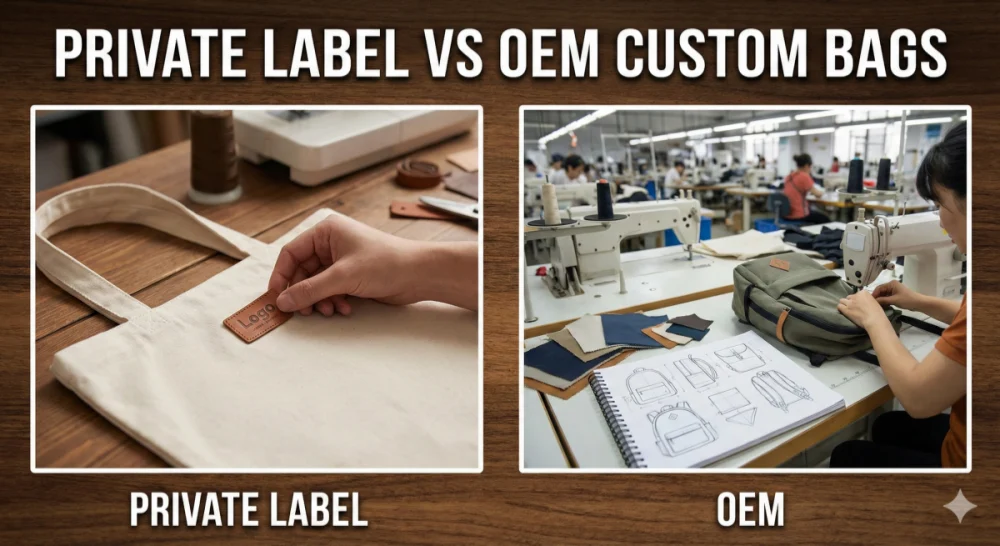
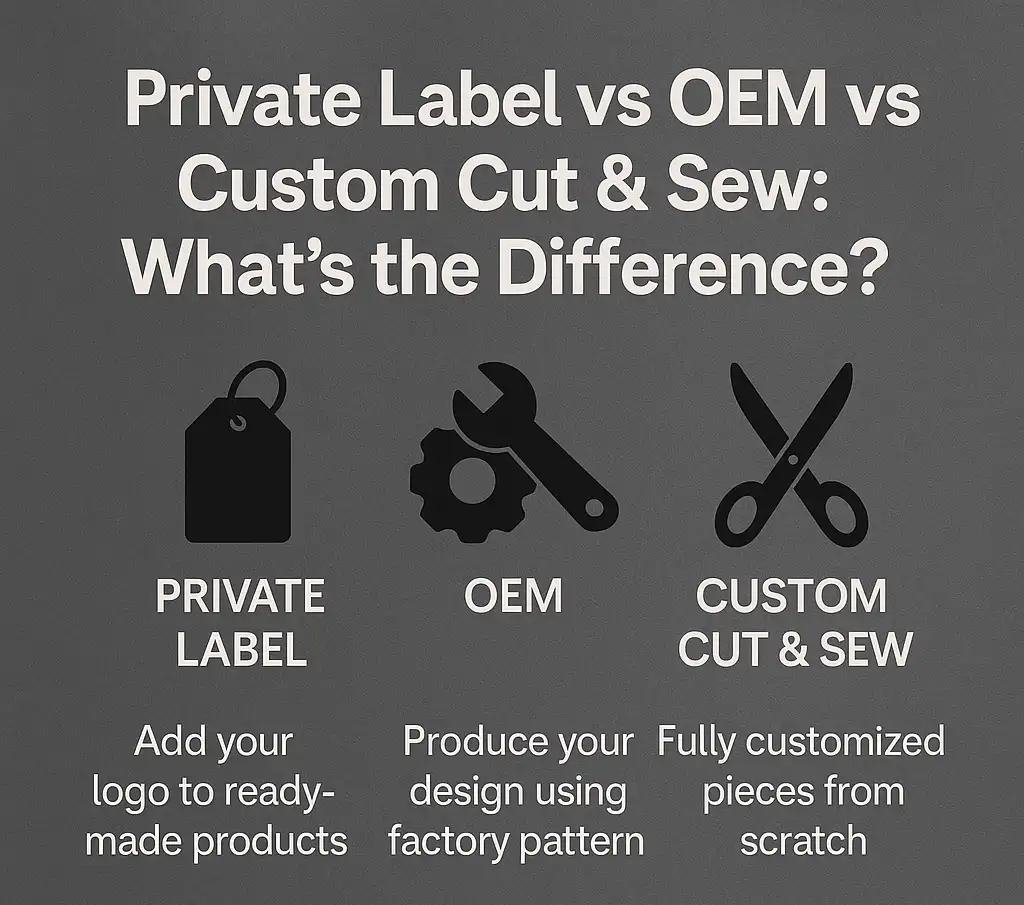
Private label typically means you choose an existing (or semi-existing) bag design from a manufacturer, then brand it as your own—often with changes like logo placement, labels, colors, packaging, or minor feature edits. In retail and consumer goods, private label products are commonly made by third parties and sold under the buyer’s brand name [1].
OEM (Original Equipment Manufacturer) usually means the factory builds a product based on your specifications—often with higher control over structure, materials, trims, and detailing. In manufacturing, OEM refers to a company that produces components or products used in another company’s finished goods, typically in B2B relationships [2].
In the bag industry, people sometimes mix “OEM” and “ODM” language. A helpful way to remember it: OEM generally implies you own the design direction, while ODM often means the manufacturer owns the base design and you customize around it [3].
When Private Label Bags Make the Most Sense
Private label is often the fastest route to market—especially if you’re validating demand or operating with limited cash tied up in inventory.
- You need speed: If you want to launch in weeks (not months), private label reduces development cycles.
- You want lower upfront investment: Fewer sampling rounds and fewer custom components can reduce early costs.
- You’re testing multiple SKUs: Private label lets you test tote bags, backpacks, and duffles without reinventing every pattern.
- Your differentiation is branding + marketing: If your edge is storytelling, community, and retail execution, private label can work well.
If you’re building a range quickly, explore ready-to-customize categories first and then add stronger differentiation later. For example, you might start with a private label duffle and add higher-spec OEM versions once you confirm your best sellers.
- Browse product directions and baseline styles on LilaLila Bags.
- Check established SKUs and feature sets in Duffle Bags.
When OEM Custom Bags Are the Better Choice
OEM is typically the best choice when your product itself is the brand—meaning your construction, materials, usability, and details must be clearly different from what competitors can source from the same catalogs.
- You need real differentiation: Custom structure, proprietary pocket layout, improved ergonomics, and unique material choices.
- You require performance standards: Reinforced load-bearing areas, strict zipper durability, abrasion resistance, and consistent QC.
- You’re building a long-term line: A signature bag that defines your brand (not just a seasonal trend).
- You plan to scale: OEM pays off when you amortize development over larger volume and repeat orders.
OEM can also reduce long-term risk. With better control over bill of materials (BOM), you can protect consistency across batches—especially important for wholesalers, distributors, and importers.
- See manufacturer positioning and capabilities on the About page.
Private Label vs OEM: Side-by-Side Comparison
| Factor | Private Label Bags | OEM Custom Bags |
|---|---|---|
| Time to market | Fast (often fewer development steps) | Slower (design + sampling + approvals) |
| Upfront cost | Lower (less tooling, fewer custom parts) | Higher (development, custom trims, iterations) |
| MOQ flexibility | Often lower when using stock materials | Often higher if custom materials/hardware required |
| Product differentiation | Medium (branding and minor edits) | High (structure, materials, performance, details) |
| Long-term defensibility | Lower (others can source similar bases) | Higher (unique specs are harder to copy) |
Cost, MOQ, and Lead Time: What Changes (and Why)
Most quote gaps happen because the factory is pricing different assumptions. Here’s what usually changes between private label and OEM:
1) MOQ moves with materials and components
Private label can keep MOQ lower by using stock fabrics, standard zippers, and existing patterns. OEM can push MOQ higher when you request custom-dyed fabrics, special hardware, or unique trims that have supplier minimums.
2) Lead time isn’t just sewing time
OEM timelines stretch mainly in pre-production: pattern revisions, sample rounds, material approvals, custom hardware tooling, and packaging confirmations. Private label shortens these steps.
3) Shipping terms can change the “price”
Make sure you compare quotes under the same Incoterms (EXW, FOB, etc.). Incoterms define responsibilities and cost allocation across logistics and export processes [4].
4) Quality control requirements affect cost
If you need consistent standards and sampling-based inspection, align on an inspection approach early. ISO 2859-1 is widely referenced for attribute sampling inspection frameworks [5].
A Simple Decision Framework (5 Questions)
Use these questions to choose quickly:
- Is your competitive advantage the product itself? If yes, lean OEM. If no, private label may be enough.
- How fast do you need to launch? If you need speed, private label wins.
- What’s your cash strategy? If cash is tight, private label reduces early investment.
- Do you need proprietary features or materials? If yes, OEM is the safer path.
- Are you planning repeat orders and scaling? If yes, OEM’s upfront work pays back over time.
Many successful brands use a hybrid approach: launch with private label to validate demand, then upgrade best sellers into OEM versions with stronger differentiation.
- Expand assortment ideas using Tote Bags as an entry SKU for private label, then add OEM hero products.
FAQs
Is private label the same as white label?
Not always. White label often implies a more generic product sold to multiple brands with minimal changes. Private label often allows more customization and exclusivity, depending on the factory and agreement.
Can I start with private label and later switch to OEM?
Yes—and it’s a common strategy. Launch a private label version to test pricing and market fit, then invest in OEM upgrades (better materials, unique construction, improved usability) once you have traction.
Which model is better for wholesalers and distributors?
If your customers demand consistency and repeatability, OEM often provides better long-term control. If you need speed and flexibility for seasonal assortments, private label can be effective.
References
- Investopedia: Understanding Private Brands (Private Label)
- Investopedia: Original Equipment Manufacturer (OEM) Definition
- SEACOMP: OEM vs ODM in Manufacturing
- ICC: Incoterms Rules Overview
- ISO: ISO 2859-1 Sampling Procedures for Inspection by Attributes
If you’re sourcing custom bags in bulk, working directly with a manufacturer can reduce cost and improve quality.
Message Us on WhatsApp for Fast Factory Support