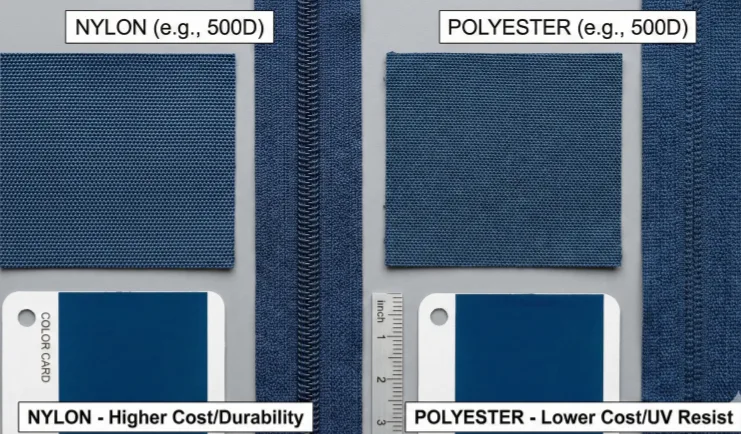
For many bag buyers, nylon vs. polyester is a confusing decision because the fabrics can look almost identical on a product photo. Then the quote comes back—and suddenly there’s a price gap. On top of that, performance requirements are getting stricter: better tear resistance, stable color, lighter weight, and fewer complaints after real-world use.
This guide breaks the decision down the way a factory and sourcing team would: what matters for tear resistance, colorfastness, weight, and total landed cost.
Table of Contents
Quick answer: which one “wins”?
If you want the fastest shortcut, use this:
- Choose nylon when tear strength and toughness are the priority (high-stress seams, corners, heavy loads, abrasion zones).
- Choose polyester when color stability, UV exposure, dimensional stability, and cost control are the priority (large color ranges, outdoor exposure, price-sensitive programs).
- Neither wins automatically if the real requirement is waterproofing: coatings/lamination and seam design will dominate performance more than the base fiber.
[Image suggestion: A summary “winner card” infographic: Nylon = toughness/tear; Polyester = UV/color/cost; Footnote: weave/denier/coating decide final results.]
Why they look similar (and why specs matter more than names)
Nylon is a family of polyamides, widely used as fibers because of toughness and the ability to be melt-spun into filaments (Britannica). Polyester in bags is most commonly PET (polyethylene terephthalate), used both as resin and as textile fiber (Britannica). Those chemistry differences matter—but for finished bag fabric, the construction often matters even more:
- Denier (D): yarn thickness (e.g., 210D, 420D, 600D, 1680D)
- Weave: plain weave, twill, ripstop, ballistic-style weaves
- Yarn type: normal vs high-tenacity yarn
- Finishing: PU coating, TPU lamination, DWR, PVC backing
- Dye method: piece-dyed, solution-dyed, dope-dyed, printed/sublimated
This is why two “600D” fabrics can behave very differently. When you evaluate materials, treat “nylon” and “polyester” as the starting point—then lock down construction and test standards.
How polyester can still win in real products
Polyester can be an excellent choice when the bag must keep shape, resist stretching over time, and maintain a consistent appearance. In many everyday bags, a well-built polyester (right denier + weave + coating) is more than sufficient, especially if you reinforce seams correctly.
How to choose (buyer-friendly): Nylon vs. Polyester
[Image suggestion: A simple “decision table” infographic showing common buyer pains (tearing, fading, budget, outdoor use) and whether nylon or polyester is recommended, with 1-line reasons.]
If you want a simple way to decide, don’t start with the material name. Start with the main complaint you want to avoid (tearing, fading, scuffing, deformation, or budget pressure). Then pick the fabric construction that matches it.
A 10-second rule
- If your biggest fear is ripping or sudden damage (corners, strap roots, heavy loads) → choose nylon (then confirm denier + weave + coating).
- If your biggest fear is color issues (fading, color transfer, inconsistent dye lots) or you need many colors at a stable cost → choose polyester.
- If your biggest fear is “waterproof performance” → the winner is usually coating/lamination + seam design, not the base fiber. Nylon or polyester can both work when finished correctly.
Most common buyer scenarios (plain language)
| Buyer Situation | Choose | Why it’s the safer pick | What to lock in (so quotes are comparable) |
|---|---|---|---|
| Backpacks / duffles that carry heavy loads; corners and seams get abused | Nylon | Tends to feel tougher under shock load and helps reduce tear-risk in high-stress areas | Denier (e.g., 420D/840D), weave (ripstop/plain), reinforcement at strap roots, abrasion target |
| Fashion bags with many Pantone colors; repeat orders must match color | Polyester | Often easier to control color consistency and manage large color programs at scale | Color approval standard, rubbing/lightfastness targets, same dye lot rules |
| Outdoor exposure (sun, heat); you worry about fading over time | Polyester (often) | Common choice when light exposure is a major risk (still validate with a lightfastness test) | Lightfastness method/grade, UV-stabilized finish if needed |
| Budget is tight, but you still need “good enough durability” | Polyester | Usually the best cost/performance baseline in standard constructions | Minimum denier + fabric weight (GSM), coating type, key durability tests |
| You need “waterproof” and fewer leakage complaints | Either | Waterproofing depends more on coating/lamination thickness, quality, and seams | Coating/lamination spec, hydrostatic head target, seam tape or binding plan |
| Laptop bags / commuter bags: clean look, stable shape, scuff resistance | Polyester (often) | Good for structure + appearance stability; can add nylon reinforcements where needed | Surface finish, anti-scuff requirement, reinforcement at handle/strap tabs |
One line to share with your team
Nylon = “toughness-first” for high-stress zones. Polyester = “color & cost stability-first” for scalable programs. Final performance depends on denier + weave + coating + design, so always confirm those before you compare prices.
Weight: what changes grams and shipping cost
Many buyers assume nylon is always lighter. The truth: finished fabric weight depends on denier, weave density, backing/coating thickness, and any foam/lamination—not just fiber type.
That said, the base polymer densities differ: PET (polyester) is commonly listed around 1.38 g/cm³, while nylon is often around 1.14 g/cm³ (PET density shown in PET property tables; nylon density varies by type). In practice, that means for the same yarn volume and construction, polyester can trend heavier—but coatings and weave choices can easily outweigh that effect.
A simple rule for buyers
- If your goal is lighter weight, don’t specify “nylon” only—specify target GSM/oz, denier, and required waterproof rating (if any).
- If your goal is lower freight cost, remember packaging and carton optimization can beat small fabric weight differences on many programs.
How to choose by use case (bags, travel, outdoor, laptop)
Outdoor & performance backpacks
- Typical priority: tear + abrasion + reliable coating performance
- Often a strong choice: nylon in high-stress panels, reinforced weave; validate abrasion using recognized methods (ISO 12947 series describes Martindale abrasion testing) (ISO 12947-1/2).
Travel duffle / luggage soft goods
- Typical priority: durability + shape retention + cost control
- Often a strong choice: polyester for consistent color and stable structure; upgrade denier and backing where abrasion is high (base, corners).
Laptop bags and commuter bags
- Typical priority: clean look, color consistency, scuff resistance, controlled cost
- Often a strong choice: polyester with the right finish; add nylon reinforcement only where needed (handle tabs, strap roots).
Fashion bags with many colors
- Typical priority: color palette, repeatability, fewer dye-lot issues
- Often a strong choice: polyester programs with clear colorfastness targets (rubbing + light) and a stable color approval process.
If you need help turning use cases into specs, start with your target product category and send your requirements through our OEM/ODM channel: https://www.lilalilabags.com/oem-odm/.
Need a fast recommendation for your specific bag category? Share your target market, required tests, and target price, then send an inquiry here: https://www.lilalilabags.com/contact-us/. You can also browse our latest product direction for reference: https://www.lilalilabags.com/.[Image suggestion: Decision flowchart: Use case → key KPI → test standards → construction/coating → choose nylon/polyester.]

References
- Nylon definition and polyamide background (Britannica): https://www.britannica.com/science/nylon
- PET (polyester family polymer) overview (Britannica): https://www.britannica.com/science/polyethylene-terephthalate
- ISO 105-X12:2016 (Color fastness to rubbing): https://www.iso.org/standard/65207.html
- ISO 105-C06:2010 (Color fastness to domestic and commercial laundering): https://www.iso.org/standard/51276.html
- ISO 105-B02:2014 (Color fastness to artificial light: Xenon arc test): https://www.iso.org/standard/65209.html
- ISO 12947-1:1998 / ISO 12947-2:2016 (Martindale abrasion method overview): https://www.iso.org/standard/1931.html | https://www.iso.org/standard/61058.html