Estimated reading time: ~8–10 minutes
The hardest part of launching a handbag brand is not getting your first design idea—it’s turning that idea into a repeatable, sellable product.
The right manufacturing partner can help you improve construction, control cost, hit launch timelines, and scale with fewer surprises.
The wrong partner can trap you in endless resampling, inconsistent quality, unclear pricing, and missed delivery windows.
This guide walks you through a practical, startup-friendly process to find, evaluate, and onboard a manufacturer—without needing a massive budget or years of sourcing experience.
You’ll get checklists, red flags, and negotiation tips you can use immediately.
Table of Contents
- How to Find Custom Handbag Manufacturers for Startups
- Step 1: Define Your Product Brief (So Factories Can Quote Accurately)
- Step 2: Choose Your Production Model (OEM vs ODM vs Private Label)
- Step 3: Build a Shortlist of Manufacturers
- Step 4: Vet Capability and Fit (Sampling, Materials, Capacity)
- Step 5: Validate Quality and Compliance (QC, Testing, Certifications)
- Step 6: Compare Quotes and Negotiate Terms
- Step 7: Protect Your IP and Designs
- Step 8: Run a Pilot Order, Then Scale
- Common Red Flags (Save These Before You Pay a Deposit)
- Manufacturer Scorecard Template (Quick Decision Tool)
- FAQ
- References
[Image suggestion: A simple flowchart showing the manufacturing process: brief → tech pack → proto → sample → PP sample → bulk production → QC → shipment.]
Step 1: Define Your Product Brief (So Factories Can Quote Accurately)
Startups often lose weeks because they ask factories for pricing without providing enough detail. The factory replies with a vague range, and then every new detail changes the quote.
Instead, build a one-page product brief that forces clarity early.
Minimum brief checklist
- Bag type: tote, shoulder bag, crossbody, satchel, backpack, travel bag, etc.
- Materials: PU, vegan leather, genuine leather (spec grade), canvas, nylon, RPET, lining type.
- Hardware: zipper brand/type, buckles, logo plate, magnetic snap, rivets, color (gold/silver/gunmetal).
- Dimensions & capacity: target size + tolerance (e.g., ±5mm).
- Compartments: divider, pockets, laptop sleeve, key leash, inner zipper pocket, etc.
- Branding: emboss/deboss, woven label, hangtag, dust bag, custom packaging.
- Target price band: your expected landed cost range (not just “cheap”).
- MOQ target: e.g., 50–300 pcs per color/style (be honest—this affects supplier selection).
- Timeline: desired sample date + ship date + launch window.
If you can, include a simple tech pack (even a lightweight one). Clear specifications reduce “interpretation risk,” which is one of the biggest hidden costs in custom production.
If you want to see how a factory-friendly brief can look, keep a standard template on your supplier page (example: OEM/ODM overview).
Step 2: Choose Your Production Model (OEM vs ODM vs Private Label)
Your “manufacturer search” will be faster if you decide which collaboration model you want:
- OEM: You provide the design (or a strong concept), the factory manufactures to your specs. Best for differentiation, but needs better documentation.
- ODM: You choose an existing factory style, then customize (color, logo, hardware, lining). Best for speed and lower sampling risk.
- Private label: Minimal changes (logo/packaging). Best for market testing and fast launches, but weaker differentiation.
Startups often do a hybrid: use ODM to validate demand quickly, while developing 1–2 OEM hero products for brand identity.
Step 3: Build a Shortlist of Manufacturers
Don’t rely on a single channel. Aim for 10–20 candidates, then narrow to 3–5 finalists.
Use multiple sourcing routes so you’re not trapped by one supplier’s MOQ or timeline.
Where to find manufacturers
- Industry directories: Alibaba, Global Sources, Made-in-China, Thomasnet (for US-based). Treat listings as leads, not proof of capability.
- Trade shows: Look for bag/leather goods fairs where you can touch samples and compare craftsmanship quickly.
- Referrals: Ask founders in adjacent categories (wallets, accessories) who they trust—and who they avoid.
- Brand reverse-engineering: Study competitor import records (where available), labeling, and material notes to infer likely regions and capabilities.
Shortlisting tip: filter by the type of construction you need. A factory great at fashion PU bags may not be the best partner for heavy-duty travel duffles or technical outdoor products.
Step 4: Vet Capability and Fit (Sampling, Materials, Capacity)
A “good manufacturer” is not just quality—it’s also communication, repeatability, and the ability to scale without degrading the product.
Your goal is to reduce uncertainty before you pay for tooling or place a large deposit.
Questions that reveal real capability
- Sampling workflow: How many revisions are included? What is the typical sample lead time? Who owns the pattern?
- Material sourcing: Can they source your required PU grade, lining, and hardware consistently? Do they offer traceability?
- Capacity & specialization: How many units per month? What are their top 3 bag categories?
- QC checkpoints: Do they do in-line checks or only final inspection?
- Project management: Will you have a dedicated merchandiser/PM? How often will they update you?
[Image suggestion: Side-by-side photos of prototype vs revised sample highlighting stitching, edge paint, zipper alignment, and strap reinforcement.]
For early-stage brands, responsiveness matters more than “big factory” claims.
A smaller factory with clear processes can outperform a large one that treats you as a low-priority account.
Step 5: Validate Quality and Compliance (QC, Testing, Certifications)
Quality is not a vibe—it’s a system. When you evaluate custom handbag manufacturers for startups, ask to see how quality is managed, documented, and improved.
ISO 9001, for example, is a globally recognized quality management standard that focuses on consistent processes and continual improvement (useful as a signal in supplier evaluation). See ISO’s overview for context.
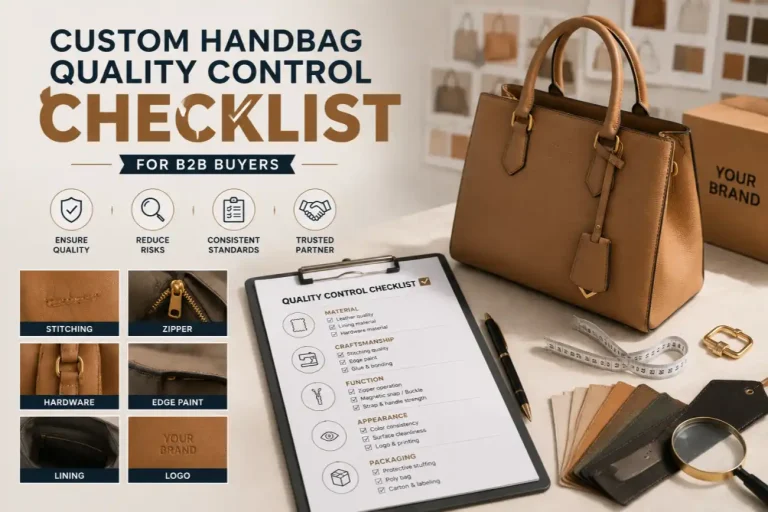
Quality validation checklist
- Golden sample: A signed, approved reference sample that becomes the benchmark for bulk.
- AQL standard: Agree on an Acceptable Quality Limit for major/minor defects.
- In-line + final inspection: Not just final “end-of-line” checks.
- Stress testing: Strap pull tests, zipper cycle tests, weight load tests (especially for travel/duffle categories).
- Defect taxonomy: Define what counts as “major” vs “minor” (e.g., edge paint cracks, misaligned logos, zipper failure).
Compliance considerations (EU/US)
If you sell internationally, you need to understand chemical and product safety constraints early—before selecting materials.
For EU markets, REACH and related chemical obligations can affect material choices (adhesives, dyes, coatings). ECHA provides official guidance for REACH obligations and how chemicals are regulated in the EU.
For US markets, if your products are intended for children (or marketed that way), you may need to consider CPSIA requirements, which include testing and certification obligations for children’s products (see CPSC’s CPSIA overview).
For social compliance and ethical sourcing, many brands request third-party audit frameworks such as amfori BSCI (useful when you need structured improvement and monitoring in the supply chain).
Step 6: Compare Quotes and Negotiate Terms
Two quotes can look similar but produce very different landed costs and risk profiles.
Your job is to compare apples to apples: materials, construction, packaging, sampling fees, QC, and shipping terms.
RFQ (Request for Quote) checklist
- Unit price breakdown: material + hardware + labor + packaging (even rough percentages help).
- MOQ by color: clarify MOQ per color and whether mixed colors are allowed.
- Sampling fees: cost per sample + how many rounds included.
- Tooling/mold fees: for custom hardware, logo plates, embossing dies.
- Lead times: sample lead time + bulk lead time (and what changes it).
- Payment terms: typical is deposit + balance before shipment; negotiate based on trust and track record.
- Incoterms: FOB, CIF, DDP, etc. Incoterms® rules define responsibilities and risk transfer points in global trade—use official ICC guidance to choose correctly.
Practical negotiation tip: if you’re stuck on MOQ, negotiate SKU simplification first (fewer colors, fewer hardware variants), then expand after you validate demand.
Also consider bundling your initial purchase across categories (e.g., a handbag + a small accessory) if the factory can share materials and reduce minimums.
If you need a manufacturer discussion checklist and a simple RFQ template, keep a public-facing version for your team and vendors (example: contact page + a downloadable RFQ request flow).
Step 7: Protect Your IP and Designs
Startups often skip IP protection because they feel “too small to matter.”
But your first successful design is exactly what attracts copycats—sometimes unintentionally through the supply chain.
IP protection basics for manufacturing
- NDA: Use an NDA before sharing full tech packs and design files.
- Ownership clauses: Clarify who owns patterns, molds, artwork, and custom hardware designs.
- Non-circumvention: If you use an agent or sourcing partner, define boundaries clearly.
- Controlled disclosure: Share only what is needed at each stage; keep master files versioned.
IP is not only legal—it’s operational. If you can’t control who has your pattern files and custom molds, you lose leverage in negotiations and reorders.
Step 8: Run a Pilot Order, Then Scale
The best way to validate a manufacturer is not a perfect sample—it’s a controlled pilot order.
Sampling shows capability; pilot production shows consistency under real constraints (time, workforce variation, packaging, and bulk material lots).
Recommended pilot sequence
- Proto sample: validate structure and usability.
- Revised sales sample: confirm materials, hardware, and branding.
- PP sample (pre-production): final confirmation before bulk. Sign it as the golden sample.
- Pilot run: small batch (e.g., 50–200 pcs) with QC inspection and defect analysis.
- Scale-up: increase volume only after defect rate and lead time are stable.
If you run both B2B and DTC, consider building your website to support both: a wholesale inquiry path and a DTC product update cadence.
For example, keep a wholesale category page (e.g., handbags collection) and a dedicated inquiry funnel with clear MOQ expectations.
Common Red Flags (Save These Before You Pay a Deposit)
- Vague answers: can’t explain material specs, QC steps, or lead time drivers.
- “Yes to everything”: claims they can do any material, any hardware, any MOQ, instantly.
- No documented QC: only promises “we do good quality” without checkpoints, AQL, or inspection reports.
- Sample hostage behavior: refuses to send samples unless you commit to a large order.
- Pricing whiplash: quote changes dramatically without clear spec changes.
- Unclear trade terms: won’t define Incoterms or insists on confusing shipping responsibilities.
Manufacturer Scorecard Template (Quick Decision Tool)
Use a simple scorecard to avoid “gut-feel sourcing.” Rate each supplier 1–5 and weight what matters most to your business stage.
| Category | What to Check | Weight (Example) | Score (1–5) |
|---|---|---|---|
| Sampling | Speed, revision clarity, pattern ownership | 20% | |
| Quality System | Golden sample, AQL, in-line QC, inspection reports | 25% | |
| Materials & Hardware | Spec accuracy, sourcing stability, alternatives offered | 15% | |
| Communication | Responsiveness, English clarity, PM ownership | 15% | |
| Commercial Terms | MOQ flexibility, transparent quote, Incoterms clarity | 15% | |
| Compliance & Ethics | ISO/BSCI/audit readiness, REACH/CPSIA awareness | 10% |
[Image suggestion: A screenshot-style graphic of the supplier scorecard with example scores filled in.]
FAQ
What should I include in my first message to a manufacturer?
Send your one-page brief + reference photos + target quantity range + target ship date.
Ask for their MOQ, sample timeline, and whether they support OEM or ODM for your category.
How many manufacturers should I talk to before choosing one?
Ideally 10–20 initial leads, then 3–5 serious sampling conversations. This gives you enough market context on price, MOQ, and lead times.
Is ISO 9001 mandatory for handbag manufacturers?
No. But it can be a useful signal that the factory has a structured quality management system and a culture of continuous improvement (depending on how it’s implemented).
How do I reduce risk if I can’t visit the factory?
Request a virtual tour, require a PP sample, use a third-party QC inspection for the pilot run, and lock specs through a signed golden sample plus documented defect criteria.
How do I avoid ordering the wrong MOQ for a startup launch?
Start with fewer colors, fewer hardware variations, and a pilot run. Use preorder/waitlist demand signals, then reorder fast once you confirm sell-through.
References
- ISO — ISO 9001:2015 overview and requirements:
https://www.iso.org/standard/62085.html - ICC — Incoterms® 2020 (official):
https://iccwbo.org/business-solutions/incoterms-rules/incoterms-2020/ - amfori — amfori BSCI (social compliance framework):
https://www.amfori.org/en/solutions/social/amfori-bsci - ECHA / EU chemicals regulation context (REACH):
https://eur-lex.europa.eu/legal-content/EN/TXT/HTML/?uri=LEGISSUM:l21282 - U.S. CPSC — CPSIA overview:
https://www.cpsc.gov/Regulations-Laws–Standards/Statutes/Summary-List/Consumer-Product-Safety-Improvement-Act-CPSIA
Next step: If you want, share your target bag category, target landed cost, and MOQ range. I can turn this into a ready-to-send RFQ email + a manufacturer scorecard sheet you can use to compare factories quickly.
For wholesale inquiries, you can also route prospects to a clear inquiry page (example:
Contact).