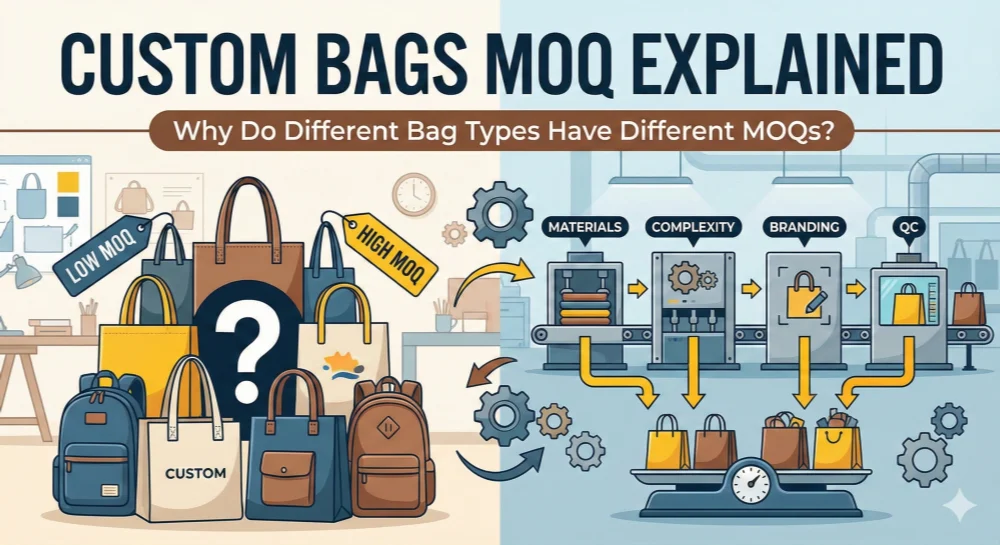
If you’ve requested quotes from multiple manufacturers, you’ve probably noticed something confusing: a simple tote bag might come with a low MOQ, while a backpack or leather weekender suddenly requires hundreds or even thousands of units. That difference is not random. MOQ (Minimum Order Quantity) is a practical number tied to materials, production efficiency, supplier minimums, and quality control—not just a factory’s “preference.”
In this guide, we’ll explain custom bags MOQ in plain English, then break down why different bag types (totes, duffles, backpacks, cosmetic bags, leather styles) often have different minimums. You’ll also learn how to lower MOQ smartly—without creating a quality or delivery disaster.
Table of Contents
What MOQ Means in Custom Bag Manufacturing
MOQ stands for Minimum Order Quantity: the smallest order size a supplier or manufacturer will accept for a production run. In B2B manufacturing, MOQs exist because small orders can’t always cover fixed costs like setup, labor planning, material procurement, and administrative work. Many businesses define MOQ as the minimum number of units required in one purchase to make production efficient and profitable [1].
In custom bags, MOQ isn’t only about sewing. It’s also about:
- Material buying minimums: mills and suppliers often sell fabric by roll or batch.
- Production setup: cutting patterns, sewing line balancing, hardware preparation.
- Branding setup: screens/plates for printing, embroidery digitizing, custom molds.
- Quality control approach: sampling inspection and rework time, especially for strict standards.
Quick example: A basic canvas tote with a standard zipper and one-color logo might run smoothly in small batches. But a structured backpack with foam padding, multiple pockets, custom zipper pulls, and a molded logo plate requires more suppliers, more steps, and more chances for delays. That complexity drives MOQ upward.About the Factory (Capabilities, Lead Time, MOQ)
Why Different Bag Types Have Different MOQs (The Real Drivers)
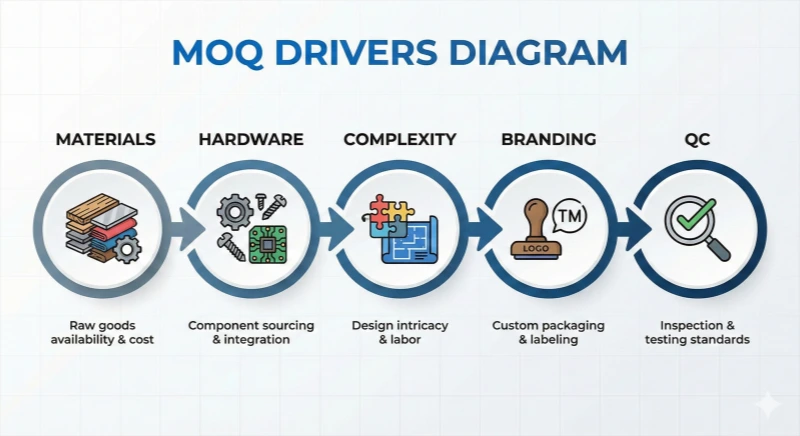
Different bag types have different MOQs because each type triggers a different mix of material minimums, labor minutes, and supplier dependencies. Below are the drivers that matter most in real factories.
1) Fabric roll minimums and colorways
Totes often use common materials (canvas, basic PU, standard linings) that factories already stock. That can keep MOQ lower. But high-denier nylon, coated fabrics, special textures, or custom colors may require ordering full rolls or meeting a mill’s dye-lot minimum. Each new colorway increases complexity and can raise MOQ even when the bag design stays the same.
2) Hardware and tooling requirements
Backpacks and duffles frequently use more hardware: buckles, D-rings, hooks, adjusters, logo plates, zipper pulls, and reinforced bottom feet. If you need custom-branded metal parts, suppliers may require minimum quantities (and sometimes molds). Even when the bag quantity is small, the hardware MOQ may force the overall MOQ up.
3) Construction complexity (minutes per bag)
MOQ is also connected to how long each unit takes to make. A flat tote can be quick. A backpack with structured foam, laptop padding, hidden pockets, and multiple binding steps takes more operator time and skill. Factories allocate line capacity based on stable, repeatable steps—complex designs are harder to run profitably in small lots.
4) Branding method and setup costs
Private label or “light customization” projects (label + hangtag + simple logo) often run at lower MOQs. But certain branding methods introduce setup costs:
- Embroidery: digitizing files, test runs, thread matching.
- Screen printing: screen/plate setup; each color can require a separate setup.
- Heat transfer/patches: die cutting and placement precision, especially for premium finishes.
5) Inspection standards and defect risk
When you demand strict inspection and consistent quality, the factory needs time for in-line checks and final inspection. Many buyers reference acceptance sampling standards such as ANSI/ASQ Z1.4 for inspection by attributes [2]. Sampling frameworks are also reflected in ISO’s inspection-by-attributes system (ISO 2859-1) [3]. Higher quality expectations can increase effective MOQ by prompting factories to plan for rework buffers, replacement parts, and additional QC checkpoints.
Typical MOQ Ranges by Bag Type (With Practical Notes)
MOQ varies by factory, country, season, and material availability. The ranges below are directional (not universal) but help you understand why one category is usually easier than another.
| Bag Type | Typical MOQ Range (Directional) | Why MOQ Is Often Higher/Lower | MOQ-Friendly Choices |
|---|---|---|---|
| Tote Bags | 50–300 pcs | Simple construction; common fabrics; fewer components | Use stock canvas/lining; 1–2 colors; simple logo |
| Cosmetic / Pouches | 100–500 pcs | Smaller size but zipper + lining; printing setup can dominate | Standard zipper; one print method; reduce variant count |
| Duffle Bags | 100–800 pcs | More panels, reinforcement, straps, and hardware | Standard webbing/hardware; limit pocket complexity |
| Backpacks(Laptop/Travel) | 200–2000 pcs | Highest complexity: foam, multiple pockets, binding, structure | Use existing base pattern; stock nylon colors; standard trims |
| Leather / PU Structured Handbags | 100–1500 pcs | Material grading, edge finishing, hardware, higher QC sensitivity | Standard hardware; fewer custom metal parts; stable color palette |
Suggested video: Insert a short factory clip showing cutting → sewing → binding → final inspection to explain why backpacks consume more capacity than totes.
How to Lower Your MOQ Without Sacrificing Quality
If you need a smaller first run, the goal isn’t “force the factory to accept anything.” The goal is to remove the specific constraints that cause high MOQ. Here are practical ways to do that while protecting your brand.
1) Start with stock materials and standard colors
This is the #1 MOQ lever. If a factory already has the fabric and lining in-house (or can source it without roll minimums), MOQ usually drops. Keep custom colors for later runs, after you validate demand.
2) Reduce the number of variants (SKUs)
MOQ often applies per style, per color, or per material. A 300-unit order split across 6 colors may function like six “50-unit” orders—harder to schedule and more likely to trigger supplier minimums. For launch, focus on 1–2 best-selling colors.
3) Use “semi-custom” branding
Instead of custom metal molds and complex multi-process logos, consider options that look premium but are MOQ-friendly: woven labels, rubber patches, standard zipper pulls, or a single embroidery placement. You can still build a strong brand identity without expensive tooling in run one.
4) Combine orders across categories or align components
If you’re launching a tote and a duffle, ask whether the same lining, webbing, or hardware can be shared. Component alignment increases purchasing efficiency and can help factories accept a lower MOQ because materials can be pooled.
5) Pay a small MOQ surcharge (and ask for a roadmap)
Some factories can do a lower MOQ with a higher unit price to cover setup. This can be a fair tradeoff for new brands that prioritize market testing. If you take this route, request a clear roadmap: “If we reorder 1000 pcs next time, what will the price drop to?”
6) Standardize your quality expectations early
Quality disputes create hidden delays and unexpected costs. Align on inspection and defect handling before bulk starts. Many buyers use acceptance sampling systems like ANSI/ASQ Z1.4 to define sampling plans [2], and ISO 2859-1 provides a widely cited international framework for inspection by attributes [3].
Mini RFQ checklist (MOQ-focused):
- Confirm MOQ is per style / per color / per material (get it in writing).
- List materials by exact specs (fabric type, weight/denier, coating, lining).
- Specify branding method(s) and number of colors for printing/embroidery.
- Clarify whether custom hardware is required (and its MOQ/tooling lead time).
- Ask for a milestone schedule (material arrival, sample approval, line start, final inspection).
If you’d like a manufacturer to review your MOQ target and suggest an MOQ-friendly configuration (materials + branding + packaging), start with a clear brief and reference comparable categories so the factory can propose the fastest path.
References
NetSuite: Minimum Order Quantity (MOQ) Definition and Key Drivers
ASQ: ANSI/ASQ Z1.4 Sampling Procedures for Inspection by Attributes (AQL)
ISO: ISO 2859-1 Sampling procedures for inspection by attributes
ShipBob: What Is a Minimum Order Quantity? (Overview + Practical Considerations)
If you’re sourcing custom bags in bulk, working directly with a manufacturer can reduce cost and improve quality.
Message Us on WhatsApp for Fast Factory Support