Estimated reading time: 8 minutes
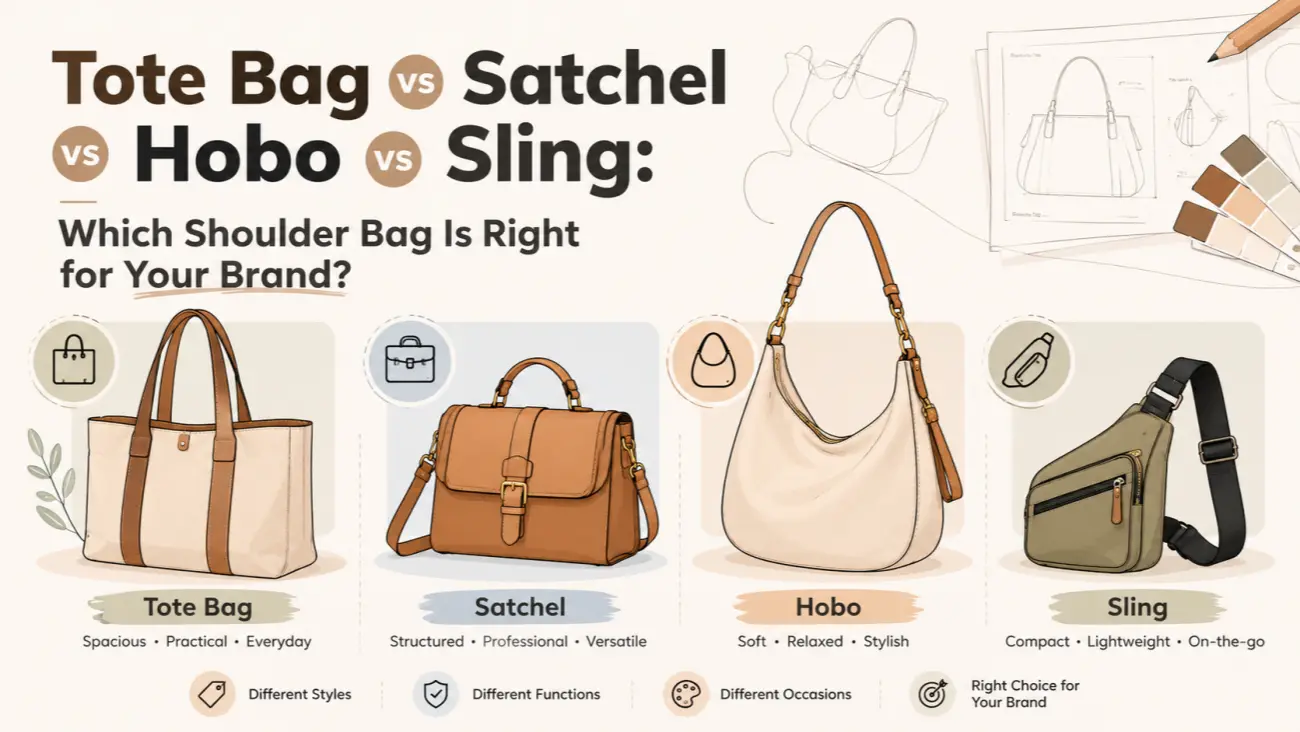
Among the many types of shoulder bags, four silhouettes cause the most confusion for first-time buyers: tote, satchel, hobo, and sling. They look different, but on a spec sheet, the differences can blur — and a blurred spec sheet leads to a sample that does not match what you imagined. This article compares the four styles from a manufacturer’s perspective, covering structure, materials, MOQ, logo options, and which brand type each one suits best.
If you are new to bag manufacturing, we recommend starting with our complete types of shoulder bags guide for an overview of all silhouettes. This article focuses on the four that matter most for B2B buyers.
Table of Contents
- Why Getting the Bag Type Right Matters for Your Brand
- The 4 Shoulder Bag Types at a Glance
- Tote Bag — The Volume Workhorse
- Satchel — The Structured Professional
- Hobo Bag — The Relaxed Curve
- Sling Bag — The Compact Hands-Free
- Head-to-Head Comparison: Which One Should You Choose?
- Conclusion — Start Your Shoulder Bag Sourcing
- References
Why Getting the Bag Type Right Matters for Your Brand
Choosing the wrong bag silhouette is the most common reason samples do not match buyer expectations — not poor craftsmanship, but a mismatch between what was ordered and what the design requires.
In our experience, we see this happen frequently: a buyer sends a reference photo of a structured satchel but asks for soft, slouchy materials suitable for a hobo. The factory produces a sample that meets the spec, but it does not look like the photo because the material cannot hold the shape. The result is wasted time, money, and frustration on both sides.
Each of the four bag types — tote, satchel, hobo, and sling — has a specific construction method, material requirement, and production complexity. Understanding these before you start sampling saves you at least one revision round and the cost that comes with it.
The 4 Shoulder Bag Types at a Glance
| Bag Type | Key Feature | Best Material | Typical MOQ | Production Complexity |
|---|---|---|---|---|
| Tote | Open-top, two handles | Canvas, Nylon, PU | 200–500 pcs | Low |
| Satchel | Structured, flap closure | Leather, Microfiber, Stiff PU | 500–1,000 pcs | High |
| Hobo | Crescent, slouchy, single strap | Soft PU, Microfiber, Soft Leather | 300–500 pcs | Medium |
| Sling | Compact, zip closure, crossbody | Nylon, PU, Polyester | 300–600 pcs | Medium |
Tote Bag — The Volume Workhorse
The tote is the simplest bag to manufacture and the most forgiving for new brands. Its defining features are an open-top compartment and two parallel shoulder straps.
From a production standpoint, the tote has the fewest potential failure points compared to other shoulder bag types. It has no zipper (in most designs), no flap mechanism, and a straight-forward pattern. The one critical area is the handle attachment — a tote’s handles carry 100% of the load. Experienced custom handbag manufacturers reinforce this area with box-X stitching or bartacks at every anchor point.
Specs at a glance: MOQ from 200 pcs. Sampling takes 2–3 weeks. Recommended for entry-level brands, corporate gifting, and promotional programs. Best logo methods: screen printing for large surface areas, woven labels, and fabric patches.
For wholesale orders, we usually suggest tote bags for brands testing the market — they have the lowest production complexity and fastest sampling turnaround.
Satchel — The Structured Professional
The satchel is defined by its rigid structure, flap closure, and polished appearance. It typically includes a top handle paired with a detachable shoulder strap. Satchels require stiff materials that hold their shape — genuine leather, microfiber, or stiff PU with a backing board.
The satchel is the most complex of the four types to manufacture. It requires a PE baseboard inside the bottom for structure, precise flap alignment, and consistent stitching around tight corners. If you are producing a satchel and plan to use genuine leather, we recommend reviewing our leather quality grades guide to choose a grade firm enough to hold structure.
Specs at a glance: MOQ from 500 pcs. Sampling takes 4–6 weeks. Recommended for premium brands, office-oriented labels, and any brand positioning above mid-range pricing. Best logo methods: metal nameplate, embossing, and debossing.
Before confirming the sample on a satchel, check the flap alignment and the gap between the flap and the bag body — an uneven gap is the most common satchel defect.
Hobo Bag — The Relaxed Curve
A hobo bag is defined by its crescent shape, slouchy body, and single shoulder strap. The hobo’s charm comes from its soft, unstructured silhouette, which means it needs flexible materials — soft PU, microfiber, or supple genuine leather.
The hobo presents a unique production challenge: curved seam construction. Unlike the straight lines of a tote or satchel, a hobo’s crescent shape requires skilled sewing operators who can maintain consistent tension along a curve. In our experience, this is the skill that most visibly separates experienced operators from newer ones. The material waste rate is also slightly higher — up to 10–15% — because the curved pattern does not nest on the cutting table as efficiently as rectangular patterns.
Specs at a glance: MOQ from 300 pcs. Sampling takes 3–4 weeks. Recommended for casual lifestyle brands, fast-fashion collections, and comfort-first designs. Best logo methods: metal nameplate that follows the curve, woven label at the seam.
This may sound like a small detail, but if you are ordering a hobo in genuine leather, account for natural hide variation — the crescent cut creates more waste per hide than a straight-cut tote pattern, which affects both material cost and yield.
Sling Bag — The Compact Hands-Free
The sling bag is a compact, zip-closed, crossbody style worn across the chest or back. It is the most technical of the four types in terms of hardware — multiple zippers, D-rings for strap attachment, and sometimes internal organizer panels.
The sling bag’s popularity has grown significantly with the rise of Amazon FBA sellers and DTC brands, because it offers a compact form factor with wide appeal. The production focus is on hardware reinforcement: D-rings must be securely anchored, zippers must glide smoothly around corners, and strap adjusters must be tested for durability. The custom handbag quality control guide covers what to inspect at each stage for hardware-intensive designs like slings.
Specs at a glance: MOQ from 300 pcs. Sampling takes 3–4 weeks. Recommended for Amazon sellers, outdoor brands, and minimalist labels. Best logo methods: foil stamping on the front panel, metal logo plate, and silicone patch.
If you are ordering for the first time and targeting Amazon, the sling bag is a strong starting point — it ships flat in polybags, reducing storage and freight costs, and the compact size means fewer returns due to sizing issues.
Head-to-Head Comparison: Which One Should You Choose?
The table below compares all four types across the dimensions that directly affect your sourcing decision.
| Dimension | Tote | Satchel | Hobo | Sling |
|---|---|---|---|---|
| Structure | Soft / Unstructured | Rigid / Structured | Soft / Slouchy | Soft to Semi-structured |
| Production Complexity | Low | High | Medium | Medium |
| Typical MOQ | 200–500 | 500–1,000 | 300–500 | 300–600 |
| Sampling Time | 2–3 weeks | 4–6 weeks | 3–4 weeks | 3–4 weeks |
| Material Cost (Relative) | Low | High | Medium | Low-Medium |
| Best Logo Methods | Print, Woven Label | Metal Plate, Emboss | Metal Plate, Label | Foil Stamp, Metal Logo |
| Best for Brand Type | Entry-level, Promo | Premium, Office | Casual, Fashion | DTC, Amazon, Outdoor |
Decision Matrix by Brand Type
| If Your Brand Is… | Start With | Why |
|---|---|---|
| New / testing the market | Tote | Simplest production, lowest MOQ, fastest sampling |
| Premium / Luxury | Satchel | Structured silhouette communicates quality and exclusivity |
| Casual fashion / Lifestyle | Hobo | Soft, effortless look that appeals to trend-driven buyers |
| Amazon / DTC / E-commerce | Sling | Compact, low shipping cost, broad consumer appeal |
Conclusion — Start Your Shoulder Bag Sourcing
Tote, satchel, hobo, and sling each serve a different brand position, price point, and production requirement. The tote is the safest entry point for new brands. The satchel requires higher investment but communicates premium quality. The hobo suits casual and fashion-forward lines. And the sling is the e-commerce-friendly compact option. There is no universally “best” type — only the one that best fits your brand’s market position and production budget.
For a complete overview of all shoulder bag styles, see our types of shoulder bags guide. Ready to start your custom bag project? Contact us with your product idea and target quantity, and we will recommend the right silhouette for your brand.
References
- Fortune Business Insights — Handbag Market Size Report — Market data on global handbag industry growth, including shoulder bag segment trends through 2028.
- ASTM D4157 — Abrasion Resistance of Textile Fabrics — Standard test method used to evaluate material wear for shoulder bag fabrics and synthetic leathers.
- ISO 9001 — Quality Management Systems — Quality framework used by professional bag manufacturers to maintain consistent production across different bag silhouettes.
- International Trade Administration — Importing Textiles and Apparel — U.S. government compliance guide for importing bags and leather goods.