Estimated reading time: 18 minutes
If you are planning to launch a custom bag line, the type of shoulder bag you choose determines everything about your production process — the materials your factory will recommend, the sampling timeline, the minimum order quantity, and even the logo options available to you. A tote bag and a satchel may both sit on the shoulder, but they are built completely differently and serve very different brand positions.
This guide covers the seven most popular custom handbag types from a manufacturer’s perspective: what makes each one unique, how they differ in production, which materials work best, and what buyers should know before requesting a quote. Whether you are a first-time brand or scaling an existing line, understanding these differences is the first step toward a successful sourcing outcome.
Table of Contents
- What Defines a Shoulder Bag? (B2B Definition)
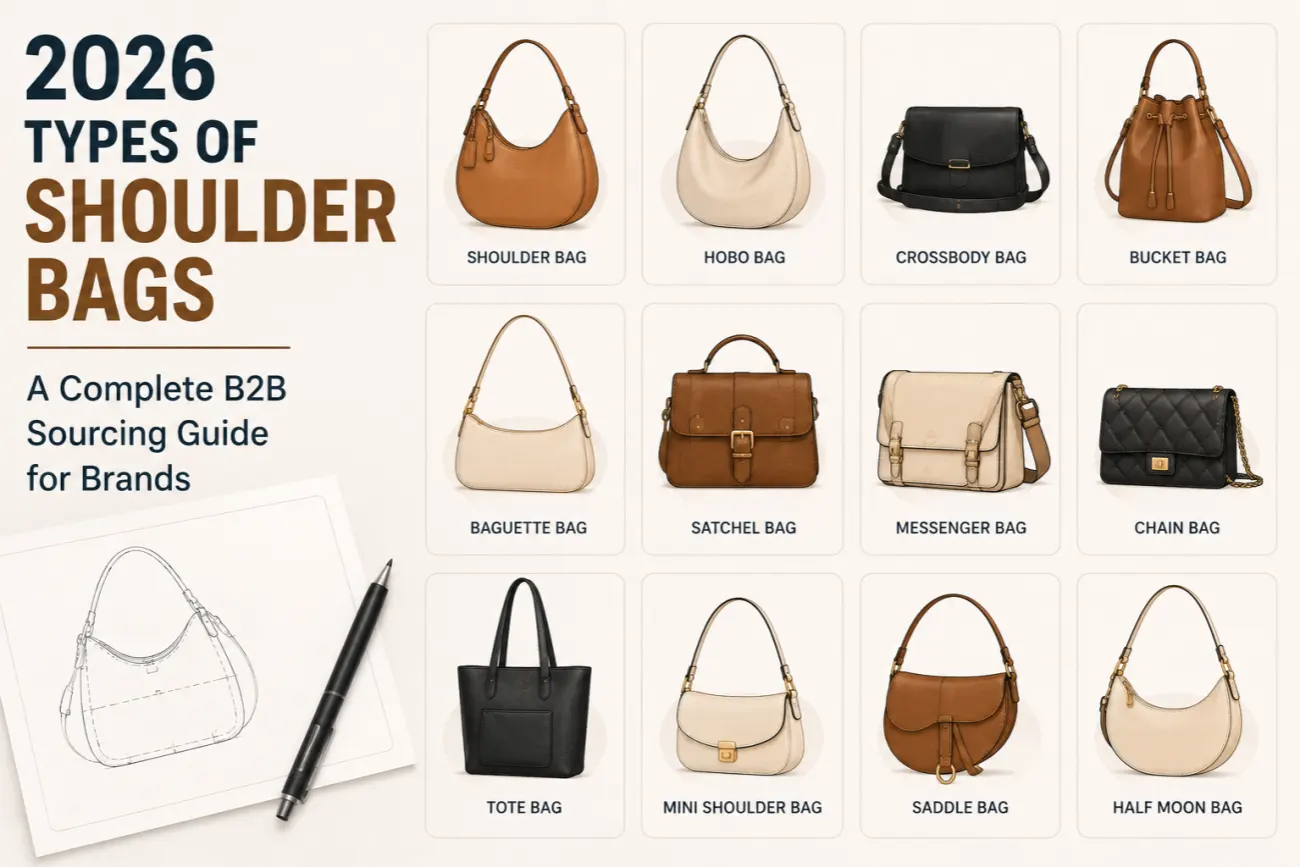
- The 7 Most Popular Shoulder Bag Types for Brands
- Shoulder Bag Types Comparison Table
- How to Choose the Right Shoulder Bag Type for Your Brand
- Logo & Branding Options by Shoulder Bag Type
- Recommended Materials by Shoulder Bag Type
- Quick Quality Checklist by Shoulder Bag Type
- Common Shoulder Bag Sourcing Mistakes (and How to Avoid Them)
- Conclusion — Start Sourcing Your Custom Shoulder Bags
- References
What Defines a Shoulder Bag? (B2B Definition)
A shoulder bag is a handbag with at least one strap long enough to rest on the shoulder. From a manufacturing standpoint, the critical element is not the shape or size — it is the strap attachment method, which determines the bag’s structural integrity and weight distribution.
There are three common strap attachment methods used in production: top-stitched (the strap is sewn directly into the seam — common on totes and messengers), riveted (hardware attaches the strap to the body — common on satchels and hobos), and D-ring suspended (the strap clips to D-rings — common on crossbody and adjustable styles). Each method requires different hardware sourcing, reinforcement techniques, and quality control checks.
Many buyers focus on the look of the bag first — but from what we see in bulk production, the strap attachment method determines more about durability than almost any other design decision. A bag that looks beautiful but has a poorly reinforced strap attachment will generate customer complaints within weeks, not months. In our experience, a well-attached strap using bartack stitching at the stress point can withstand over 50 kg of pull force, while a standard straight stitch without reinforcement may fail at under 15 kg.
The 7 Most Popular Shoulder Bag Types for Brands
Here are the seven shoulder bag styles most commonly sourced by brands, with production notes for each.
Tote Bag
The tote is the simplest and most versatile shoulder bag type. It is an open-top bag with two parallel handles, typically rectangular or square. From a production standpoint, the tote has the simplest pattern — straight cuts with minimal curves — which means it is the fastest to sample and the most material-efficient in cutting. Fabrics are used at approximately 92–95% efficiency, compared to 80–85% for curved styles like the hobo.
Totes work well in virtually any material: canvas, nylon, PU, microfiber, or genuine leather. They also offer the most logo flexibility — woven labels, screen printing, heat transfer, embroidery, and metal plates all work well on the flat front and side panels of a tote. For first-time buyers, we usually suggest starting with a tote: lower MOQ (200–300 pcs), faster sampling (2–3 weeks), and fewer QC risks.
Production details: The tote’s handle attachment is the single most important QC point. Handles should be reinforced with bartack stitching at both the top and bottom of each attachment point. A standard tote handle (35–45 cm drop length) typically requires 4–6 bartacks per handle to meet retail-grade durability standards. In bulk production, the handles are tested with a weight load of 15–20 kg for 24 hours — any stretching or seam separation means rejection.
Common buyer mistake: Many first-time buyers assume a larger tote means proportionally larger handles. In fact, handle length should stay within a functional range even for oversized totes, or the bag becomes uncomfortable to carry. If you are sourcing a “large vinyl tote bag” (a style that sees strong search interest in our GSC data), pay special attention to handle width — wider handles (2.5–3 cm) distribute weight better than thin ones (1–1.5 cm).
What we tell buyers: If your budget is limited and you need to launch quickly, a tote is the safest bet. The sampling cost is about 30–40% lower than a messenger or satchel of equivalent material quality, and you will have fewer rejections in bulk.
Satchel
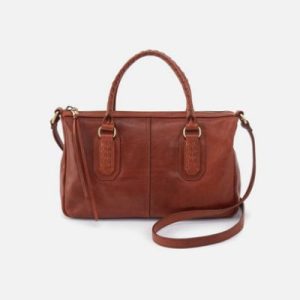
A satchel is a structured bag with a top handle and an optional detachable shoulder strap. The defining production characteristic is that it requires stiffening materials — often a foam or cardboard insert between the outer fabric and lining — to maintain its shape. Satchels demand more skilled labor than totes because the structure must be consistent across every unit. A satchel made with soft material will not hold its shape, which is one of the most common issues we see in bulk production.
Production details: The stiffening layer in a satchel is typically 2–4 mm thick PE foam or fiberboard. The quality of this stiffening material directly affects the bag’s longevity: foam that is too soft will compress over time, causing the bag to sag; fiberboard that is too rigid may crack in cold climates. We recommend closed-cell PE foam for satchel projects because it resists compression and maintains shape across temperature variations from -10°C to 50°C.
Satchel designs also require more hardware than other types — the top handle, strap swivel clips, feet (metal studs on the bottom), and often a lock or magnetic closure. Each hardware component must be sourced separately, which adds 1–2 weeks to the sampling timeline. Recommended materials for satchels are firm PU, microfiber, and genuine leather. Metal logo plates or embossed logos suit the structured front panel best.
Satchel projects typically have higher MOQs (500+ pcs) due to the additional component sourcing and more complex assembly. In our experience, the satchel is the most popular choice for premium and luxury brand launches. The structured silhouette commands a higher retail price point, making the higher MOQ worthwhile if your pricing strategy supports it.
Hobo Bag
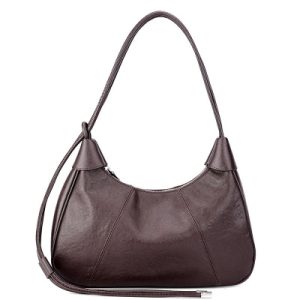
The hobo is characterized by its crescent shape and slouchy, relaxed silhouette. The hobo’s curved pattern makes it the most labor-intensive shoulder bag type to produce. Every seam follows a curve, which requires experienced sewing operators and more precise quality control. The material waste rate is higher — approximately 10–15% compared to 5–8% for a straight-cut tote. Hobo bags work best with soft, drapable materials: soft PU, microfiber, and supple genuine leather.
Production details: The curved pattern of a hobo bag means each piece must be cut and sewn with careful attention to grain direction. If the material is cut against the grain on a curved panel, the hobo’s signature slouch will look uneven — the bag may twist or sit asymmetrically on the shoulder. Skilled sewing operators are essential here, and not every factory has operators experienced with curved seams. This may sound like a small detail, but the curve stitching alone adds about 20% more labor cost compared to a straight-seam tote of similar size.
For logo placement, metal plates that follow the curve or woven labels are preferred over embossing, which can distort on curved surfaces. The hobo’s relaxed structure also means internal organization is simpler — typically one main compartment with a single zip pocket. If your brand requires multiple internal compartments, consider whether the hobo silhouette can accommodate them without losing its characteristic drape.
Common buyer mistake: Some buyers choose a cheap PU material for their hobo to save costs, but low-quality PU cracks under the tension of curved seams. The curved panels put uneven stress on the material, and a low-grade PU (below 0.8 mm thickness) will develop micro-cracks within 3–6 months of use. We usually recommend at least 1.0–1.2 mm microfiber or soft PU for hobo projects.
Sling Bag / Crossbody Bag
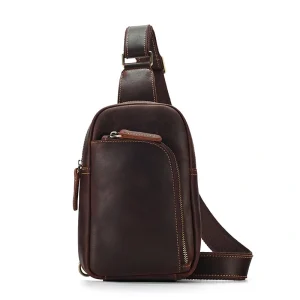
This is a single-strap bag designed to be worn across the body. The key production consideration is weight distribution: because the bag hangs on one strap, the strap attachment point must be reinforced more heavily than on a tote or satchel. Sling bags typically have more internal organization — 2–3 zip pockets, card slots, or phone compartments — compared to a tote’s single open compartment.
Production details: The strap attachment point on a sling bag should be reinforced with a double or triple layer of material at the stress zone. We use a reinforcement patch (approximately 4 × 6 cm) sewn into the seam where the strap meets the bag body. This patch alone can increase the pull strength of the attachment point from roughly 20 kg to over 60 kg. The strap itself should be at least 2.5 cm wide for comfort — narrower straps dig into the shoulder under load and generate customer complaints.
Zipper quality is critical in sling bags. The zipper closure is the primary access point and the most common failure mode in customer returns. For sling bag projects, we recommend YKK #5 or #8 zippers with auto-lock sliders. A lower-grade zipper on a sling bag will fail noticeably faster than on a larger bag type, because the zipper is opened and closed more frequently per day.
The most common material choices are lightweight nylon (for active use), PU (for fashion), and microfiber (for durability). For first-time orders, sling bags are an excellent second choice after totes — moderate MOQ (300–500 pcs) and reasonable sampling costs.
Bucket Bag
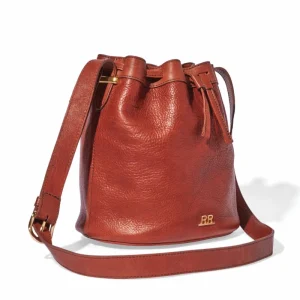
A bucket bag has a round or oval bottom, a cylindrical body, and typically a drawstring or open-top closure. The bucket bag’s round base pattern creates the highest material waste rate of any shoulder bag type — approximately 15–20% of the fabric is lost in cutting the circular shape. This directly increases the material cost per unit by 10–15% compared to a straight-cut tote. Bucket bags work well with soft or medium-weight materials: soft PU, canvas, microfiber, and lightweight genuine leather.
Production details: The most critical seam on a bucket bag is where the round base meets the cylindrical body. This curved seam must be sewn with precision — if the circumference of the base does not match the body panel exactly, the bag will pucker or sit unevenly. We use a laser-cutting step for the base panel to ensure perfect circularity, which adds a small cost (approximately $0.15–0.30 per unit) but virtually eliminates this defect.
The drawstring closure uses a cord or leather strap threaded through metal grommets or fabric loops. The number of grommets affects both the look and the function: 4 grommets is the minimum for a small bucket bag, while larger designs typically use 6–8. Each grommet must be reinforced to prevent tearing under tension. Logo options on bucket bags are limited compared to flat-front styles — a metal tag or printed logo on a leather patch hung from the drawstring is a common solution.
Bucket bags are currently gaining popularity as a fashion-forward style on social platforms. From what we see in buyer inquiries, demand for bucket bags has grown about 25% year over year, making them a good option for brands targeting trend-conscious customers who want something different from the standard tote or crossbody.
Messenger Bag
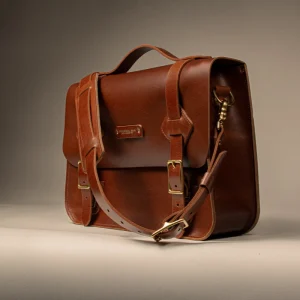
The messenger bag is a rectangular bag with a flap closure and a long crossbody strap. This is technically the most complex shoulder bag to produce. It combines multiple closure types — magnetic snaps, buckle clasps, and sometimes zippers — all on one bag. The flap requires precision cutting and alignment to ensure consistent closure across all units.
Production details: A messenger bag typically requires 3–4 more production steps than a tote, including flap padding, closure installation, and extra strap reinforcement. The flap itself is usually constructed with a foam layer (2–3 mm) sandwiched between the outer material and lining, then edge-stitched to maintain its shape. This padded flap construction adds roughly 15–20 minutes of labor per bag compared to a simple tote.
The closure system is where most messenger bag QC issues arise. A buckle closure adds a classic look but requires precise alignment to within 2 mm tolerance. A magnetic snap closure is faster to assemble but may lose strength over time — the industry standard for magnetic snap strength is a minimum hold force of 1.5 kg. We typically recommend buckle closures for premium messenger bags and magnetic snaps for mid-range price points.
Messenger bags are commonly made from canvas, nylon, PU, or waxed cotton for a heritage look. Metal logo plates on the front flap are the standard branding method. Messengers usually have the highest MOQ among shoulder bag types (500–1,000 pcs) due to the complexity of component sourcing and assembly. If your brand targets the professional/laptop bag segment, the messenger is a strong choice — but expect a longer lead time (4–6 weeks for sampling, 8–12 weeks for bulk production).
Flap / Structured Shoulder Bag
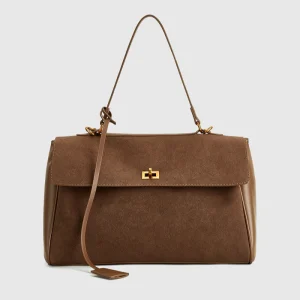
This category covers shoulder bags with a front flap closure and a structured or semi-structured body. The flap requires precise cutting and consistent alignment during assembly — a misaligned flap is both a functional problem (the closure may not line up) and an aesthetic one.
Production details: Flap alignment is checked using a jig during assembly. The tolerance standard we use is no more than 2 mm deviation between the flap edge and the bag body when closed. This margin matters because any misalignment becomes more visible when the bag has contrast edge painting or piping. For brands using edge painting, the paint layer adds approximately 1–2 mm to the edge thickness, so the alignment check must account for this added dimension.
The closure mechanism on structured flap bags is typically a turn-lock, magnetic snap, or metal clasp. Turn-lock closures demand the highest precision in installation — the male and female components must be aligned within 1 mm tolerance, or the lock will feel loose or fail to engage. Of all closure types, turn-locks generate the most QC rejections in our experience, accounting for roughly 8–10% of defects in structured flap bag production.
Structured shoulder bags work with firm materials — stiff PU, microfiber, and genuine leather. Soft materials will not support the flap structure. This type suits premium and luxury brand positioning, and metal logo plates or embossed logos are the standard branding choices. The GSC data shows that buyers are actively searching for “structured shoulder bags,” indicating growing interest in this style for brand collections. If you are considering this category, allocate 3–5 weeks for sampling and plan for 500+ pcs MOQ.
Shoulder Bag Types Comparison Table
| Bag Type | Production Complexity | Typical MOQ | Best Logo Options | Best Materials | Sampling Timeline |
|---|---|---|---|---|---|
| Tote | Low — straight cuts, minimal seams | 200–300 pcs | Woven label, print, embroidery, metal plate | Canvas, nylon, PU, microfiber, leather | 2–3 weeks |
| Satchel | Medium-high — requires stiffening, structured assembly | 500+ pcs | Metal plate, emboss | Firm PU, microfiber, genuine leather | 3–5 weeks |
| Hobo | High — curved seams, skilled labor needed | 300–500 pcs | Metal plate (curved), woven label | Soft PU, microfiber, supple leather | 3–5 weeks |
| Sling / Crossbody | Medium — strap reinforcement, multiple pockets | 300–500 pcs | Metal plate, woven label | Nylon, PU, microfiber | 2–4 weeks |
| Bucket | Medium-high — round base, curved panels | 300–500 pcs | Metal tag, printed patch | Soft PU, canvas, microfiber | 3–5 weeks |
| Messenger | High — flap closure, multiple hardware types | 500–1,000 pcs | Metal plate (flap front) | Canvas, nylon, PU, waxed cotton | 4–6 weeks |
| Flap / Structured | Medium-high — flap alignment, structural support | 500+ pcs | Metal plate, emboss | Firm PU, microfiber, genuine leather | 3–5 weeks |
Quick note on sampling costs: In our experience, the sampling fee roughly follows the production complexity. A tote sample typically costs $80–150 depending on materials and hardware. A messenger or satchel sample can range from $200–400. Factor these costs into your product development budget — especially if you plan to sample multiple styles before making a final decision.
How to Choose the Right Shoulder Bag Type for Your Brand
There is no single “best” shoulder bag type — the right choice depends on your brand positioning, sales channel, and budget.
| Brand Type | Recommended Shoulder Bag Type | Why |
|---|---|---|
| Premium / Luxury brand | Satchel, Structured Flap | Structured silhouettes with genuine leather or high-grade microfiber, metal hardware, and higher MOQ support premium pricing |
| Contemporary fashion / DTC | Tote, Bucket, Sling | Faster sampling, trend-responsive, material flexibility, lower MOQ to test new styles |
| Amazon / E-commerce | Sling, Hobo, Tote | Lower return rates (simpler construction), consistent production across batches, cost-effective materials |
| Corporate / Promotional | Tote, Messenger | Large front panel for logo printing, high-volume MOQ-friendly, durable materials suit daily use |
| First-time brand | Tote or Sling | Lowest MOQ, fastest sampling, simplest QC — build experience before moving to complex styles |
Scenario example: A DTC brand launching its first women’s accessories line came to us with a satchel design. After reviewing their budget and timeline, we suggested starting with a tote and a sling bag instead — two styles that could be sampled in 3 weeks total, with a combined MOQ of 500 pcs. Six months later, after the tote and sling validated their market, they ordered the satchel at 800 pcs with full confidence. Starting with the satchel first would have required a 500+ pcs MOQ commitment before they had any sales data.
If you are ordering for the first time, we usually suggest starting with a tote or sling bag. The lower MOQ and faster sampling allow you to test the market and build a relationship with your factory before committing to more complex silhouettes like the satchel or messenger. In our experience, brands that start simple and scale to complex styles tend to have fewer quality surprises and stronger factory partnerships.
Logo & Branding Options by Shoulder Bag Type
The shoulder bag type you choose directly affects which logo application methods will work — and which will look cheap or fade quickly.
| Bag Type | Embossing | Metal Plate | Woven Label | Print / Screen | Embroidery |
|---|---|---|---|---|---|
| Tote | ⭐️⭐️⭐️ | ⭐️⭐️⭐️ | ⭐️⭐️⭐️ | ⭐️⭐️⭐️ | ⭐️⭐️⭐️ |
| Satchel | ⭐️⭐️⭐️ | ⭐️⭐️⭐️ | ⭐️⭐️ | ⭐️ | ⭐️ |
| Hobo | ⭐️⭐️ | ⭐️⭐️⭐️ | ⭐️⭐️⭐️ | ⭐️⭐️ | ⭐️⭐️ |
| Sling / Crossbody | ⭐️⭐️ | ⭐️⭐️⭐️ | ⭐️⭐️⭐️ | ⭐️⭐️ | ⭐️⭐️ |
| Bucket | ⭐️ | ⭐️⭐️ | ⭐️⭐️⭐️ | ⭐️⭐️ | ⭐️ |
| Messenger | ⭐️⭐️ | ⭐️⭐️⭐️ | ⭐️⭐️ | ⭐️ | ⭐️ |
| Flap / Structured | ⭐️⭐️⭐️ | ⭐️⭐️⭐️ | ⭐️⭐️ | ⭐️ | ⭐️ |
⭐️⭐️⭐️ = Excellent ⭐️⭐️ = Good ⭐️ = Limited
The tote bag offers the widest range of logo options because its flat, uninterrupted panels provide a clean canvas for any application method. By contrast, the bucket bag’s curved, unstructured surface limits options — woven labels and printed patches are the most practical choices.
Practical consideration: If logo flexibility is a priority for your brand (for example, if you plan to offer different branding options across retail and wholesale channels), consider selecting a bag type with larger flat surface areas. The tote and messenger offer the most usable surface area for branding. On the other hand, if your brand identity is centered on a distinctive metal logo plate, the satchel, hobo, and structured flap types showcase this hardware more prominently than a tote or sling bag would.
Also consider your minimum order quantity for branding. Woven labels and basic screen printing add little to no MOQ increase (they cost approximately $0.10–0.30 per bag). Metal plates and custom embossing stamps have tooling costs ($50–150 per die or mold) that are best amortized across larger quantities. For a detailed breakdown of branding costs per quantity tier, see our custom handbag manufacturing guide.
Recommended Materials by Type
Choosing the wrong material for a shoulder bag type is one of the most common sourcing mistakes. A satchel made with soft fabric will collapse. A hobo made with rigid leather won’t drape. Here is a quick material guide by type:
- Tote — Works with almost any material: canvas, nylon, PU, microfiber, genuine leather. For large-volume totes, lightweight materials like nylon or canvas reduce shipping weight. If you are comparing fabric options, see our nylon vs polyester for bags guide.
- Satchel — Requires firm materials: structured PU, microfiber, or genuine leather. Soft fabric will not hold the bag’s shape. Material thickness recommendation: at least 1.0 mm for PU/microfiber, at least 1.2 mm for genuine leather.
- Hobo — Needs soft, drapable materials: soft PU, microfiber, or supple genuine leather. Stiff materials defeat the hobo’s relaxed silhouette. Minimum recommended thickness: 0.8–1.0 mm for flexibility.
- Sling / Crossbody — Lightweight materials preferred: nylon, PU, microfiber. For travel-focused designs, lightweight nylon (200–400D) keeps the bag under 300g.
- Bucket — Soft to medium-weight materials: soft PU, canvas, microfiber. Circular base requires flexible but durable fabric. Canvas bucket bags typically use 12–16 oz weight.
- Messenger — Durable, structured materials: canvas, nylon, PU, waxed cotton. The flap requires material that resists curling over time. For a heritage look, waxed cotton (8–10 oz) is a premium choice.
- Flap / Structured — Firm materials that hold edges: stiff PU, microfiber, genuine leather. See our leather quality grades explained guide for choosing the right genuine leather grade for structured designs.
For a deeper comparison of synthetic and natural material options, see our PU vs microfiber vs genuine leather guide.
Quick Quality Checklist
Each shoulder bag type has its own QC risk areas. Here is what to prioritize when inspecting samples and production units:
- Tote — Check handle attachment reinforcement. The handles bear the full weight load and are the most common failure point. Verify bartack stitching at both ends of each handle. Test with a 15 kg pull.
- Satchel — Verify the bag holds its shape when empty. The internal stiffening should not shift or buckle. Press the body panels — if the stiffening layer crinkles, the foam quality is insufficient.
- Hobo — Inspect curved seam consistency. Uneven stitching on curves is the most common defect. Run your finger along each curved seam — any skipped stitches or loose tension will be noticeable to the touch.
- Sling / Crossbody — Test zipper function and strap attachment strength. Open and close each zipper 10 times in a row. If the slider catches or skips teeth at any point, flag it for replacement.
- Bucket — Check the base seam where the round bottom meets the body. This seam takes the most stress during use. Any visible puckering at the base seam is a structural defect.
- Messenger — Verify flap alignment and closure function. The flap should sit straight and close securely. Test the closure 20 times — if it becomes misaligned, the assembly tolerance is too loose.
- Flap / Structured — Check flap alignment and hardware finish. Misaligned flaps are both functional and aesthetic defects. Turn-lock closures should engage with a clear “click” and not wobble.
For a complete QC workflow that covers all production stages from sample to shipment, see our custom handbag quality control guide.
Common Shoulder Bag Sourcing Mistakes (and How to Avoid Them)
After working with hundreds of shoulder bag projects, these are the most common mistakes we see buyers make — and how to avoid each one.
Mistake #1: Choosing the material before the bag type
Many buyers find a material they like and try to force it into a bag type it does not suit. A beautiful stiff genuine leather will make a terrible hobo bag. A soft nylon will collapse in a satchel. Choose your bag type first based on your brand positioning and target customer, then let that decision guide your material selection — not the other way around.
Mistake #2: Underestimating hardware lead time
Custom hardware (logo plaques, turn-locks, buckles with brand engraving) typically takes 3–5 weeks to produce from mold creation to finished pieces. Many buyers finalize their bag design but forget to account for hardware lead time. The hardware often ends up being the critical path item — order it as early as possible, ideally during the sampling phase.
Mistake #3: Ignoring the impact of curved seams on MOQ
Bag types with curved patterns (hobo, bucket) require more skilled labor and produce more material waste. This means factories may set higher MOQs for these styles regardless of the material chosen. If your budget constrains you to a lower MOQ, consider whether a straight-cut style (tote or sling) could achieve a similar look with simpler production.
Mistake #4: Not planning for QC sampling time
A common timeline mistake is assuming sampling is a one-step process. In reality, most shoulder bag projects require 2–3 rounds of sampling: development sample for design approval, revision sample for fit and function fixes, and a pre-production sample that matches the final bulk spec. Budgeting for only one round of sampling is the most common planning error we see from new buyers. See our custom handbag sample process guide for a realistic timeline.
Conclusion — Start Sourcing Your Custom Shoulder Bags
Choosing the right shoulder bag type for your brand is a business decision, not just a design preference. Each type comes with different production costs, material requirements, MOQ commitments, logo options, and quality risks.
Here is a quick summary to guide your decision:
- Low complexity, fast launch: Tote bag — lowest MOQ, fastest sampling, widest material and logo flexibility.
- Premium positioning: Satchel or structured flap — higher MOQ but supports higher retail pricing.
- Trend-forward, fashion-focused: Bucket bag — growing demand, moderate MOQ, distinctive silhouette.
- Maximum brand logo visibility: Tote or messenger — large flat surface areas for any branding method.
- First-time order: Start with a tote or sling bag — lower investment, fewer QC risks, faster time to market.
By understanding these differences before you approach a factory, you will get more accurate quotes, faster sampling, and fewer surprises in production.
Ready to start your custom shoulder bag line? Contact us with your design ideas and target quantities — we will recommend the right type, material, and production plan for your project. If you are still unsure which style fits your brand best, send us your mood board or reference images and we will provide a free type recommendation based on your goals.
References
- ISO 9001:2015 — Quality Management Systems — Quality management framework used by professional bag manufacturers to maintain consistent production and inspection standards across all bag types.
- ASTM D4157 — Standard Test Method for Abrasion Resistance of Textile Fabrics (Wyzenbeek) — Industry abrasion testing standard relevant to evaluating material durability for high-wear shoulder bag styles.
- International Trade Administration — Importing Textiles and Apparel — U.S. government resource for import compliance, labeling requirements, and customs documentation for bag imports.
- ISO 2859-1 — Sampling Procedures for Inspection by Attributes — The international AQL standard used for pre-shipment quality inspection of bag production orders.