Estimated reading time: 7 minutes
If you are searching for a custom handbag manufacturer, you have likely seen the terms OEM and ODM used on nearly every factory website. They are often thrown around as if every buyer already knows the difference. In reality, choosing between OEM and ODM is one of the most important decisions you will make in your sourcing journey — it determines your upfront cost, your design control, your timeline, and even who owns the rights to your bag. This guide breaks down both models from a manufacturer’s perspective so you can make the right call from day one.
Table of Contents
- What Do OEM and ODM Mean in Handbag Manufacturing?
- OEM vs ODM — The 5 Key Differences at a Glance
- When OEM Is the Right Choice for Your Handbag Brand
- When ODM Works Better for Your Business
- Cost, MOQ & Timeline: OEM vs ODM Compared
- How to Decide Between OEM and ODM
- Conclusion — Start Your Handbag Sourcing with the Right Model
- References
What Do OEM and ODM Mean in Handbag Manufacturing?
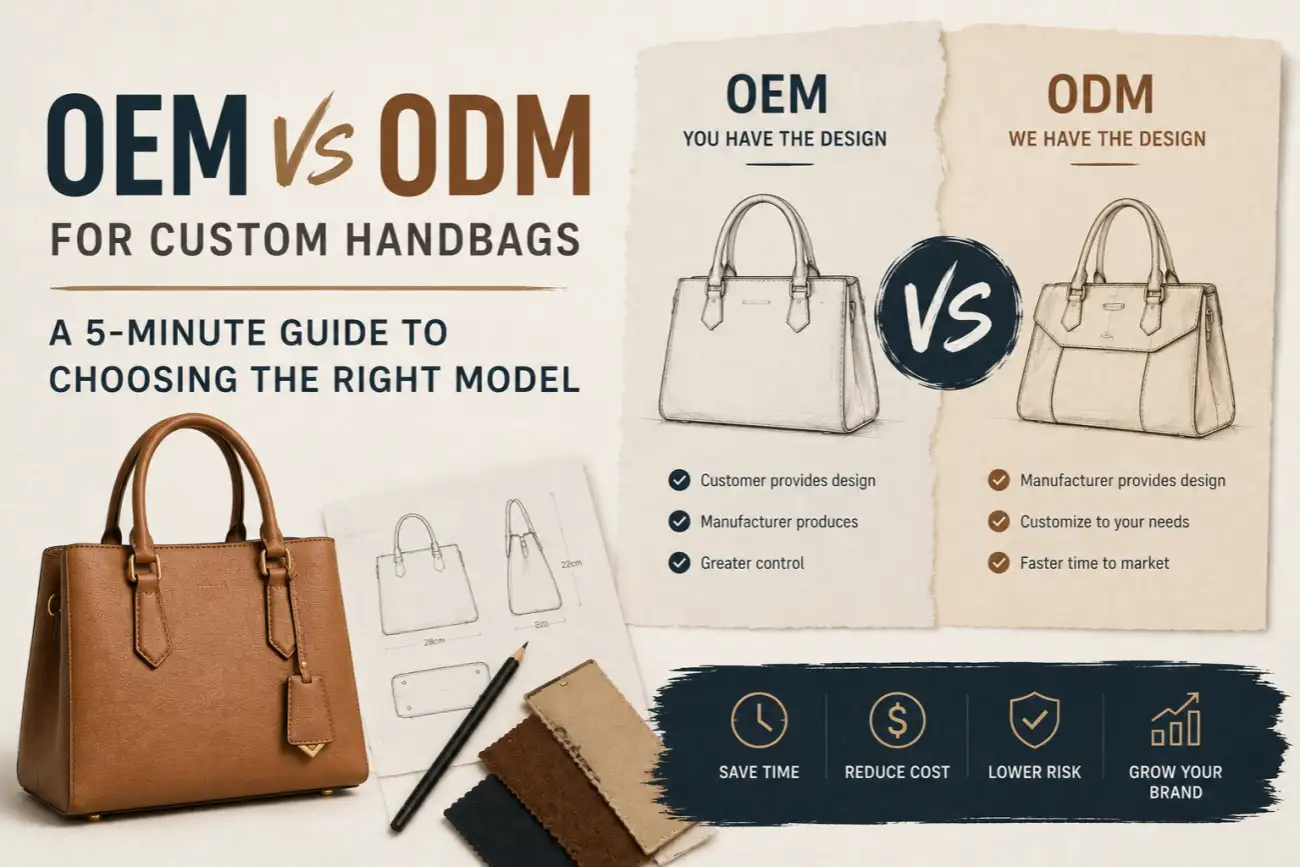
The difference comes down to one question: who brings the design? In OEM (Original Equipment Manufacturing), you provide the complete design — tech pack, sketches, material specs — and the factory produces exactly what you give them. In ODM (Original Design Manufacturing), the factory offers existing designs from their library, and you customize materials, colors, hardware, and branding within those base designs.
Think of it this way: OEM means you are the architect and the factory is the construction company. ODM means the factory built the model home, and you choose the finishes and furniture.
What Is OEM (Original Equipment Manufacturing)?
OEM is ideal when you already have a finished design. You provide detailed specifications — a tech pack with measurements, material samples, hardware references, stitching requirements, and logo artwork. The factory’s role is to execute your vision precisely. You own the complete design and the product is exclusive to your brand. OEM typically requires a higher upfront investment in sampling and a higher minimum order quantity.
What Is ODM (Original Design Manufacturing)?
ODM works when you have a product idea but not a complete design. The factory shows you their existing styles — totes, crossbody bags, backpacks, clutches — and you select one to customize. You can change the material, color, hardware finish, logo placement, and packaging. The factory owns the base design, but you own your branded version. ODM is faster, cheaper to start, and requires less design expertise from the buyer.
OEM vs ODM — The 5 Key Differences at a Glance
| Dimension | OEM | ODM |
|---|---|---|
| Design Source | You provide the complete design | Factory provides base designs |
| IP Ownership | 100% yours | Factory owns base design; you own customizations |
| MOQ | 500–1,000+ pcs per design | 200–500 pcs per style |
| Sampling Fee | $200–$800 | $50–$200 |
| Development Timeline | 4–8 weeks (sample to bulk) | 2–4 weeks |
These five dimensions — design source, IP ownership, MOQ, sampling cost, and timeline — are the most important factors when deciding between OEM and ODM for your handbag project.
When OEM Is the Right Choice for Your Handbag Brand
Choose OEM if you have a complete, unique design and need full control over the final product. In our experience, OEM works best for three types of buyers:
- Established brands expanding their product line with a specific design vision and an existing customer base that expects consistency.
- Brands with in-house designers who can produce a thorough tech pack with CAD drawings, material specifications, and construction details.
- Luxury or premium positioning — if exclusivity and unique construction details are part of your brand value, OEM is the only way to guarantee no other brand sells the same bag.
One common mistake we see is first-time buyers jumping into OEM without a complete tech pack. If you order OEM without detailed specifications, you may end up with multiple sample rounds, higher development costs, and a product that does not match your original vision. Before confirming the sample, make sure your tech pack includes every detail — from stitch density to hardware finish.
What About E-Commerce Sellers?
If you sell on Amazon, Shopify, or other online platforms, OEM is usually not the right starting point unless you already have a proven product and need to scale. The upfront cost and longer timeline make it a better fit for brands that have already validated their product-market fit.
When ODM Works Better for Your Business
Choose ODM if you want to launch faster, test the market, or do not have a complete design ready. In our experience, ODM is the smarter choice for the following scenarios:
- First-time handbag brands — You have an idea and a target price point, but you have not finalized every detail. ODM lets you see what works in production before committing to a full custom design.
- Amazon FBA sellers — Speed matters. ODM allows you to go from concept to sample in 2–3 weeks, test a few styles, and scale what sells. Many Amazon sellers we work with start with 2–3 ODM styles, prove the market, then move to semi-custom on their best sellers.
- Seasonal collections or trend-driven products — If you need to launch a spring collection or a holiday-specific bag quickly, ODM cuts your development time in half.
This may sound like a small detail, but one advantage of starting with ODM is that you can see the factory’s actual workmanship on a proven design before trusting them with a full custom project. It is a lower-risk way to evaluate a manufacturing partner.
If you are ordering for the first time, we usually suggest starting with ODM. Once you understand the production process and have proven your sales channel, transitioning to OEM is a natural next step.
Cost, MOQ & Timeline: OEM vs ODM Compared
The financial difference between OEM and ODM is significant — especially for first-time buyers.
Sampling costs: OEM sampling typically ranges from $200 to $800 per style, depending on complexity. ODM sampling costs $50 to $200 because the factory works from an existing pattern. The difference comes from pattern-making: in OEM, the factory must draft a new pattern from scratch; in ODM, the pattern already exists and only minor adjustments are needed.
Minimum order quantities: OEM requires more commitment. Most factories set OEM MOQs at 500 to 1,000 pieces per design because every new pattern requires dedicated setup time. ODM MOQs are lower — typically 200 to 500 pieces per style — since the production line is already familiar with the design.
Timeline: OEM development takes 4 to 8 weeks from sample approval to bulk production. ODM is faster at 2 to 4 weeks because there is no pattern-making phase.
IP Protection — Who Owns the Design?
One concern we hear from buyers is: “If I choose ODM, can another brand buy the same bag?” The short answer is yes — unless you negotiate an exclusivity agreement with the factory. In OEM, the design is 100% yours; the factory cannot produce it for another buyer. In ODM, the factory retains the base design rights and can sell it to multiple buyers. However, you can request a market-specific or time-limited exclusivity for an additional fee. This is something we routinely arrange for clients launching in specific regions.
How to Decide Between OEM and ODM
Ask yourself these three questions:
- Do I have a complete design ready? If yes (tech pack, material specs, patterns), OEM is viable. If not, start with ODM.
- What is my budget and timeline? If you need to launch in under 6 weeks with a limited budget, ODM is the practical choice.
- Is exclusivity critical for my brand? If you cannot accept another brand selling a similar design, OEM offers full IP protection.
✅ Quick Checklist — Before You Contact a Factory
- ✅ I have a complete tech pack / design → Go OEM
- ✅ I have a product idea but no design → Go ODM
- ✅ I know my target price range and budget for sampling
- ✅ I have reference photos or a physical sample
- ✅ I know my estimated order quantity
- ✅ I have discussed exclusivity terms with the factory (for ODM)
In our experience, many brands start with ODM and transition to OEM as they grow. The three-phase approach works well: pick proven ODM styles first → test the market → design your own OEM collection once you know what sells.
Conclusion — Start Your Handbag Sourcing with the Right Model
There is no universal right answer between OEM and ODM. The right choice depends on your brand stage, design readiness, budget, and timeline. If you have a complete design and need exclusivity, OEM gives you full control. If you want to move fast, test the market, or do not have a finalized design, ODM allows you to launch with lower risk and cost.
What matters most is that you go into your factory conversations knowing which model fits your situation — and that you choose a partner who can support you in both. Ready to start? Contact us with your requirements, and we will recommend the best approach for your project.
References
- ISO 9001:2015 — Quality Management Systems — International standard for quality management, widely adopted by bag and soft goods manufacturers.
- ISO 2859-1 — Sampling Procedures for Inspection by Attributes — The statistical AQL standard used for quality control inspection in bag manufacturing.
- Leeline Bags — How to Apply AQL Inspection Standards — Practical guide on how AQL sampling works for bag production, aligned with ISO 2859-1.
- International Trade Administration — Textile and Apparel Resources — U.S. government resource for import regulations, compliance, and market data for textile and bag imports.