Estimated reading time: 6 minutes
You have placed your wholesale leather handbag order, negotiated the price, and confirmed the delivery date. But without a proper quality control checklist, you are trusting that every bag in your shipment will match the sample you approved. In our experience working with importers, most quality issues — color mismatch, hardware failure, stitching defects — are completely preventable if you know what to check before the container leaves the factory.
This guide covers the QC checklist we use internally at our factory, written from a manufacturer’s perspective so you can protect your investment with confidence.
Table of Contents
- H2-1: Why a QC Checklist Matters for Wholesale Leather Handbag Imports
- H2-2: Pre-Production QC — What to Check Before Production Starts
- H2-3: Common Quality Issues in Bulk Leather Handbag Production
- H2-4: QC Checklist Template — Use This Before Every Shipment
- References
- H2-5: Conclusion — Protect Your Brand with Proper QC
Why a QC Checklist Matters for Wholesale Leather Handbag Imports
Leather is a natural material, and natural materials have variation. A single hide can show differences in color, texture, and thickness across different sections. When you multiply that across hundreds or thousands of bags in a wholesale order, those variations can become a real problem if no one is checking them systematically.
From what we see in bulk production, the most common reason importers end up with substandard goods is not that the factory cut corners — it is that the buyer did not specify the acceptable quality standards clearly before production began. A QC checklist solves this by giving both sides a clear reference for what “good enough” looks like.
If you are ordering for the first time, having a written checklist also signals to your supplier that you know what you are doing, which typically results in better attention to detail throughout the production run.
Pre-Production QC — What to Check Before Production Starts
Most quality problems are actually locked in before the first bag is cut. The pre-production stage is where you set the baseline. Here are the key checks to run before giving the green light.
Leather Material Inspection
Before production begins, your supplier should provide a physical leather swatch card for your approval. This is non-negotiable. Check the following:
- Leather grade match: Is the material full grain, top grain, genuine, or bonded as specified in your order? A quick cross-section check can reveal the difference.
- Color consistency: Compare the swatch against your approved Pantone reference or physical color sample. Accept a tolerance range — natural leather will never be 100% identical across batches.
- Surface quality: For full grain leather, agree on how many visible natural marks per square foot are acceptable. For top grain, check that the coating is evenly applied with no bare spots.
- Thickness: Confirm leather thickness in millimeters. A 1.2 mm leather and a 1.8 mm leather feel completely different in the finished bag and affect the price.
Hardware & Zipper Test
Hardware issues are one of the most common sources of customer complaints on leather handbags. Before approving production:
- Zipper test: Open and close the zipper fully at least 20 times. It should run smoothly without catching or skipping teeth. Check that the zipper tape color matches the bag lining.
- Magnetic snap test: Test the snap strength. A weak magnet means the closure may pop open during use.
- Metal finish: Check for sharp edges, rough spots, or uneven plating on all metal parts — zipper pulls, buckles, rivets, and logo plates. Rub the finish with a dry cloth to check for immediate tarnishing.
Final Assembly & Packing QC
Once the bags are assembled, do not skip the final checks before packing. These items are often overlooked but can create serious issues for your customers:
- Logo placement: Confirm the brand logo — embossing, metal plate, or printed label — is centered, straight, and securely attached. Check 10-15% of the production run for consistency.
- Lining fit: The interior lining should sit flat against the leather with no wrinkles, bubbles, or loose sections. Loose lining is a common defect that signals poor assembly.
- Dust bag & tags: Verify that each bag includes the correct dust bag, care card, and brand hang tags as specified. This seems minor, but missing accessories create a poor unboxing experience for your end customers.
- Packaging integrity: Check that outer cartons are sturdy enough for sea freight. Cartons should be at least double-walled for international shipping, with proper edge protection inside.
Common Quality Issues in Bulk Leather Handbag Production
Even with good pre-production checks, certain problems tend to show up during bulk runs. Knowing what to look for helps you catch them early.
Batch-to-batch color variation. Natural leather takes dye differently depending on the hide’s origin, age, and tanning method. The solution is not to demand zero variation — that is unrealistic — but to agree on a specific acceptable range at the swatch stage and keep a signed reference sample in your file.
Stitching defects. This may sound like a small detail, but inconsistent stitch density — too loose or too tight — affects the bag’s structural integrity. For handbags, the industry standard is 8-10 stitches per inch. Check especially at stress points like strap attachments and corners.
Edge paint cracking. Edge paint (edge ink) that is applied too thickly or dried too fast will crack during use. A simple bend test on the edge of the bag will reveal whether the paint is flexible enough.
Hardware tarnishing. Low-quality metal plating can tarnish or discolor within weeks. Ask your supplier for a salt spray test report on metal hardware, which is the industry standard for measuring corrosion resistance.
One common mistake we see is importers only checking the top bags in a carton. Always inspect bags from the middle and bottom of the stack as well — defects often hide where they are least expected.
QC Checklist Template — Use This Before Every Shipment
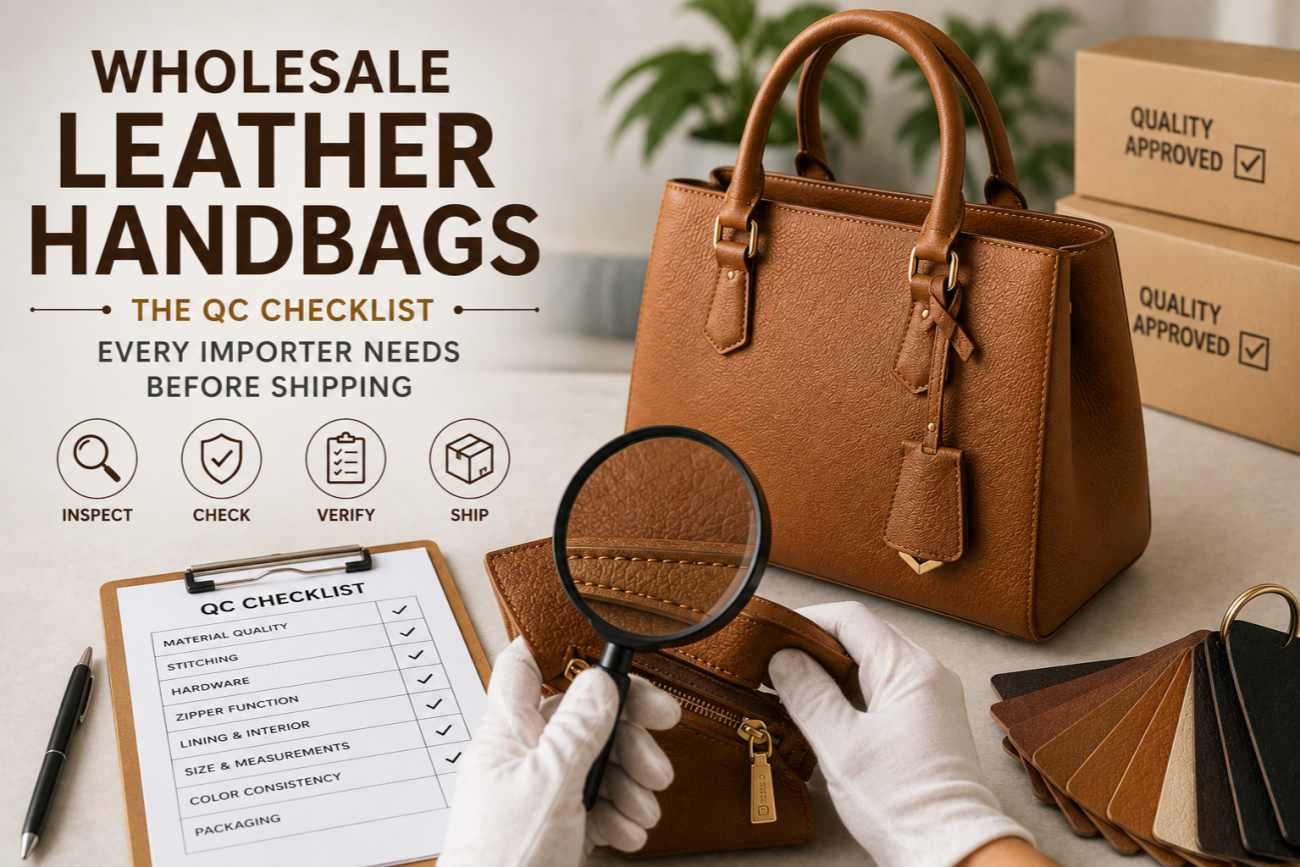
Below is a simplified QC template based on our factory’s actual inspection process. Use it as a starting point and customize it for your specific order requirements.
For a printable PDF version of this checklist, contact us and we will send it to you with our recommended AQL (Acceptable Quality Limit) sampling guide.
Conclusion — Protect Your Brand with Proper QC
A consistent QC process does not just protect you from receiving bad goods — it builds trust with your supplier and saves money over the long term. Every issue caught at the factory is a return, a refund, or a bad review that you will not have to deal with later.
The most important takeaway is this: do not wait until the finished goods are ready to start thinking about quality. The checks that happen before production and during the run are far more impactful than the final inspection at the end.
Ready to source wholesale leather handbags with confidence? Contact us for a detailed QC walkthrough. We provide comprehensive inspection reports with every bulk order and welcome third-party QC inspections at our factory.
References
- FYBagCustom — Genuine Leather for Custom Bags: The B2B Guide to Sourcing Luxury & Craftsmanship — Manufacturer-level overview of leather grades, tanning processes, and quality indicators used in bag production.
- Anuent — Full-Grain vs Top-Grain vs Genuine Leather — Practical comparison of natural leather types covering lifespan, surface quality, and cost-per-year analysis.
- Steel Horse Leather — Grain Leather Definition: What is Grain Leather? — Detailed explanation of leather grain types, durability characteristics, and quality assessment methods.
- Alibaba Product Insights — Understanding Genuine Noble Leather Handbags — Industry material property comparisons relevant to wholesale handbag sourcing and quality standards.