Estimated Reading Time: 7 minutes
If you are sourcing leather handbags for your brand, the material choice is the single most important decision you will make. It affects your product cost, quality perception, durability, and ultimately how your customers see your brand. In this guide, we walk through the main leather types used in handbag manufacturing, how their grades compare, and what to look out for when placing an OEM order. Whether you are a startup brand or an established retailer, understanding these fundamentals will help you make smarter sourcing decisions.
H2-1: The 4 Types of Leather Used in Handbag Manufacturing
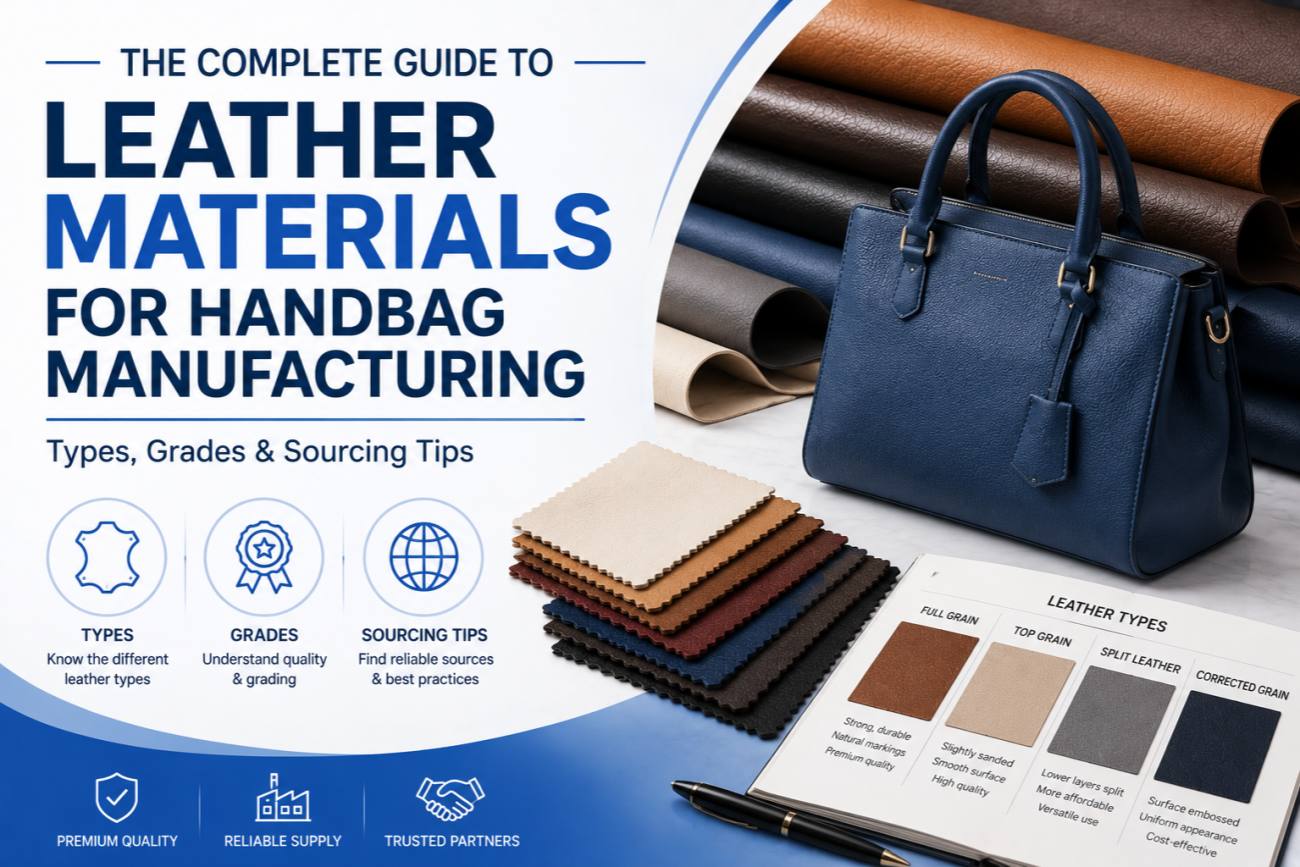
Not all leather is the same. In fact, the word “leather” covers a wide range of materials with very different qualities and price points. In handbag production, there are four main types you will encounter:
| Leather Type | Source Layer | Key Feature | Typical Use in Handbags |
|---|---|---|---|
| Full Grain | Top layer (intact) | Natural texture, develops patina | High-end designer bags |
| Top Grain | Top layer (sanded) | Smooth finish, more uniform | Mid-to-premium brand bags |
| Genuine Leather | Split layers | Affordable, processed surface | Mass-market handbags |
| Bonded Leather | Reconstituted fibers | Lowest cost, least durable | Budget / promotional bags |
Full Grain is the highest quality. It uses the entire top layer of the hide with the natural grain left completely intact. This gives each bag a unique texture and character, and the material develops a beautiful patina over years of use. From what we see in bulk production, full grain is typically chosen by brands positioning themselves in the premium or luxury segment where storytelling around natural materials is part of the value proposition.
Top Grain is the second-highest grade. The top layer is lightly sanded to remove surface imperfections, resulting in a smoother and more uniform finish. It is a popular choice for mid-to-premium brands that want good durability at a slightly lower cost. Many of our wholesale clients choose top grain for their core collection because it offers the best balance of quality and price.
Genuine Leather comes from the lower layers of the hide after the top grain has been split off. It is more affordable but also less durable and less breathable. In our experience, many first-time buyers choose genuine leather to keep costs down, only to find that the bags show wear faster than expected. That said, for fast-fashion cycles or entry-level price points, genuine leather can still be a practical choice.
Bonded Leather is made from leather fibers mixed with adhesives and pressed into sheets. It is the lowest cost option by a wide margin, but it tends to peel and crack within one to two seasons. We generally do not recommend it for handbag collections intended to last more than one season. If your budget is tight, a high-quality PU leather may serve you better.
H2-2: Leather Grade Comparison: Quality, Cost & Best Use Cases
When we talk about leather “grades,” we are really comparing three things: durability, appearance, and cost. These factors directly affect your product positioning and profit margin. According to industry market data, the global leather goods market continues to grow, with increasing demand for both genuine and synthetic alternatives across different price segments.
| Grade | Durability | Surface Quality | Relative Cost Factor | Best Market Fit |
|---|---|---|---|---|
| Full Grain | Excellent (10+ years) | Natural, unique texture | 4x–5x of genuine leather | Luxury / premium brands |
| Top Grain | Very good (5–8 years) | Smooth, uniform | 2x–3x of genuine leather | Mid-premium / contemporary |
| Genuine Leather | Moderate (2–4 years) | Processed, less breathable | Baseline | Mass market / entry-level |
| Bonded Leather | Low (1–2 years) | Uniform but artificial feel | 0.5x of genuine leather | Promotional / budget lines |
One common mistake we see is brands choosing full grain for a mid-range product, which then forces their retail price too high for their target market. Conversely, choosing genuine leather for a premium-priced product can lead to customer complaints about quality — the material simply will not hold up to the expectations that come with a high price tag. Matching the leather grade to your price point and brand positioning is essential.
For wholesale orders, we usually suggest top grain as the “sweet spot.” It offers strong durability and a clean appearance while keeping the FOB price within a workable range for most brand owners. If you are targeting a luxury segment, full grain is worth the investment. If you need maximum cost efficiency, genuine leather or high-grade PU are better options.
H2-3: Genuine Leather vs PU Leather: What B2B Buyers Should Know
This is one of the most frequent questions we get from buyers: “Should I go with genuine leather or PU leather?” The answer depends on your target market, price point, and brand values.
| Factor | Genuine Leather | PU Leather |
|---|---|---|
| Material origin | Animal hide (by-product of meat industry) | Synthetic polymer coating on fabric base |
| Durability | 2–4 years with normal use | 1–3 years depending on quality grade |
| Breathability | Good (natural pores) | Low (synthetic surface) |
| Consistency | Natural variations in grain and color | Highly uniform, batch to batch |
| FOB cost range | $12–$30+ per bag (material dependent) | $5–$15 per bag (quality dependent) |
| Best for | Brands that value natural material storytelling | Brands needing cost control or vegan positioning |
A common misconception is that PU leather is always lower quality. In reality, high-grade PU — sometimes called microfiber leather — can closely mimic the look and feel of genuine leather at a fraction of the cost. Organizations like the Leather Working Group and other industry bodies have been working on sustainability standards for both genuine and synthetic materials, and the gap in environmental impact between the two is narrowing as manufacturing technology improves.
Many buyers focus on the material label first, but we recommend looking at actual performance metrics — abrasion resistance, flexing endurance, and color fastness — rather than the name alone. If your target retail price is under $80, PU leather is likely the more practical choice. Above that, genuine leather or high-grade PU both become viable depending on your brand story. For more on material comparisons, see our travel bag materials guide.
H2-4: How to Choose the Right Leather for Your Handbag Collection
Here is a simple four-step framework we use with our clients when developing new handbag collections:
Step 1: Define your retail price target. Your material cost should represent roughly 15–25% of your wholesale price. Work backward from your target retail to determine how much you can reasonably allocate to leather. For example, if you plan to retail a handbag at $120, your wholesale price might be around $60, leaving you a material budget of roughly $9–$15 per bag.
Step 2: Match leather grade to brand positioning. Full grain supports a premium narrative and commands higher retail prices. Top grain is the safe all-rounder that works across most mid-range collections. Genuine leather works for entry-level pricing, and bonded leather is best avoided for any serious collection. According to SATRA, an independent testing organization, material selection is one of the top factors affecting product longevity in footwear and leather goods.
Step 3: Consider your customer’s expectations. If your end customer is used to genuine leather products, switching to PU without communicating the change clearly may cause pushback. If your customer is looking for vegan or cruelty-free options, on the other hand, PU is actually a selling point that should be highlighted in your product messaging.
Step 4: Order a sample panel first. Before committing to bulk production, ask your manufacturer for sample swatches of 2–3 leather options in your chosen color. This may sound like a small detail, but seeing and feeling the material in person will tell you more than any spec sheet. Color take, surface feel, and stiffness can all vary significantly between batches — a physical sample is the only reliable way to confirm the material meets your expectations.
If you are ordering for the first time, we strongly recommend starting with one leather type per style. This keeps the production process simpler and reduces the risk of quality issues during the first run. Once you are confident in the material and the manufacturer, you can expand into multiple leather options across your collection.
H2-5: Leather Sourcing Checklist for OEM Handbag Orders
Once you have decided on the leather type and grade, here is a practical checklist to go through before confirming your OEM order:
- Confirm MOQ per color and per style. Some leathers, especially full grain, may have higher minimum order quantities due to hide variability. Make sure the MOQ works for your budget before moving forward.
- Specify leather thickness (oz or mm). Handbag leather typically ranges from 1.0 mm to 1.6 mm. Thinner leather (1.0–1.2 mm) is softer and more drapeable, suitable for slouchy styles. Thicker leather (1.4–1.6 mm) holds shape better and works for structured silhouettes.
- Approve a physical sample before production. A photo or video is not enough. Always request a sealed sample that matches your production spec, and keep it on file for reference during quality inspection.
- Clarify color matching tolerance. Natural leather takes dye differently depending on the hide. Set an acceptable range with your supplier — typically ±5% in shade variation is considered acceptable for natural leather.
- Request a quality inspection report. A reliable manufacturer should provide thickness testing, peeling resistance, and color fastness data per ISO standards upon request. If they cannot provide basic test documentation, that is a red flag.
- Discuss packaging early. Genuine leather bags require tissue paper wrapping and dust bags to prevent scuffing during shipping. PU leather bags are more forgiving but still benefit from proper packaging to avoid creasing.
- Review the lead time for leather sourcing. Unlike PU which is produced in rolls and readily available, genuine leather hides need to be sourced, sorted, and cut. This can add 1–2 weeks to your standard production timeline.
Before confirming the sample, make sure your supplier can provide clear documentation on each of these points. A good manufacturer will welcome these questions — it shows you are a serious buyer who understands the production process. If you are new to OEM ordering, check our custom bag manufacturing guide for a broader overview of the process.
Conclusion: What This Means for Your Sourcing Decision
Choosing the right leather for your handbag collection does not have to be complicated. Start by understanding the four main types — full grain, top grain, genuine, and bonded — and match them to your price point and brand positioning. Consider genuine leather vs PU based on your target retail price and what your end customers expect. And before you place your first order, run through the sourcing checklist above to avoid the most common pitfalls we see from first-time buyers.
The right material choice will save you from expensive sampling rounds, customer complaints about quality, and margin pressure from misaligned pricing. Contact us with your design requirements, and we can recommend the best leather option for your target market based on our production experience across hundreds of OEM handbag projects.