If you are sourcing travel bags for wholesale, one of the first decisions is not the color or the material — it is the size. Travel bag size determines your target customer, your FOB cost per unit, your shipping density, and even your return rate.
A 20L carry-on bag and a 60L check-in duffle are completely different products in terms of production cost, packaging, and logistics. In our experience working with retail buyers across North America and Europe, the brands that plan their size mix upfront consistently outperform those who add sizes later as an afterthought.
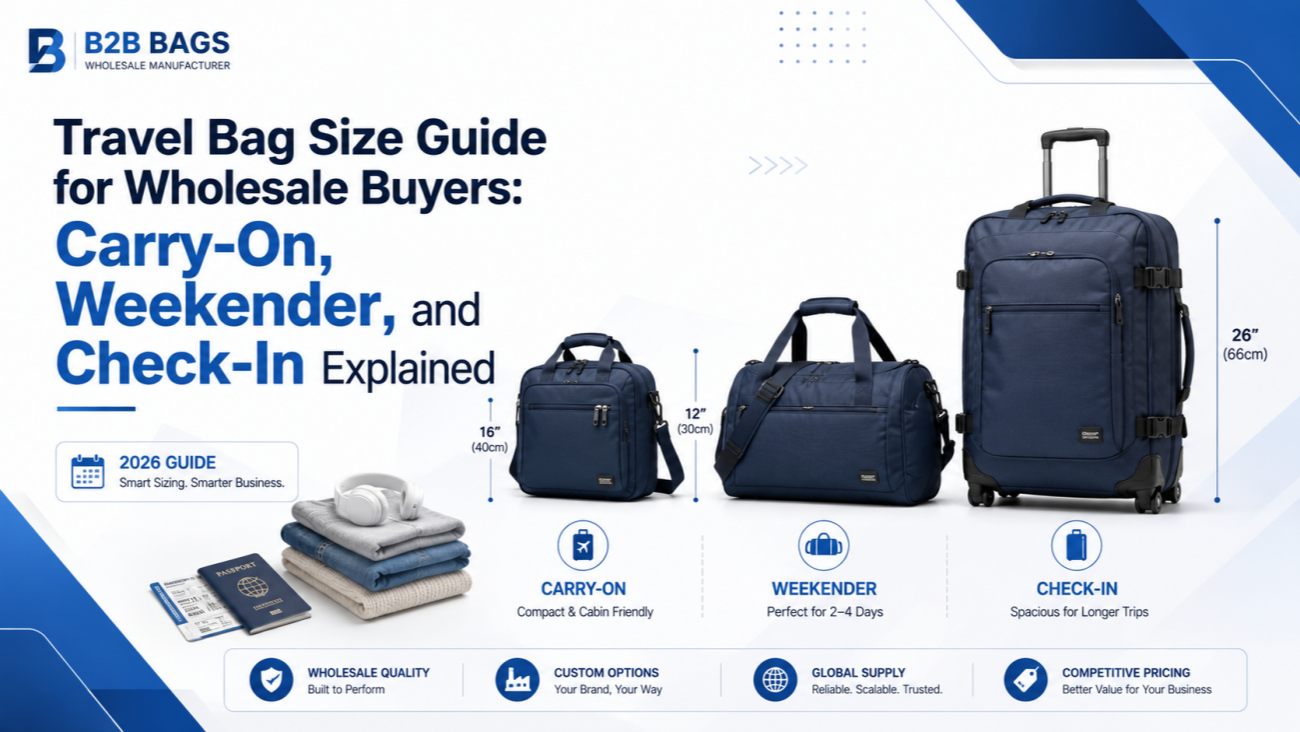
This guide breaks down the three standard travel bag sizes — carry-on, weekender, and check-in — so you can decide which ones to stock, in what mix, and at what price points.
Why Size Matters in Wholesale Buying
Size is not just about capacity — it is a pricing signal, a logistics variable, and a customer segmentation tool. In wholesale buying, different sizes mean different price points, different profit margins, and different target audiences.
From what we see in bulk production, here is how size affects the key buying decisions:
- FOB cost scales with size: Each additional liter of capacity adds roughly $0.30-0.50 to the unit cost. A 20L carry-on might cost $8-12 to produce, while a 60L check-in bag runs $18-30 for the same material and construction quality.
- Shipping density varies significantly: A 20-foot container holds roughly 3,500-4,000 carry-on bags, 2,000-2,500 weekender bags, or 1,000-1,500 check-in bags. That difference of $1-3 per unit in shipping cost adds up fast at scale.
- Inventory planning is size-dependent: Many buyers focus on price first, but the real risk is carrying the wrong size mix. Too many large bags in Q1 (a low-travel season) can tie up warehouse space and cash for months.
One common mistake we see is buyers ordering one “average” size to cover all customers. In practice, the brands that perform best offer at least two sizes — usually carry-on and weekender — to give retailers a price ladder without overcomplicating their SKU count.
Carry-On Travel Bags: The Sweet Spot for Volume
Carry-on bags (20L-35L) are the highest-volume segment in the travel bag market. They fit under airplane seats or in overhead bins, making them a practical choice for short trips, business travel, and everyday commuting.
Size standard: Most airlines allow carry-on dimensions of approximately 22″ x 14″ x 9″ (56 x 35 x 23 cm). Whether you plan to sell through travel retail or not, staying within these dimensions gives you the widest possible market.
Typical FOB price: $8-15 per unit for basic to mid-range materials (600D polyester or nylon).
Best customization fit: Carry-on bags offer large, flat side panels that are ideal for logo embroidery or screen printing. In our experience, this is the easiest size category to brand — the logo area is generous and the construction is simple enough that alignment issues are rare.
Best sales channels: Corporate gift programs, business travel accessories, airline amenity programs, DTC travel brands, and promotional product distributors.
MOQ: 300-500 pcs for ODM (existing designs with custom colors and logo); 500-800 pcs for fully custom OEM.
Airline Compliance: What Buyers Need to Know
If your target market includes airline or travel retail, size compliance is non-negotiable. Different airlines have slightly different carry-on limits, but most fall within the IATA-recommended range. One detail many buyers overlook: the bag’s filled dimensions can exceed the empty dimensions by 1-2 inches due to fabric bulge. Before confirming the sample, make sure to test the bag fully packed against your target airline’s sizer.
Weekender Bags: The Weekend Travel Standard
Weekender bags (35L-50L) sit in the middle of the size range, and in our experience, this is where the best margins are. They are too large for carry-on but perfect for 2-4 day trips — the most common travel duration for leisure and business travelers alike.
Size standard: Weekenders typically measure 24″ x 12″ x 12″ (61 x 30 x 30 cm). The duffle bag format dominates this size category, though backpack-style weekenders are growing in popularity.
Typical FOB price: $12-22 per unit, depending on material and construction complexity.
Material versatility: Weekenders work well across a wide range of materials — from 600D polyester (budget-friendly) to canvas (mid-range) to PU leather (premium). This gives you room to create a tiered product line within one size category.
Best sales channels: Fashion brands (as a seasonal item), sportswear labels, weekend-travel focused retailers, and hotel gift shops.
Retail price range: $60-150, giving you a healthy margin over the FOB cost while staying accessible to mid-market consumers.
One common mistake we see with weekenders: buyers often add too many interior pockets and features, driving the price up and production time longer. A weekender’s appeal is its simplicity. For wholesale orders, we usually suggest keeping the interior clean — one zippered pocket and one shoe bag is enough for most buyers.
Check-In Travel Bags: Large Capacity for Extended Travel
Check-in sized bags (50L-70L+) serve travelers on longer trips — families, tour groups, and extended vacationers. This is the smallest-volume segment but the highest in per-unit revenue potential.
Size standard: Check-in bags range from 50L to 70L+, with typical dimensions of 28″ x 16″ x 12″ (71 x 41 x 30 cm) or larger. Unlike carry-on bags, there are no airline restrictions to worry about, but you should still provide packed dimensions so your buyers can estimate shipping costs.
Typical FOB price: $18-30+ per unit. The higher cost comes from more fabric, heavier zippers, reinforced handles (which must carry more weight), and often additional features like compression straps or lockable zippers.
Material requirements: Larger bags carry more weight, so the stress on seams, handles, and zippers is significantly higher. From what we see in bulk production, 900D polyester or reinforced nylon is the minimum for this size category. Before confirming the sample, make sure the handle anchors and zipper ends are reinforced with bartack stitching.
Seasonality: Check-in bag orders are strongly seasonal — Q3 (preparing for holiday travel) is the peak ordering period. If you are planning to stock this size, place your production order by early Q3 to ensure delivery before the holiday rush.
Best sales channels: Travel luggage brands, tour operators, cruise lines, family travel brands, and travel gear rental services.
Quick Size Reference Table
| Dimension | Carry-On (20-35L) | Weekender (35-50L) | Check-In (50-70L+) |
|---|---|---|---|
| Best for | Short trips, business, commuting | Weekend getaways, 2-4 day trips | Family vacations, tour groups, long stays |
| FOB price range | $8-15 | $12-22 | $18-30+ |
| Main material | Polyester 600D, Nylon | Polyester 600-900D, Canvas, PU Leather | Polyester 900D+, Reinforced Nylon |
| Units per 20′ container | 3,500-4,000 | 2,000-2,500 | 1,000-1,500 |
| Customization ease | Easy (large flat panels) | Easy to medium | Medium (more seams, hardware) |
| Best channel | Corporate gifts, travel retail, DTC | Fashion brands, sportswear, hotels | Luggage brands, tour operators, cruise lines |
| Seasonality | Year-round (moderate peaks) | Year-round (moderate peaks) | Strong Q3 (holiday travel prep) |
Conclusion: What Size Should You Stock?
The right size mix depends on your target market and sales channels. Here is a simple framework based on what we see working for buyers across different segments:
- Corporate gifts / promotional channel: Focus on carry-on (20-35L). These bags are affordable, easy to brand, and practical for the widest audience. One common mistake is spending too much on a premium size that the recipient may not need.
- Fashion or sportswear brand: Lead with weekender (35-50L). This is the sweet spot for margins and brand positioning. Add a carry-on as an entry price point and a check-in as a premium option if you want a full range.
- Travel luggage or tour operator: Stock all three sizes, but use the weekender as your core SKU — it moves fastest across the broadest customer base. From what we see in bulk production, a 60/30/10 mix (weekender / carry-on / check-in) works well for most travel retail channels.
If you are ordering for the first time, start with one size that matches your best channel, test the market response, then expand. A focused inventory beats a scattered one every time. For more on how to plan your travel bag sourcing, see our complete guide to choosing a travel bag manufacturer.
References
- Future Market Insights. (2025). Travel Bags Market Size and Share Forecast Outlook 2025 to 2035. futuremarketinsights.com
- Mordor Intelligence. (2026). Travel Bag Market Size & Share Analysis — Growth Trends and Forecast (2026-2031). mordorintelligence.com
- IATA. (2025). Baggage and Cabin Bag Guidelines. iata.org