Finding the right shoulder bag manufacturer is one of the most critical decisions for any wholesale buyer. Whether you are a brand owner launching your first collection, an Amazon seller scaling your product line, or a retail buyer sourcing for the next season — the manufacturer you choose directly impacts your product quality, profit margins, delivery timelines, and brand reputation.
The global handbag market was valued at over USD 74 billion in 2025 and is projected to grow to USD 104 billion by 2032, with shoulder bags capturing approximately 35% of the market share (360iResearch, 2026). This growing demand means more suppliers are entering the space — but not all of them can deliver consistent quality at wholesale scale.
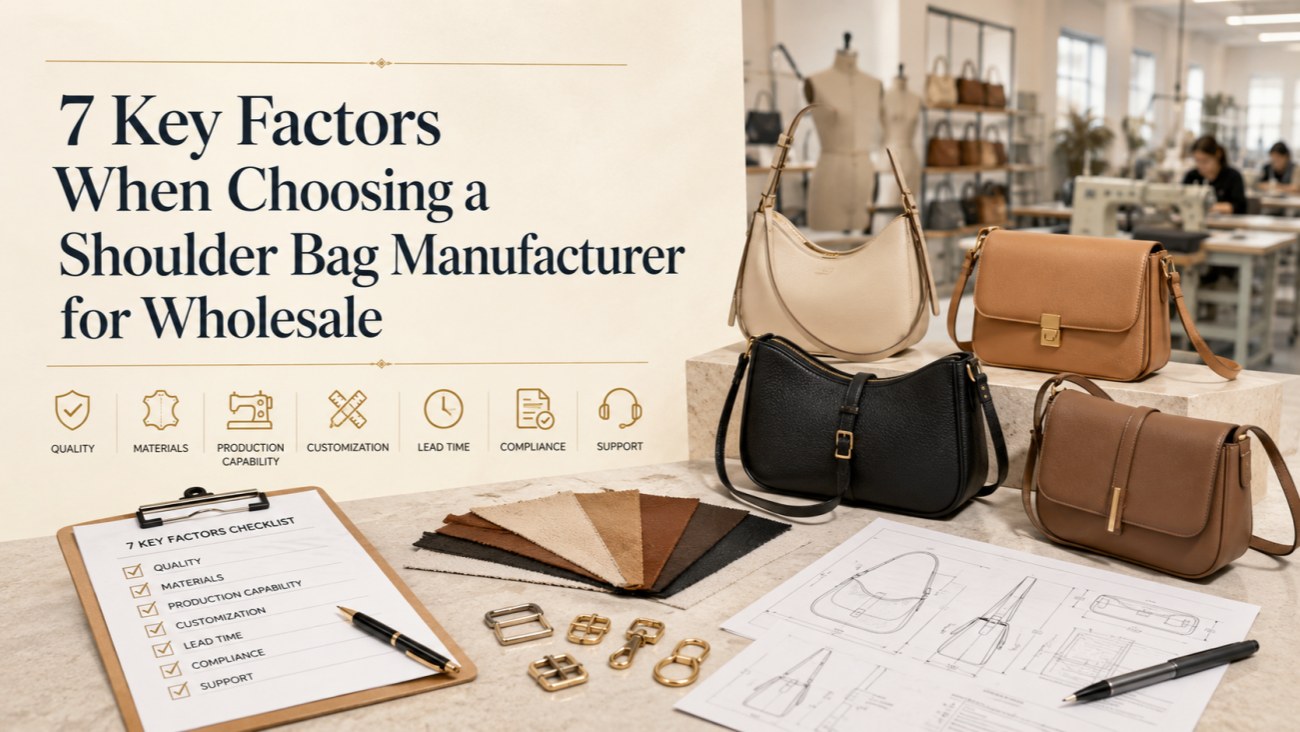
This guide breaks down the 7 key factors you must evaluate before committing to a shoulder bag manufacturer. Use this as your sourcing checklist to minimize risk and find a partner who can scale with your business.
1. Manufacturing Experience & Specialization
Not all bag factories are the same. A manufacturer that specializes in backpacks may not have the right equipment or expertise for shoulder bags. The first question you should ask any potential supplier is: “How many years have you been making shoulder bags specifically?”
A specialized shoulder bag manufacturer with 10+ years of experience understands critical structural details that general bag factories often miss:
- Weight distribution: Shoulder bags carry uneven loads. The strap attachment points must be reinforced to handle repeated stress.
- Hardware compatibility: Different shoulder bag styles (crossbody, hobo, satchel) require different buckle, zipper, and strap slider specifications.
- Silhouette construction: A structured shoulder bag needs different interfacing and lining materials than a slouchy hobo style.
Ask for their client portfolio — especially brands in your target market segment. A manufacturer who has produced for US or European brands will already understand your compliance and quality expectations.
What to verify: Years in business, number of production lines dedicated to shoulder bags, past client references, monthly production capacity.
2. Customization & OEM/ODM Capabilities
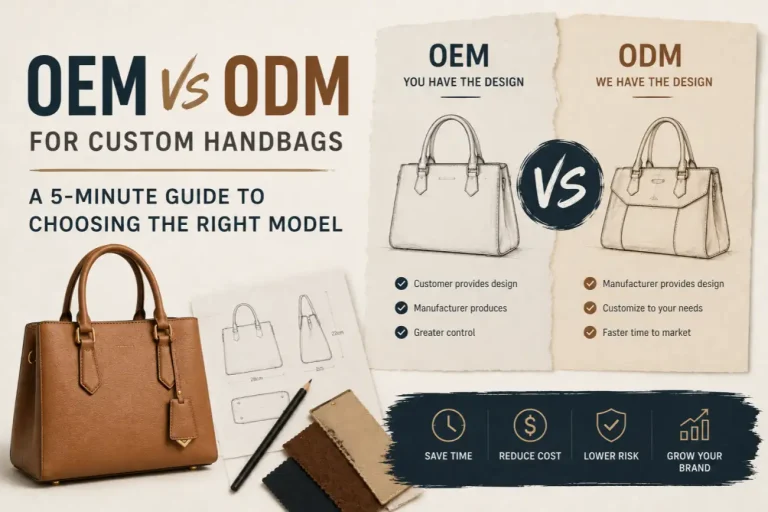
The best shoulder bag manufacturer offers flexible customization options. Most wholesale buyers fall into one of two categories: OEM (Original Equipment Manufacturing — you provide the design, they produce it) or ODM (Original Design Manufacturing — they offer existing designs you can modify and brand).
Here is what a capable manufacturer should support:
| Customization Type | Common Options | MOQ Impact |
|---|---|---|
| Logo | Embroidery, heat transfer, debossing, metal plate, screen print | Low |
| Material | PU leather, genuine leather, canvas, nylon, recycled fabrics | Medium |
| Size & Dimensions | Custom patterns based on your tech pack | Medium-High |
| Hardware | YKK zippers, zinc alloy buckles, magnetic snaps, D-rings | Low-Medium |
| Packaging | Individual dust bags, hang tags, barcode stickers, retail-ready boxes | Low |
Sample Development Process
A professional manufacturer will have a structured sample process. Expect this timeline:
- Design review & tech pack confirmation — 1-3 days
- Sample cutting & sewing — 5-10 days
- Sample inspection & revision — 2-3 days
- Final sample approval — 1-2 days
Total: approximately 10-15 working days for the first sample. Ask whether the sample fee is refundable upon bulk order placement — many reliable manufacturers offer this policy as a sign of good faith.
3. Quality Control & Compliance Standards
Quality control (QC) is what separates a professional shoulder bag manufacturer from an unreliable one. Without a proper QC system, you risk receiving shipments with inconsistent stitching, wrong colors, or defective hardware — and by then, your selling season may be over.
A factory with ISO 9001:2015 certification follows standardized processes. But certification alone is not enough. You need to understand their three-stage QC system:
- IQC (Incoming Quality Control): Raw materials (fabric, leather, hardware) are inspected before production begins. This catches problems like color shade variation between dye lots.
- IPQC (In-Process Quality Control): Inspections happen during production — typically every 2 hours — checking stitch density, seam alignment, and hardware placement.
- FQC (Final Quality Control): Finished bags are inspected using AQL (Acceptable Quality Level) sampling standards (ISO 2859-1). Industry standard for bag manufacturing: AQL 2.5 for major defects, AQL 4.0 for minor defects.
Compliance checklist: ISO 9001, BSCI (social compliance), REACH (EU chemical safety), CPSIA (US children’s product safety if applicable). Ask for current certificates — they should be less than 2 years old.
For a deeper dive into bag quality standards, refer to ISO 9001:2015 and the AQL inspection guide by Cosmo Sourcing.
4. Minimum Order Quantity (MOQ) & Pricing Structure
MOQ is one of the first deal-breakers in wholesale bag sourcing. Every shoulder bag manufacturer has a minimum quantity they require per style, per color. Understanding how MOQ works — and how to negotiate it — can save you from overcommitting on your first order.
Typical MOQ ranges for shoulder bag manufacturers:
- Stock designs (ODM): 200-500 pcs per style
- Custom designs (OEM with new mold/hardware): 500-1,000 pcs per style
- Mixed colors per style: Usually 100-200 pcs per color minimum
Pricing is typically structured on a tiered FOB (Free On Board) basis:
- 500 pcs → USD 12.50/pc
- 1,000 pcs → USD 10.80/pc
- 3,000 pcs → USD 8.90/pc
Major price drivers include: material type (genuine leather vs. PU), hardware quality (YKK vs. generic), construction complexity (number of compartments, lining type), and packaging requirements.
Tip: Some manufacturers offer a trial order option at a slightly higher per-unit price to let you test the market before committing to full MOQ. Always ask about this.
5. Material Selection & Hardware Options
The material you choose defines both the cost and the customer perception of your shoulder bag. A reliable shoulder bag manufacturer should offer a wide range of material options and be transparent about the pros and cons of each.
Common material choices for wholesale shoulder bags:
- PU (Polyurethane) Leather: Most popular for mid-range wholesale. Good durability, wide color range, lower cost. Average lifespan: 2-4 years with proper care.
- Genuine Leather: Premium segment. Higher MOQ and price point but commands higher retail margins (40-65%). Requires skilled craftsmanship.
- Canvas / Cotton: Casual styles, eco-friendly positioning. Lower cost but less structured silhouette.
- Nylon / Polyester: Lightweight, water-resistant. Ideal for travel-oriented shoulder bags and activewear brands.
- Recycled / Eco-Friendly Materials: RPET (recycled polyester), recycled nylon, pineapple leather (Piñatex). Growing in demand — over 28% of new 2024 collections featured sustainable materials (MarketGrowthReports, 2025).
Hardware matters just as much. Always confirm the zipper brand (YKK is the industry gold standard), buckle material (zinc alloy vs. stainless steel), and strap connector type. Weak hardware is the #1 cause of customer returns for shoulder bags.
6. Packaging & Shipping Logistics
How your shoulder bags arrive matters as much as how they are made. Poor packaging leads to damaged goods, which means refunds, chargebacks, and unhappy customers. A professional shoulder bag manufacturer will have standardized packaging options and clear shipping procedures.
Packaging options typically include:
- Basic: Each bag in a PP (polypropylene) bag, packed in export cartons
- Retail-ready: Individual dust bags + hang tags + barcode stickers
- Premium: Branded boxes with foam inserts, tissue paper, and ribbon
Shipping methods and typical timelines:
- Sea freight (FOB): 20-35 days. Most cost-effective for orders above 1,000 pcs. Cost: USD 2-5 per bag depending on volume.
- Air freight: 5-7 days. For urgent restocks. Cost: 3-5x sea freight.
- Express courier (DHL/FedEx): 3-5 days. For samples or small trial orders.
Ask whether the manufacturer has experience shipping to your target country and whether they handle customs documentation. Some manufacturers also offer DDP (Delivered Duty Paid) terms — meaning they handle all duties and taxes — which simplifies the process for first-time importers.
7. Communication & After-Sales Support
The relationship with your shoulder bag manufacturer does not end when the shipment leaves the factory. After-sales support — how a factory handles defects, shipping damage, or communication gaps — is what separates a long-term partner from a one-time supplier.
Evaluate these factors before signing a purchase order:
- Response time: Do they reply within 24 hours during your time zone’s business hours?
- Dedicated project manager: One point of contact from sample to delivery — not a different person every week.
- Language support: English proficiency matters. Miscommunication on a tech pack can cost thousands.
- Defect policy: What happens if 10% of the shipment has defects? Do they offer a discount, replacement, or refund? Get this in writing.
- Production updates: Do they send regular progress photos and inspection reports during production?
Red flags to watch for: Vague answers about quality control, reluctance to share client references, no written warranty policy, or pressure to pay 100% upfront before production starts.
Conclusion: How to Start Your Wholesale Shoulder Bag Project
Choosing the right shoulder bag manufacturer is not about finding the cheapest quote — it is about finding a partner who balances quality, customization, MOQ flexibility, and reliable communication. The 7 factors above give you a structured framework to evaluate suppliers objectively.
Before you send your inquiry, prepare this information to get accurate and fast responses:
- Target quantity per style and preferred MOQ range
- Design sketches or reference images (if OEM)
- Target price range per unit (FOB)
- Target market and any compliance requirements (e.g., REACH for EU, CPSIA for US)
- Preferred shipping method (sea/air/express)
Ready to start sourcing? Contact a professional shoulder bag manufacturer with proven OEM/ODM experience and request a sample today.
Frequently Asked Questions About Wholesale Shoulder Bags
Can I get a lower MOQ for a trial order?
Many manufacturers offer trial orders at 100-200 pcs with a slightly higher unit price. This lets you test the market before committing to full-scale production. Always ask about this option.
How long does bulk production take?
Typically 30-45 days from sample approval, depending on order quantity and production complexity. Factor in an additional 15-20 days for sea freight if shipping internationally.
Do you ship to my country?
Most established shoulder bag manufacturers ship worldwide. The most common export destinations include the US, UK, Germany, France, Australia, and Canada. Confirm shipping terms (FOB, CIF, or DDP) with your supplier.
Can I get samples before placing a bulk order?
Yes. Reputable manufacturers will produce 1-2样品 before bulk production. Sample fees typically range from USD 50-200 depending on design complexity and are often refundable upon bulk order placement.
What payment terms do manufacturers accept?
Standard terms: 30% deposit via T/T (bank transfer) before production, 70% balance before shipment. L/C (Letter of Credit) is common for large orders. PayPal or Alibaba Trade Assurance is available for smaller orders.
References
- 360iResearch. (2026). Handbag Market by Product Type, Material, Gender, Usage, Age Group, Distribution Channel, End User — Global Forecast 2026-2032. GII Research
- MarketGrowthReports. (2025). Handbags Market Size, Share, Growth, and Industry Analysis, By Type, By Application, Regional Insights and Forecast to 2035. MarketGrowthReports
- ShelfTrend. (2025). Classic Leather Handbags Market Analysis: A Data-Driven Guide for Sellers & Manufacturers (2025). ShelfTrend
- ISO. (2015). ISO 9001:2015 Quality Management Systems. International Organization for Standardization
- Cosmo Sourcing. (2025). AQL (Acceptable Quality Level): Inspection Levels for Product Sourcing. Cosmo Sourcing
- LeelineBags. (2026). Bag Quality Control Checklist: A Staged System for Pass/Fail Decisions (IQC, IPQC, FQC). LeelineBags