Estimated Reading Time: 6 minutes
Table of Contents
A basic PU leather purse costs $6–$15 per unit to manufacture, while a genuine leather purse ranges from $20 to $50+ per unit. The exact cost depends on material choice, design complexity, hardware quality, and order quantity — and understanding these variables before you approach a factory is the single most important step in budgeting for your first order.
This guide breaks down exactly where your money goes, what factors move the needle on pricing, and how to get an accurate quote so there are no surprises when the invoice arrives.
1. Purse Manufacturing Cost Breakdown: Where Does Your Money Go?
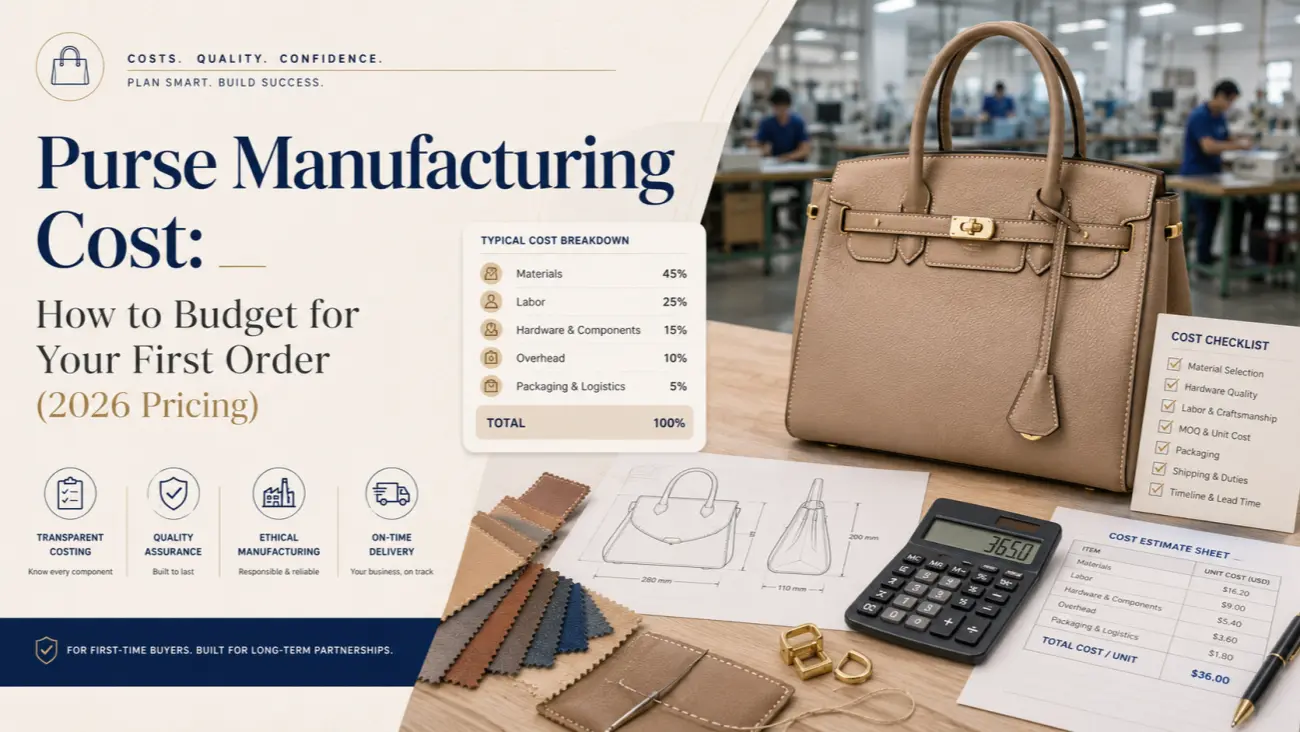
The cost of manufacturing a purse can be divided into four main components, with materials accounting for the largest share at 40–55% of the total unit price. Understanding this breakdown helps you identify where you can cut costs without sacrificing quality — and where you should never cut corners.
| Cost Component | % of Total Cost | What It Includes |
|---|---|---|
| Materials | 40–55% | Outer fabric/leather, lining, interlining, thread, adhesives |
| Hardware & Trim | 10–20% | Zippers, buckles, D-rings, chains, magnetic snaps, rivets |
| Labor | 20–30% | Cutting, sewing, assembling, quality inspection |
| Overhead & Packaging | 5–15% | Pattern making, sample development, QC, dust bags, cartons |
Materials dominate cost because they directly determine the purse’s look, feel, and durability. If you need to reduce unit cost, material substitution offers the biggest lever — switching from genuine leather to high-quality PU can cut material cost by 50–70%. However, hardware is the area where skimping creates the most visible quality issues: cheap zinc alloy zippers that stick or break within weeks can ruin an otherwise well-made bag and damage your brand reputation.
Labor cost varies significantly by manufacturing region. Chinese factories typically offer the most competitive labor rates while maintaining good quality for mid-to-high volume orders, which is why the majority of global handbag production is concentrated in Guangdong, Zhejiang, and Fujian provinces.
2. 5 Key Factors That Determine Purse Manufacturing Cost
Five variables create most of the price variation between different purse manufacturing quotes. If you understand these, you will never be confused by why one factory quotes $12 and another quotes $28 for the same-looking bag.
1. Material Choice
This is the single biggest cost driver. A simple PU leather bag costs $3–$8 in material, while the same pattern in genuine cowhide costs $15–$35 in material alone. Premium materials like Italian calfskin, exotic leathers (snake, alligator), or certified organic fabrics push material costs even higher. Your material choice dictates your price tier and your target customer.
2. Design Complexity
Every additional seam, pocket, zipper compartment, or structural detail adds labor time. A flat tote bag with one main compartment might take 20–30 minutes to sew. A structured handbag with 3 compartments, 2 zip pockets, a flap closure, and a detachable strap can take 60–90 minutes. More time = more labor cost. Complex curves, piping, pleating, quilting, or hand-stitched details add further premiums.
3. Hardware Quality & Quantity
Hardware cost scales with both quality and quantity per bag. Basic nickel-plated zippers and simple magnetic snaps cost $0.50–$1.50 per set. Premium hardware — custom-engraved logos, high-polish finishes, solid brass components, branded zipper pulls — can reach $5–$15 per bag. A purse with 3 zippers, 2 D-rings, 1 buckle, and 4 rivets costs significantly more in hardware than a minimalist design with 1 zipper and no additional hardware.
4. Order Quantity
Factory pricing follows a simple principle: larger orders = lower per-unit cost. At 200 units, you pay a higher unit price because the factory needs to recover setup costs, pattern making, and cutting time across fewer pieces. At 1,000 units, those fixed costs are spread thinner. The typical price drop curve sees a 15–25% reduction from MOQ to double the quantity, and another 15–20% reduction at 5,000+ units. For a deeper look at how MOQ affects pricing across different bag types, refer to our purse manufacturing MOQ guide.
5. Packaging & Branding
Brand-level packaging adds $0.50–$3.00 per unit. An individual dust bag, branded hang tags, tissue paper, and a custom-printed carton create a premium unboxing experience but add real cost. If you are testing a new market with a small first order, standard polybag packaging keeps costs low while you validate demand.
3. Purse Manufacturing Cost by Material: From Budget to Premium
Your material choice defines your price range more than any other decision. Here is how each material category maps to manufacturing cost in 2026.
| Material | Typical Cost Per Unit | Best For | Perceived Value |
|---|---|---|---|
| Nylon / Polyester | $3–$8 | Casual, sporty, travel-friendly bags | Budget — Mass market |
| Canvas / Cotton | $4–$10 | Tote bags, eco-friendly lines, beach bags | Mid-budget — Lifestyle |
| PU Leather | $6–$15 | Fashion handbags, work bags, entry-level luxury | Mid-range — Best value |
| Vegan / Recycled Materials | $8–$20 | Sustainable brands, eco-conscious collections | Mid-premium — Differentiator |
| Genuine Leather (Cowhide) | $20–$40 | Premium handbags, luxury accessories | Premium — High margin |
| Premium / Exotic Leather | $35–$80+ | Designer-level, high-end boutique, luxury market | Ultra-premium — Niche |
PU leather offers the best value-to-quality ratio for first-time importers. Modern PU formulations from Chinese manufacturers have improved dramatically, offering soft hand-feel, consistent texture, and good durability at a fraction of genuine leather prices. Many mid-market brands successfully use high-quality PU to deliver a premium look at an accessible price point. For brands specifically targeting the sustainability segment, our guide on vegan leather purse manufacturing covers material options, certifications, and cost comparisons in detail.
The same bag design in PU leather might cost $10/unit at 500 pieces, while the genuine leather version costs $28/unit. The question is not which is “better” — it is which aligns with your brand positioning and target customer.
4. How to Get an Accurate Purse Manufacturing Quote
A precise quote depends on how much information you provide upfront. The more detailed your specifications, the more accurate — and comparable — your factory quotes will be. Vague inquiries like “how much for a leather handbag” will get you vague answers ranging from $8 to $80.
To get reliable pricing, prepare the following information before reaching out to manufacturers:
- Design reference and technical drawing — photos, sketches, or CAD files of the bag showing front, back, side, interior, and strap details
- Material specification — type of outer material (PU, leather, fabric), lining material, and any special finishes
- Hardware list — types, quantities, and desired finish for all zippers, buckles, rings, and closures
- Dimensions and weight — approximate length × width × height and target empty weight
- Target quantity — be honest about your expected order size; factories need this to calculate unit pricing
- Quality expectations — any certifications required (OEKO-TEX, REACH, etc.), packaging requirements, or special QC standards
- Target price range — sharing your budget helps the factory recommend appropriate material and construction options
Always request a quotation that clearly separates: unit price, sample cost (and whether it is refundable with bulk orders), mold/tooling fees (if applicable), and shipping terms (FOB vs CIF). A transparent quote that breaks down these components signals a professional manufacturer who has nothing to hide.
Most reputable factories will provide a quotation within 24–48 hours of receiving a complete specification. The next step after reviewing the quote is to order 2–3 samples from shortlisted factories to evaluate quality, stitching, material feel, and hardware durability before committing to a full production run.
5. Conclusion: How to Start Your Purse Manufacturing Project
Budgeting for your first purse manufacturing order comes down to three decisions: choose your material tier, define your design complexity, and determine your order quantity. These three variables will determine approximately 80% of your final unit cost.
Here is a summary of realistic budget ranges for a first order:
| Scenario | MOQ | Per Unit Cost | Total Budget (Inc. Sample & Shipping) |
|---|---|---|---|
| Entry-level PU crossbody bag | 500 pcs | $8–$12 | $5,000–$8,000 |
| Mid-range vegan leather tote | 500 pcs | $12–$18 | $8,000–$12,000 |
| Premium genuine leather handbag | 300 pcs | $25–$40 | $10,000–$16,000 |
If you are preparing your first order, start by defining your target retail price and work backward to determine your allowable manufacturing cost. A good rule of thumb for B2B fashion: your landed manufacturing cost should be roughly 25–35% of your target retail price, leaving room for shipping, duties, marketing, and margin. For a full overview of what goes into getting a bag from design to delivery, our purse manufacturing guide covers the complete process.
The most important step is simply to start the conversation with factories. Send your design specifications to 3–5 manufacturers, compare their quotes and communication quality, order samples, and choose the partner that gives you the best combination of price, quality, and trust.
Ready to get an accurate quote for your purse design?
Send us your design sketch or reference images, and our team will provide a detailed cost breakdown — including material options, MOQ recommendations, and sample lead time — within 48 hours.
References