Estimated Reading Time: 7 minutes
In this guide, we are stepping away from complicated factory jargon. We will break down these three manufacturing paths from a buyer’s perspective, helping you make a confident decision that protects your profit margins and elevates your brand.
Table of Contents
- Understanding the Basics: Why Your Choice Matters
- Private Label Handbags: The Fast Track to Launch
- ODM (Original Design Manufacturing): The Sweet Spot
- OEM (Original Equipment Manufacturing): Total Creative Freedom
- OEM vs ODM vs Private Label: A Side-by-Side Comparison
- How to Choose the Right Path for Your Boutique
- Conclusion & Next Steps
Understanding the Basics: Why Your Choice Matters
Think of building your handbag collection like buying a house. You can buy a move-in-ready home, you can buy a semi-custom home where you pick the paint and floors, or you can buy an empty plot of land and hire an architect to build your dream mansion from scratch.
Your manufacturing choice dictates your upfront costs, how fast you can get your products to market, and how unique your bags will be compared to your competitors. Choosing the wrong method might leave you with too much inventory, or conversely, a product that doesn’t stand out enough.
[Image suggestion: A high-quality lifestyle image of a boutique owner reviewing handbag samples or sketches on a stylish desk. Focus on the concept of decision-making and design.]
Private Label Handbags: The Fast Track to Launch
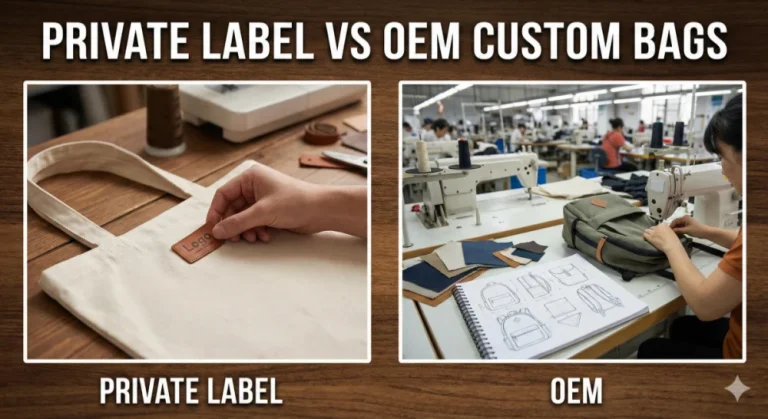
What it is: Private label is the “move-in-ready home.” A manufacturer has already designed, developed, and produced a handbag. You simply select the bag from their catalog and ask them to stamp or emboss your boutique’s logo on it.
The Pros of Private Label
- Speed to Market: Since the bags are already designed (and sometimes already made), you can launch your collection in a matter of weeks.
- Low Minimum Order Quantities (MOQs): Factories usually allow you to buy smaller batches, making it incredibly friendly for tight budgets.
- Zero Design Experience Needed: You don’t need to know how to draw a sketch or select zipper gauges. The factory has done the heavy lifting.
The Cons of Private Label
- High Competition: Because anyone can buy these bags, you might find another boutique selling the exact same handbag down the street, just with a different logo.
- Zero Customization: You usually cannot change the size, the pockets, or the strap length. What you see is what you get.
Who is it best for? Private labeling is perfect for brand-new boutiques that want to test the waters without risking a lot of capital, or clothing boutiques that want to add simple accessories to their store quickly.
ODM (Original Design Manufacturing): The Sweet Spot
What it is: ODM is the “semi-custom home.” The factory creates a core design, but they allow you to tweak it to fit your brand. For example, you might find a beautiful tote bag in their catalog, but you ask them to make it in your brand’s signature emerald green, change the canvas to premium vegan leather, and add a specific gold clasp.
This is often referred to as “white label” in other industries, but in fashion, ODM means leveraging a factory’s existing R&D (Research and Development) to create something that feels unique to you.
[Image suggestion: A side-by-side comparison image showing a plain factory prototype bag on the left, and the customized, branded version in a different color/material on the right.]
The Pros of ODM
- Professional Designs: You benefit from the factory’s experienced design team who already knows what shapes and structures sell well.
- Moderate Costs and MOQs: It costs less than starting from scratch, and the minimum orders are usually reasonable for growing businesses.
- Brand Differentiation: By changing materials, colors, and hardware, the final product looks completely unique to your store.
The Cons of ODM
- Not 100% Exclusive: The base shape of the bag is still owned by the factory. Unless you sign an exclusivity agreement, another brand could use the same base structure.
Who is it best for? ODM is the perfect middle ground for growing boutiques that want a custom, high-end feel without the massive investment of hiring a dedicated handbag designer. If you want to explore this route, you can check out our flexible handbag manufacturing services tailored for boutique brands.
OEM (Original Equipment Manufacturing): Total Creative Freedom
What it is: OEM is the “custom-built mansion.” You have complete control. You provide the factory with a detailed sketch, reference photos, and a “Tech Pack” (a blueprint that includes exact dimensions, material specs, and stitching details). The factory acts strictly as the builder—they bring your exact vision to life.
The Pros of OEM
- 100% Unique Product: Nobody else in the world will have this bag. It is entirely your intellectual property.
- High Brand Value: Because the design is unique, you can command higher retail prices and build a fiercely loyal customer base.
- Perfect Alignment: Every single detail, from the drop length of the shoulder strap to the exact placement of the inner pockets, is tailored to your target customer’s needs.
The Cons of OEM
- High Minimum Orders (MOQ): Because the factory has to source custom materials and create new molds or cutting dies just for you, they require you to buy in larger quantities.
- Longer Lead Times: Prototyping, sample adjustments, and final production can take months.
- Requires Expertise: You need a clear understanding of handbag construction or you need to hire a technical designer to create your tech packs.
Who is it best for? OEM is ideal for established brands with a strong, proven customer base, a healthy budget, and a desire to build a globally recognized, unique fashion label. If you have a clear design ready to go, partnering with an experienced custom OEM handbag manufacturer is your next critical step.
[Image suggestion: A close-up of hands working on a detailed handbag tech pack blueprint next to a tape measure and material swatches.]
OEM vs ODM vs Private Label: A Side-by-Side Comparison
To make it incredibly simple, here is a quick cheat sheet to help you compare your options:
- Design Control: Private Label (None) | ODM (Medium) | OEM (Maximum)
- Time to Market: Private Label (Fastest) | ODM (Moderate) | OEM (Slowest)
- Initial Investment: Private Label (Lowest) | ODM (Medium) | OEM (Highest)
- Profit Margins: Private Label (Lower) | ODM (Solid) | OEM (Highest potential)
- Exclusivity: Private Label (None) | ODM (Partial) | OEM (100% Yours)
How to Choose the Right Path for Your Boutique
Still not sure which route to take? Ask yourself these three fundamental questions:
- What is my budget for inventory? If you have less than $2,000 to spend on inventory, Private Label is your safest bet. If you have a moderate budget and want to stand out, ODM is ideal. If you have significant capital and are ready to scale, OEM is the way to go.
- Do I have a unique design in mind? If you just want beautiful bags to sell, Private Label or ODM works perfectly. If you have invented a new type of closure, a unique bag shape, or a specific functional feature, you absolutely need OEM.
- When do I need to launch? If the holiday season is approaching and you need stock in a month, go with Private Label. If you are planning for next year’s spring collection, you have the time to invest in ODM or OEM.
Conclusion & Next Steps
There is no “wrong” choice when it comes to manufacturing—only the choice that aligns with your current business stage. Many highly successful boutique brands start with Private Label to build cash flow, upgrade to ODM to establish their aesthetic, and eventually transition to OEM for complete creative dominance.
The key to success in any of these paths is finding a reliable, transparent manufacturing partner who understands the needs of boutique owners. They should communicate clearly, provide high-quality samples, and respect your brand’s vision.
Are you ready to bring your handbag collection to life? Whether you are looking for customizable ODM options or full-scale OEM production, contact us today to discuss your project. Let’s build something beautiful together.
References & Further Reading
- McKinsey & Company. (2022). The State of Fashion: Supply Chain Resiliency. (Understanding global manufacturing shifts).
- Forbes. (2021). How To Build A Standout Boutique Brand In A Crowded Market. (Insights on brand differentiation).
- Common Objective. (2023). Sourcing and Manufacturing Fashion Sustainably. (Best practices for choosing ethical factory partners).